Patches turn a logo into something people can see, touch and keep. Sewn onto a cap, jacket, bag or uniform, a patch carries your brand for years, long after a flyer or a digital ad is gone. The results depend on four decisions: the patch type, a logo adapted to thread or rubber, the right backing, and a sample approved before the full run. This guide walks through each one, for businesses, teams, artists, event organizers and baby apparel sellers alike.
TL;DR
- Branded items work when they are useful and well made. In PPAI’s 2026 research, 90% of U.S. consumers agreed that receiving branded merchandise improves their view of the brand.
- Match the patch type to the look you want: embroidered for texture, woven for fine detail, PVC for weather, leather for a premium feel, chenille for varsity style, printed for photo-like art.
- Simplify your logo before you order. Fewer colors, bolder lines and less tiny text give a cleaner patch.
- Choose the backing and border for the garment and how it will be washed, then approve a sample before you commit to bulk.
Table of Contents
- Why patches work as a branding tool
- Choosing the patch type that fits your brand
- Adapt your logo before you order
- Backing and borders decide how long your brand lasts
- Who uses patches for branding, and how
- Perspective: what we have learned about patch branding
- Order patches that match your brand
- A simple process for your first patch order
- FAQ
- Sources
Why patches work as a branding tool
A patch is a small object with a long life. It is stitched, molded or bonded to something a person already owns, so your brand rides along on their daily routine instead of sitting in a drawer.
The research backs the idea behind this. According to PPAI’s 2026 consumer research, nearly 90% of U.S. consumers keep branded merchandise because they find it useful (55%) or appreciate its quality (21%). The same PPAI report points to low durability, poor design and irrelevance as the main reasons merchandise feels cheap or forgettable.
That is the case for patches done well. A patch on a work jacket is useful because the jacket is. A crisp, dense, colorful patch signals quality. A faded, curling one does the opposite. The brand impression comes from the craft.
Patches also give you flexibility that printing on a garment does not:
- One design, many products. The same patch can go on caps, bags, aprons, jackets and uniforms.
- Consistency across batches. You approve the patch once, then apply it to whatever blank garments you buy.
- Texture. Raised thread, rubber or leather catches the eye and invites a touch.
- Team identity. Matching patches make staff, club members and volunteers look like one group.
If you want the full basics first, our ultimate guide to custom patches covers the process end to end.
Choosing the patch type that fits your brand
Each patch type says something different about your brand. Pick for the message first, then check the details.
| Patch type | Look and feel | Best for |
|---|---|---|
| Embroidered | Classic raised stitching, bold and textured | Uniforms, caps, jackets, team and company logos |
| Woven | Flatter, tighter threads, finer detail | Small text, intricate logos, labels |
| PVC rubber | Molded, soft-touch, weather-resistant | Outdoor gear, bags, tactical and sports items |
| Leather | Natural, understated, premium | Beanies, hats, denim, bags |
| Chenille | Thick, fuzzy, varsity feel | Letterman jackets, school and club apparel |
| Printed | Full-color artwork, gradients | Photo-style art, many colors, detailed illustrations |
Match the patch to the fabric and the use
The garment matters as much as the logo. A heavy canvas jacket can carry a thick embroidered or chenille patch. A thin knit may pucker under one. If you are weighing two styles, these guides compare them directly: woven versus embroidered for apparel, printed versus woven and PVC versus embroidered.
The shift toward quieter branding
Not every brand wants a big logo on the back of a jacket. Trade coverage of a new line of debossed leather patches describes the premium apparel market moving toward subtle branding and more refined decoration techniques. For you, that can mean a small leather patch on a beanie rather than a large front print. If that is your direction, see our notes on 2-inch beanie leather patch specs.

Adapt your logo before you order
Most patch problems start with artwork made for a screen. Thread has a thickness. A line that looks sharp on a monitor can fill in when stitched.
Big brands handle this openly. Nike’s football custom-logo guidelines from 2017 say small embroidered logos should use one or two colors and leave out small text and fine detail. When artwork cannot meet those limits, Nike recommends a sublimated patch or a different logo. That is useful guidance for any brand, not just sports teams.
Here is a practical checklist:
- Cut the color count. Keep the colors that carry your identity and drop gradients unless you choose a printed patch.
- Thicken thin lines. Hairlines vanish in thread. Go bolder.
- Enlarge small text. If a tagline is tiny, remove it or move it to a larger patch.
- Think in shapes. A simple outline gives a cleaner border than a complicated one.
- Pick the size for the placement. A cap front, a sleeve and a jacket back each need different proportions.
If your logo has fine detail you cannot give up, a woven patch may handle it better. Our guide on what fine threads can and cannot show sets realistic expectations.
If your logo is a trademark
Organizations with licensed marks may have rules on changes. The Boy Scouts of America, for example, says in its custom patch guidelines that modifying its trademarks, including adjustments made because embroidery can reproduce elements poorly, needs permission from its Licensing Team and case-by-case design approval. If you are making patches for a licensed brand, get approval for any simplified version before production.
Patch or direct embroidery?
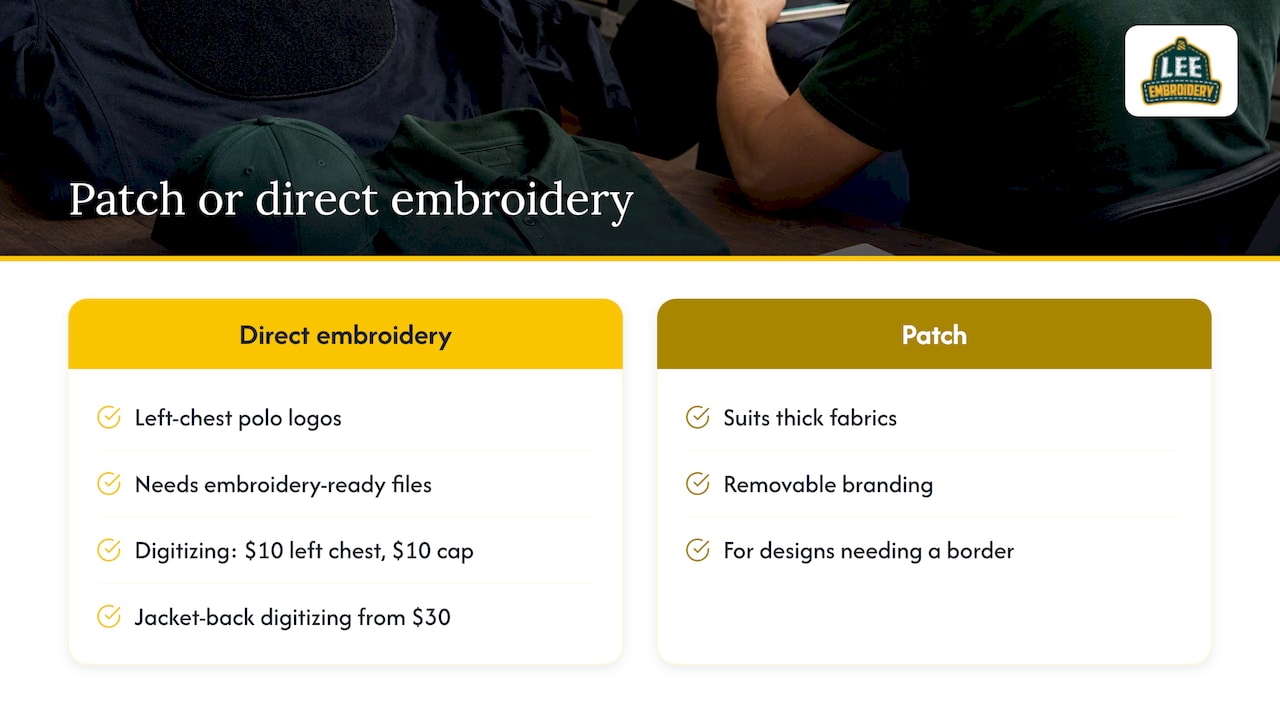
Sometimes the answer is not a patch at all. Direct embroidery suits a left chest logo on a polo. A patch suits thick fabrics, removable branding and designs that need a border. Our guide to patches versus direct embroidery shows how to decide, and this overview of patches versus embroidery helps you match the method to logo size and complexity.
If you do go direct, the file matters. We digitize artwork into embroidery-ready files, with published pricing of $10 for a left chest, $10 for a cap and from $30 for a jacket back on our embroidery digitizing page.
Backing and borders decide how long your brand lasts
A beautiful patch that peels off in the wash hurts your brand. Backing and border are the two choices buyers most often rush.
Backing options
We offer sew-on, iron-on, peel-and-stick and Velcro backings.
- Sew-on is the most secure and suits uniforms and anything washed often.
- Iron-on is quick to apply and fine for light use, and many buyers add stitching for extra hold. Here is a comparison of sew-on versus iron-on patches for long-term wear.
- Peel-and-stick works for temporary or display use, such as events.
- Velcro lets staff swap patches between garments or update ranks and roles. See our breakdown of Velcro patch strength.
Our patch backing guide explains how to test each with a sample. If the garments will be laundered at scale, read how to wash patches on uniforms before choosing.
Border options
The edge is what people see first. Choose from merrowed, embroidered or laser-cut borders. A merrowed edge gives the classic rounded, wrapped look. A laser-cut edge suits intricate shapes. If edges ever start to fray, here are five fixes by material. Before you approve a sample, use the questions in our patch border types guide.
Who uses patches for branding, and how
Businesses and uniforms
Staff uniforms are the most direct use. A consistent patch on every shirt, apron or jacket makes your team recognizable. Pair it with a backing chosen for the wash routine and you avoid reprints.
Teams, clubs and schools
For teams, patches build identity from the inside. Chenille suits letter jackets, embroidered suits jerseys and caps. Matching patches make a group look unified in photos and at events.
Event organizers
Event patches double as souvenirs and staff identifiers. Bulk orders, simple artwork and a clear theme work best. Our list of 14 event patch ideas offers a style and setup tip for each. Streetwear-minded brands can look at streetwear patch ideas.
Artists and designers
Artists use patches to sell their work in a form people can wear. Printed patches carry many colors and illustrated detail, while woven patches keep small linework crisp. A patch is a piece of art that people choose to wear.
Outdoor and hard-wearing gear
If your brand goes outdoors, durability becomes the headline. PVC is a common choice, and our guides on PVC patch durability and outdoor patch testing and peel strength cover what to ask for.
Baby apparel sellers and gift brands
Boutiques, Etsy and Shopify sellers, photography studios, hospital gift shops and gift-set companies often add a name, a logo or a milestone patch to blankets, bibs and onesies. Patches help here because you can order a consistent batch and apply it to blanks as orders come in. Before you commit, think through the points below.
- Placement and feel. Think about where the patch sits against an infant’s skin. Many sellers favor soft embroidered or woven patches on outer areas, and keep stiff or hard-edged materials away from areas that touch skin.
- Attachment. Sew-on is the most secure choice for items that will be washed often. Ask for a sample and wash it the way parents will.
- Small parts. A patch must stay on. Loose edges or threads are a concern on infant items, so test the sample with a firm tug and several washes.
- Compliance. Children’s products can carry specific legal requirements in the U.S. Confirm what applies to your product and materials with your own compliance contact or testing lab before selling.
We can send a free sample so you can run these checks on your own garments before ordering in volume.
Perspective: what we have learned about patch branding
We see the same pattern again and again. Brands that treat the patch as a product, not an afterthought, get the best results. That means a simplified logo, a material chosen for the fabric, and a sample tested before bulk production.
The mistakes are rarely dramatic. A tagline too small to read. A backing that does not suit the wash. A border approved from a screen proof instead of a real sample. All of them are cheap to catch early and expensive to catch after 500 pieces are made.
Our advice: start with one clear use, such as a cap, a uniform or a gift line. Get that right. Then reuse the approved patch across more products. That is how a patch becomes a recognizable brand mark rather than a one-off.
— Bilal
Order patches that match your brand
We make embroidered, woven, PVC, leather, chenille and printed patches, with your choice of shape, backing and border. You get a rapid quote, a complimentary sample so you can judge the stitching and feel for yourself, and free shipping. Custom patches start from $99, and we handle bulk orders for businesses, teams and events.

Ready to see your logo as a patch? Get a free quote on custom patches and tell us the garment, quantity and placement.
A simple process for your first patch order
- Define the job. Where will the patch go, who will see it and how often will it be washed?
- Pick the type. Use the table above as a starting point.
- Prepare the artwork. Send your logo in the best file you have. We can advise on simplifying it.
- Choose backing and border. Match them to the garment and care routine.
- Approve a sample. Check color, edges, size and attachment on a real garment.
- Order in bulk. Once the sample is right, repeat orders stay consistent.
For small first runs on hats, our sample-first leather patch hat guide shows how to avoid costly rework.
FAQ
Are patches better than printing for branding?
It depends on the product. Patches add texture, last through heavy wear and can be moved between garments, while printing suits large, flat, full-coverage designs. Many brands use both, with printing for large areas and a patch as the signature mark.
Which patch type is best for a company logo?
Embroidered patches are the most common choice because they are bold and durable. If your logo has small text or fine lines, woven patches handle detail better. Leather suits a premium, understated look.
Can I put patches on baby clothing?
Yes, many sellers do. Choose soft materials, a secure sew-on attachment and a sample that has been washed repeatedly. Confirm any legal requirements for children’s products with your compliance contact or a testing lab before you sell.
Can you help if my logo is too detailed for a patch?
Yes. Simplifying a logo for thread is a normal part of the process, and we can advise on which details to keep. If the detail matters, a woven or printed patch may be a better fit.
Sources
- Product Power 2026: What Consumers Want Next, PPAI
- PPAI Magazine, June 2026
- Stahls’ debossed leather patches coverage, ASI
- Nike 2017 Football Custom Logo Options and Guidelines
- Guidelines for Custom Patches, Boy Scouts of America
- Patches vs embroidery: choosing the right method
- Sew-on vs iron-on patches