There is no single US standard for uniform patches. Each organization sets its own rules: the Navy, the Army, a police department, Little League and Scouting America all say something different about who approves a design, how big it can be, and where it sits on the sleeve. The safe order of operations is simple: find the governing document for your uniform, get the design approved, confirm size and placement, then order. This guide shows what the published rules say and how to turn them into a patch order that is right the first time.
TL;DR
- Requirements come from the organization that issues the uniform. Read its current regulation before you design anything.
- Approval usually comes first. Commanding officers, review boards, committees or licensing teams sign off on a design before it can be worn.
- Size, shape, colors and placement are often fixed to the quarter inch. Order to the written spec, not to a look you like.
- Match the backing to how the patch will be attached and washed, then request a sample before a bulk run.
- Always check the issuing body’s current page. Rules are revised, and this article points you to the source documents.
Table of Contents
- Why uniform patch rules exist
- Start with the governing document
- Who has to approve the patch
- Size and shape requirements
- Colors and materials
- Where the patch goes
- Match the backing to how the patch is attached
- Applying and washing an iron-on patch
- A perspective from our side of the bench
- A checklist before you place an order
- Ordering your uniform patches from us
- FAQ
- Sources
Why uniform patch rules exist
A uniform patch is identification first and decoration second. The Army’s flight uniform policy says unit patches build esprit de corps, identify mission crew members and display unit readiness. Because a patch tells people who you are and what you are part of, organizations control it tightly.
That control shows up in three places: who can approve a design, what the patch physically looks like, and where it is worn. The sections below take them in that order, because approval problems cost the most to fix. A patch that is the wrong size can be remade. A patch that was never approved can mean an entire order sits in a box.
Start with the governing document
The first rule is that the uniform decides, not the patch maker. For the US Army, AR 670-1 states that only uniforms, accessories and insignia prescribed in the regulation, found in the Common Table of Allowances, or approved by HQDA may be worn. The version we reviewed was administratively revised on March 4, 2025. If a patch is not covered, it is not authorized by default.
For other groups, the document looks different but plays the same role:
| Group | Where the rules live |
|---|---|
| US Army | AR 670-1, plus unit and command policy |
| US Navy | Uniform Regulations, article 3603.4a for NWU shoulder patches |
| Police and sheriff departments | The department’s uniform standard operating procedure |
| Little League | The league’s patch requirements page |
| Scouting America | Its uniform insignia guides and custom patch guidelines |
If you are ordering for a team, school, department or troop, ask the person in charge for the exact document, and keep a copy with your order file. When the rule says “approved by the commander,” the approval itself is part of that file.
Who has to approve the patch
Approval chains vary, but the pattern is consistent: a design is reviewed by someone with authority over the uniform, and sometimes by more than one person.
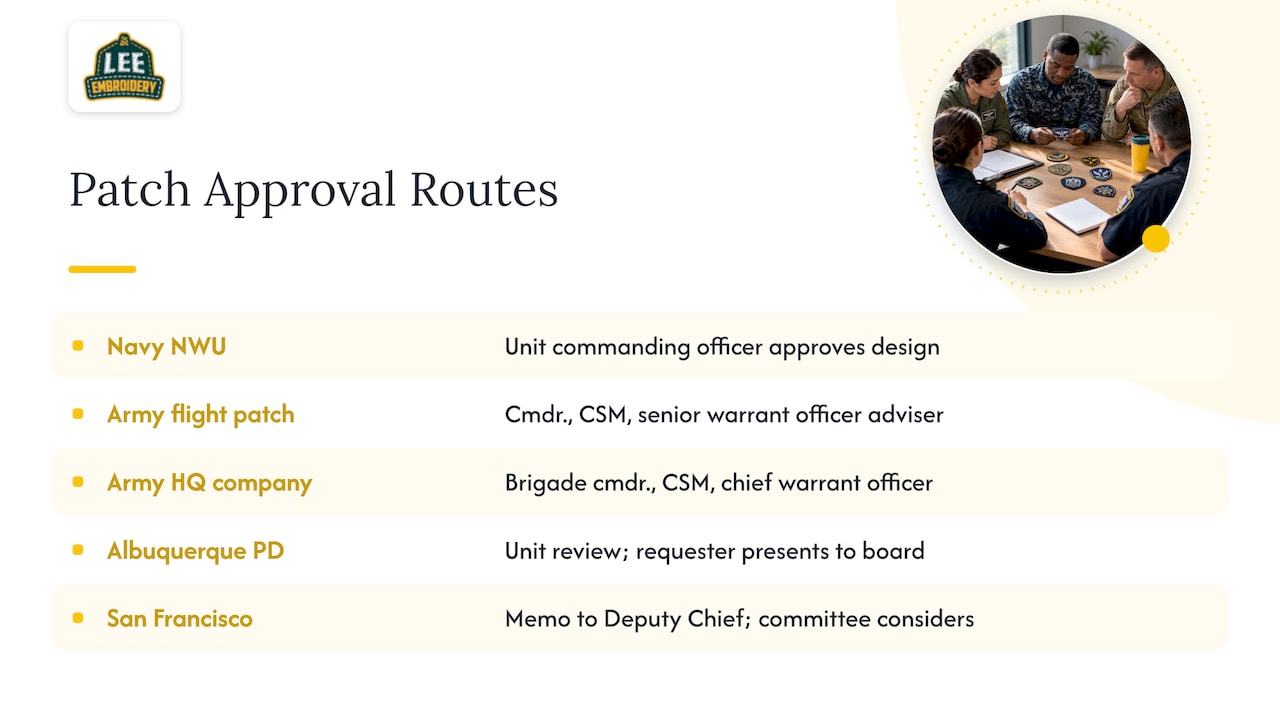
Military examples. For Navy NWU Type II and III uniforms, command or unit logo shoulder patch designs must be approved by the unit commanding officer. In Army aviation, flight-patch designs for one aviation combat brigade require approval by the battalion or squadron commander, the command sergeant major and the senior warrant officer adviser, while the headquarters company patch needs the brigade commander, command sergeant major and chief warrant officer sign-off, as laid out in the brigade’s flight uniform policy.
Police examples. Albuquerque Police Department personnel who want a new patch must submit a color image to the Policy and Procedures Unit, which passes it to the Policy and Procedure Review Board. The requester then presents it to the board, according to the department’s uniform SOP. In San Francisco, members seeking to affix another shoulder patch must submit a formal proposal by memorandum to the Deputy Chief of the Administration Bureau for the Uniform and Safety Committee to consider.
Youth and community groups. Scouting America publishes guidelines for custom patches and emblems that use its trademarks. Third-party marks require prior written authorization from the owner and written approval from the Licensing Team. Little League, for its part, set up one unified patch for all program levels, and leagues do not have to replace previously purchased patches still in stock.
The practical lesson: build approval time into your schedule. Send a proof, not a finished patch, to the approving authority. A flat digital mockup with dimensions and thread or ink colors labeled is usually enough to start the conversation.
Size and shape requirements
Where a rule exists, it is specific. Three published examples show how tight the numbers get.
- US Navy NWU Type II and III. Shoulder patches are rectangular, in one of three sizes: 2-1/8 by 3-3/4, 2-1/8 by 4, or 2-1/4 by 4 inches.
- US Army flag insignia. The flag is 2 by 3 inches and worn on the right shoulder pocket flap of utility uniforms and cold-weather jackets.
- Albuquerque Police Department. A proposed unit patch may not exceed the current department patch in total area, height or width, which is 4½ by 3½ inches.
Notice the different logic. The Navy gives you a short list of allowed sizes. The police rule gives you a ceiling. The Army gives a fixed size for a fixed insignia. When you brief a patch maker, state which type of rule you have: “must be one of these sizes,” “must not exceed this,” or “must be exactly this.”
Shape follows the same pattern. The Navy specifies rectangles for these shoulder patches. Many organizations are less strict about shape for sports and club patches, but a custom shape still needs a border that holds up. Our guide to border types and the questions to ask before approving a sample covers merrowed, embroidered and laser cut edges, so you can pick the one that suits your spec.
Colors and materials
Color rules are where many first-time buyers get caught. The Navy’s NWU patches use subdued colors that match the worn NWU pattern, exclude black pixels, and are embroidered or laser cut. In other words, the color palette and the production method are both part of the requirement, not just the artwork.
If your rule names specific colors, send those color codes to your patch maker and ask for a physical sample to compare against your uniform fabric. Screens lie about thread. Our guide to Pantone matching for custom patches explains how to get colors right and what to do when a spec calls for a precise shade.
Material choice should follow the uniform too. An embroidered patch suits most cloth uniforms. PVC works where a patch faces water, grease or hard use. Leather suits jackets, caps and workwear. If you are unsure which one fits your fabric and use, see our comparison of woven and embroidered patches for apparel.
Where the patch goes
Placement rules are written in inches from a seam, or in relation to another feature.
- Navy NWU Type II and III: patches are worn squarely and centered over the Velcro pile on the left and right shoulder pocket flaps.
- Little League: on a set-in sleeve, place the patch 1 inch below the left shoulder seam. On a raglan sleeve, place it 3 inches below the seam.
- Army flag insignia: worn with the star field facing forward, so the flag looks like it is flying as the wearer moves ahead. The Army’s own FAQ notes that the US Code does not address flag-patch positioning, so the rule comes from uniform regulation instead.
If you are outfitting a team, mark the placement on one finished sample uniform and photograph it. Hand that photo to whoever applies the patches. It prevents the most common error in bulk jobs: forty shirts with the patch half an inch off.
Match the backing to how the patch is attached
A patch can meet every size and color rule and still fail if it is attached the wrong way. Your attachment method may be set by the rule, as with the Navy’s Velcro shoulder flaps, or left to you.
- Sew-on is the most secure for uniforms washed often or worn hard.
- Iron-on is quick and convenient for teams and clubs, and works best on fabrics that tolerate heat.
- Velcro (hook and loop) lets you swap patches between uniforms, and suits pocket flaps built for it. See our look at Velcro patch strength for professionals.
- Peel-and-stick is for temporary use, not for a uniform that will be laundered.
Our guide to patch backing types, with samples and bond plus stitch helps you decide, including when to combine heat-applied adhesive with stitching for extra hold.
Applying and washing an iron-on patch
If your organization allows iron-on application, follow its instructions exactly. Little League’s guidance is a good model, because it is specific. The league says to preheat a high-heat iron for 5 minutes with no steam, put a lightweight cotton press-cloth over the emblem, and press the front for 25 seconds and the back for 45 to 60 seconds.
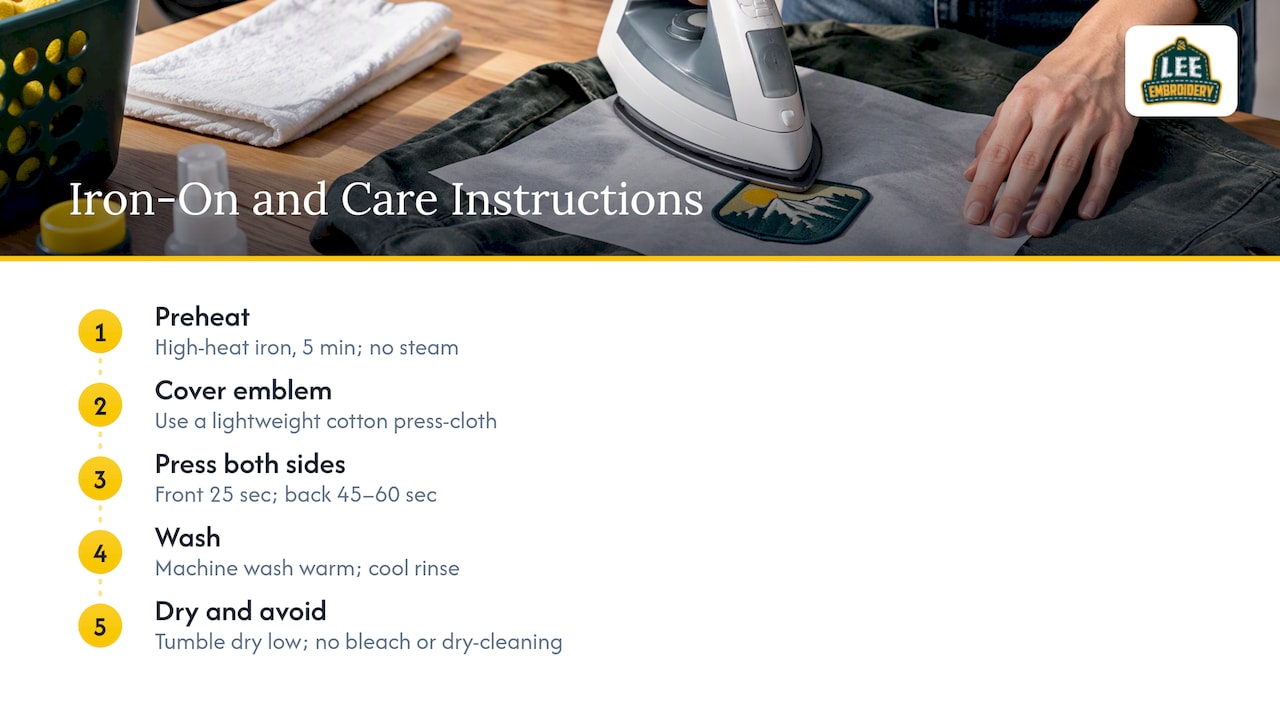
For laundering, the same page says to machine wash warm with a cool rinse, tumble dry low, and avoid bleach and dry-cleaning. Those instructions are written for Little League’s own patch and uniform fabrics, so treat them as a starting point and check what your own organization requires.
If you are setting your own press temperature, test on scrap fabric first. Our notes on heat press settings for patches walk through that test. For the wash side, wash instructions for uniform patches explain why the backing and the care routine need to match.
A perspective from our side of the bench
We see the same pattern every season. A team, department or club sends in a great design, and the first question we ask is not about thread. It is: “What does your uniform rule say?”
A patch built to a written spec goes through approval faster, fits the sleeve on the first try and avoids reprints. That is why we ask for the size limits, the color codes and the attachment method up front, and why we send complimentary samples before a bulk run. A sample in your hand beats a proof on a screen, especially when a commander or a review board has to say yes.
Our approach is built around craftsmanship and materials made to last: embroidered, PVC, leather, chenille, woven and printed patches, with the backing and border you need. A patch is a piece of art that also has to follow the rules. Done well, it does both.
Bilal
A checklist before you place an order
- Get the document. Ask your commander, chief, league administrator or council for the current uniform rule and save it.
- Confirm approval. Find out who signs off on the design, and whether they need a proof, a sample or both.
- Write down the limits. Exact size, allowed shapes, colors with codes, and the production method if specified.
- Mark the placement. Note the distance from the seam or the feature the patch is centered on.
- Choose backing and border. Base this on attachment and laundering, not just looks.
- Request a sample. Check size, colors and edge on the real uniform fabric before you approve a full run.
- Plan for replacements. Order a few extra, since patches get lost, and new members join mid-season.
Ordering your uniform patches from us
We make embroidered, PVC, leather, chenille, woven and printed patches, with the shape, border and backing you choose. You can start with a custom patch quote, where custom patches start from $99. We offer complimentary samples and fast quote turnaround, so you can check your spec against the real thing before you commit to a bulk run.

If the uniform needs embroidery directly on the garment instead, our embroidery digitizing service converts your design into an embroidery-ready file: $10 for left chest, $10 for cap, and from $30 for jacket back. For a first look at what is possible with cloth patches, see our page on embroidered patches, or read the ultimate guide for custom patches.
FAQ
Do all uniform patches need official approval?
Not all, but most organized uniforms do. Military units, police departments and youth organizations publish approval steps, and sometimes name the people or boards that must sign off. If you are not sure, ask whoever manages the uniform policy before you order.
What size should a uniform patch be?
It depends on the rule. Navy NWU Type II and III shoulder patches are rectangular and come in three listed sizes, while Albuquerque Police Department unit patches cannot exceed 4½ by 3½ inches. Get the written dimension limit from your organization, then give it to your patch maker.
Which shoulder does the patch go on?
It is set by the organization. Little League places its patch below the left shoulder seam, and the Navy centers patches on both shoulder pocket flaps. The Army wears its flag insignia on the right shoulder pocket flap of utility uniforms, with the star field forward.
Can I iron on a uniform patch instead of sewing it?
Only if your organization allows it. Little League publishes iron-on instructions for its patch, but military and police uniforms follow their own regulations. If iron-on is allowed, test the heat on scrap fabric first, and consider adding stitching for uniforms that are washed often.
How do I find the current rules for my group?
Go to the issuing body’s own publication: the service’s uniform regulation, your department’s SOP, the league’s patch page or the Scouting America insignia guidance. Rules get revised, so always confirm you are reading the latest version.
Sources
- Wear and Appearance of Army Uniforms and Insignia (AR 670-1)
- Navy Uniform Regulations, 3603.4a
- Army flight uniform policy
- Albuquerque Police Department SOP 2-1, Uniforms
- San Francisco Police Department, Wearing of Uniform Patches
- Scouting America, Guidelines for Custom Patches and Emblems
- Little League, Patch Requirements and Instructions
- US Army Institute of Heraldry, US Flag Etiquette FAQs