Colorfastness is how well a patch keeps its color when it is washed, rubbed, sweated on or left in the sun, and how well it avoids bleeding color onto the garment around it. It is not one property but a set of them, so the way to get patches that stay vibrant is to decide which conditions your patch will face, test for those, and approve a physical sample before you place a bulk order. This guide shows you how.
TL;DR
- Colorfastness covers washing, rubbing (crocking), perspiration and light. A patch can pass one and fail another, so each needs its own check.
- Results are graded on a 1 to 5 scale, where 5 means no change or staining and 1 means severe change.
- Match the test to the end use: uniforms need wash checks, hats and bags need rubbing checks, outdoor gear needs light checks.
- You can run a simple home check on a sample: wash, rub with white cloth, and compare with an untouched piece.
- Ask for a free sample and test it before you commit to a bulk run.
Table of Contents
- What colorfastness means for a custom patch
- The four tests that matter, and what each one tells you
- How results are graded
- Which patch types and colors need the closest look
- A simple home check for a patch sample
- How to specify colorfastness when you order
- Our perspective
- Get your patch colors tested before you commit
- What the trend toward fastness checks means for buyers
- FAQ
- Sources
What colorfastness means for a custom patch
In textile terms, colorfastness is a material’s resistance to changes in its color, to transferring color onto neighboring materials, or both, whether during processing, storage or everyday use. Cotton Incorporated’s technical bulletin uses this definition, and it is the one worth working from.
For a patch, that breaks into two practical questions:
- Does the patch itself change? Does a red stay red after 20 washes, or does it drift toward pink?
- Does it stain something else? Does a white shirt, a light jacket or a baby bib pick up a tint where the patch sits?
This matters more than most buyers expect. A patch is a small, high-contrast element, often placed on a lighter garment. A slight shift in a logo color is noticed immediately, especially when the patch is part of a brand or a team identity.
Colorfastness is also a set of distinct properties, not a single score. A textile can resist washing well and still fade under light, which is why each property has to be tested separately.
The four tests that matter, and what each one tells you
Labs and buyers usually talk about four families of fastness tests. Each one answers a different question about how your patch will live.
| Test | What it measures | Where it matters most |
|---|---|---|
| Washing (laundering) | Color loss on the patch and staining of other items | Uniforms, team wear, kids’ clothing, workwear |
| Rubbing (crocking) | Color transferred by friction, dry and wet | Hats, bags, jackets, anything that rubs skin or other fabric |
| Perspiration | Color change and transfer under simulated acidic and alkaline sweat | Sportswear, caps, work uniforms |
| Light | Fading from natural or artificial light | Outdoor gear, banners, vehicle and marine items |
Intertek’s overview summarizes the same split: rubbing tests look at color transfer through friction, washing tests at retention and staining, perspiration tests simulate acidic and alkaline sweat, and light tests look at fading.
AATCC, the U.S. association behind many textile methods, lists methods for perspiration, water, laundering, crocking and light exposure, including xenon-arc light testing. Its standards list includes TM8 for crocking and TM61 for laundering. Lab pages also reference TM15 for perspiration, TM16 for light and TM162 for chlorinated pool water.
Washing fastness
This is the one most people picture. A typical U.S. method is the Army and Air Force Exchange Service laundering procedure, which uses the care-label wash and dry method over five cycles, with an unwashed specimen kept for comparison. According to the AAFES laundering method, the test specifies 66 g of detergent and a 1.8 kg load, then evaluates color loss and staining on a gray scale.
Five cycles is a short horizon for a uniform patch that will go through a hundred washes. Treat a five-cycle pass as a baseline and ask how the patch is built for long-term care. Our guide to washing patches on uniforms covers the backing and care side of that.
Rubbing fastness (crocking)
Crocking measures color that rubs off. AATCC TM8 is designed to measure how much color transfers from a colored textile to another surface by rubbing. It uses white test cloth under dry and wet conditions, then rates the transferred color against a staining scale.
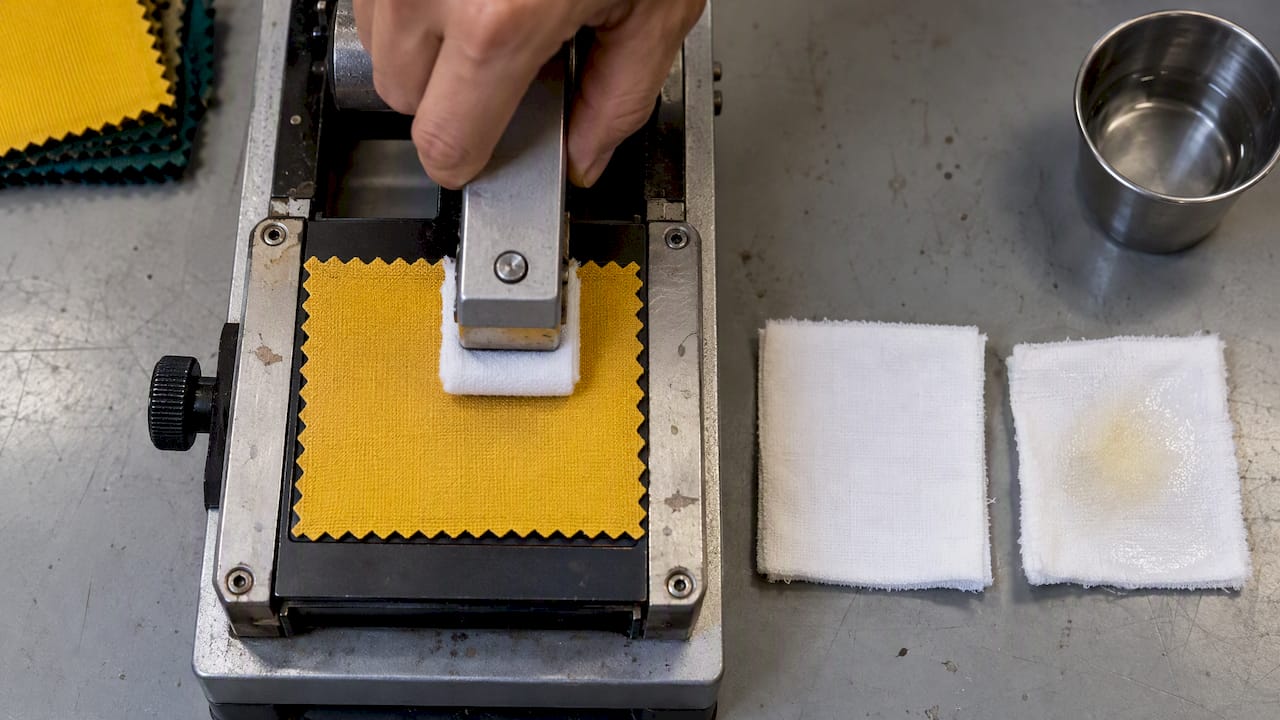
Wet rubbing is the stricter case, and it is the one that matters when a patch sits against sweaty skin or a damp jacket. Transfer complaints often come from garments worn in warm weather. If you want a real-world example of how a product brand handles this, Jaguar Golf describes a quick AATCC check to prevent dye transfer on headcovers, the same logic you apply to a patch on a light cap.
Perspiration fastness
Sweat is acidic or alkaline depending on the person, and it can change how dyes behave. The AAFES perspiration method exposes a specimen and a multifiber fabric to simulated perspiration under pressure and heat, then grades both shade change and transferred color. The cited procedure uses 38°C (100°F) for six hours before grading. For team patches and work caps, this is the test that mirrors a hard day.
The same idea shows up in apparel printing. The Light Blonde’s comparison of screen print versus DTG durability is a useful look at how decoration methods hold up to wear and washing.
Lightfastness
Light testing measures resistance to fading under natural or artificial light, and it is particularly important for outdoor items. If your patches go on tents, packs, flags or vehicle gear, light is the property to specify first. Our page on outdoor patches and ASTM tests explains what buyers should ask for in that case.
How results are graded
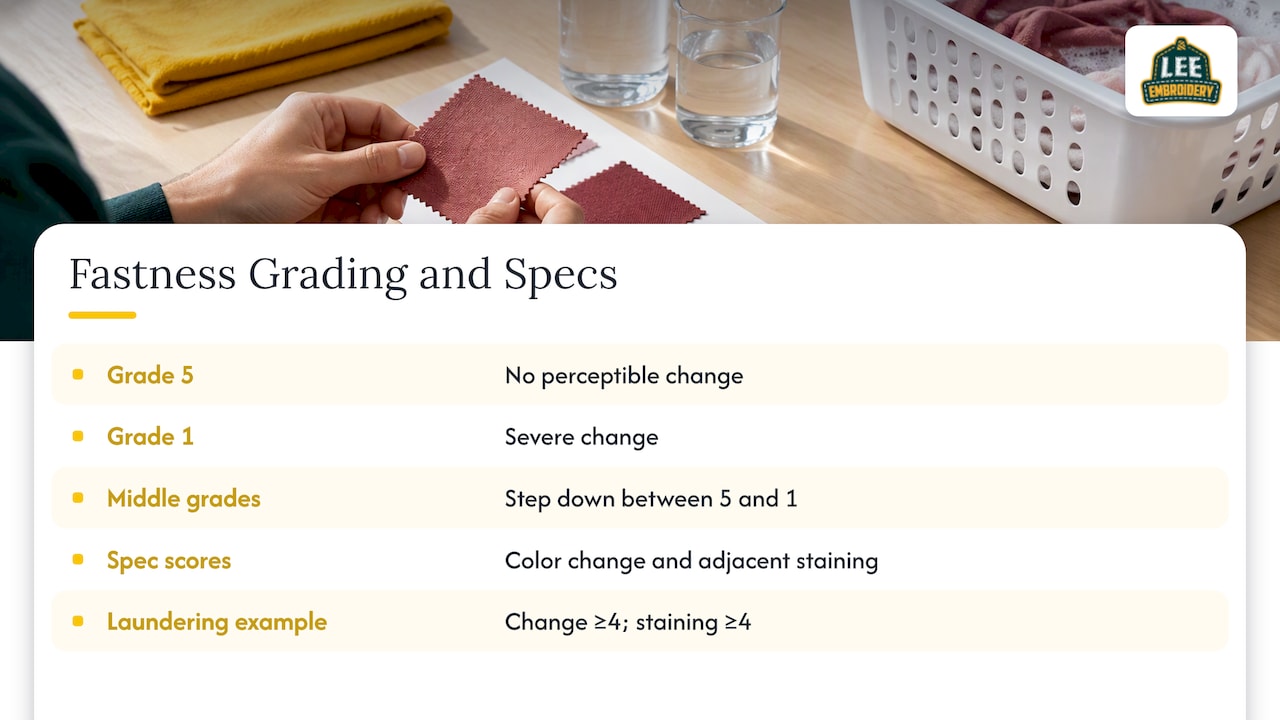
Fastness results are judged visually against gray scales. Grade 5 means no perceptible change, grade 1 means severe change, and the numbers between step down from there, as laid out in this specification guide. The AAFES laundering method uses the same logic: Grade 5 is no color loss or staining, Grade 1 is noticeable or heavy loss or staining, per the laundering method.
Standards for the visual evaluation itself, such as ASTM D2616, describe how to judge color differences with a gray scale. That standard also notes that rough or mottled specimens can make perceived color differences look smaller than on smooth, uniform surfaces. That is worth remembering with textured patches: chenille or heavily stitched embroidery can hide a shift that a flat printed patch would show plainly.
A fastness requirement is usually written as two numbers: one for color change of the specimen itself and one for staining of an adjacent material. When you write a spec for a supplier, give both, for example “4 or better for change, 4 or better for staining after laundering.” Pick the numbers with your end use in mind, and ask the supplier what they can support.
Which patch types and colors need the closest look
Patches differ in how color gets into them, and that shapes what you should check.
- Embroidered and woven patches get their color from dyed thread. Thread dye selection, wet processing and laundering practices all play into the result. Cotton Incorporated notes that fiber quality, yarn formation, fabric construction, wet processing, dye selection, detergent selection and laundering practices all influence colorfastness.
- Printed patches carry color as ink on a surface, so rubbing and wash checks on the printed face deserve attention. Our comparison of printed vs woven patches helps you choose between them.
- PVC patches have color molded into the material. See our notes on PVC patch durability for care and attachment.
- Leather patches are best judged on the actual leather sample, particularly for rubbing against light fabric.
- Chenille patches have a plush surface, so check how the yarn colors look after washing and handling.
Dye class matters too. For cotton, pigments and direct dyes typically show good lightfastness but poor washfastness, while naphthol dyes show good lightfastness and washfastness but poor crockfastness, according to Cotton Incorporated. The lesson is not that one is bad. It is that every color route has a profile, and the profile has to match the job.
Dark saturated shades, especially deep reds and navy, are the first to examine on a light garment, since any transfer is most visible there. Check them first on your sample.
A simple home check for a patch sample
You do not need a lab to learn a lot. A basic approach that mirrors the formal methods:
- Keep a control. Cut or set aside an identical, untouched patch, or keep a second sample. Every comparison needs an unwashed reference.
- Wet rub test. Dampen a clean white cotton cloth, rub the patch firmly 10 times and look for color on the cloth. Repeat with a dry cloth. This is a rough version of what crocking tests do under controlled conditions.
- Wash test. Sew or attach the patch to a scrap of the actual garment fabric, add a white cloth to the load, and wash using the care label method you plan to give customers. Repeat several times. The formal method uses five cycles.
- Compare. Put the washed patch next to the control in daylight. Check the patch for shifts, and the white cloth and surrounding fabric for tint.
- Test light if outdoors. Leave a sample in a sunny window beside a covered control piece and compare over time.
If you press the patch on with heat, run your checks on a scrap first. Heat can stress materials, and our heat press settings guide explains how to test before production. Attachment matters as well: our comparison of iron-on vs sew-on patches shows how to test each with free samples.
This is a screening check, not a certified result. If your patches ship on a product with compliance requirements, such as children’s apparel, talk to a testing lab and see our guide to safe baby patch materials.
How to specify colorfastness when you order
Most colorfastness problems begin as vague briefs. A short checklist avoids them:
- Name the end use. “Uniform shirt, washed weekly” or “cap, worn outdoors” tells the maker which properties count. Cotton Incorporated notes that the appropriate tests depend on the product’s intended end use.
- Give exact colors. Use Pantone references so everyone matches the same target. See Pantone matching for custom patches.
- Flag the risk pairings. Dark red or navy next to white or pale fabric is the pairing to mention up front.
- State the care method. Tell the maker how the garment will be washed and dried, and give your customers the same instructions.
- Choose the right construction. Our comparison of woven vs embroidered patches for apparel shows which fits which fabric.
- Approve a physical sample. Screens lie about color. A sample in your hands, tested on your fabric, does not. Read our guide to confirming embroidery color matching with a free sample.
Our perspective
Color is the first thing people see on a patch and the first thing they judge when it fails. We have seen that most disappointments are not about a bad patch. They come from a brief that never said how the patch would be used.
That is why we push every buyer toward the same simple habit: tell us the garment, the wash routine and the exact colors, then test a sample on the real fabric before the bulk run. Our free samples exist for this reason. You see the color, you rub it, you wash it, and you decide with evidence.
We build patches with vibrant color and durability in mind, across embroidered, woven, PVC, leather, chenille and printed options, and we match each material to how you will use it. A patch should look like a piece of art on day one and keep looking that way. Test it, and hold us to it.
Bilal
Get your patch colors tested before you commit
If color stability matters to your order, start with a sample. We offer complimentary samples and a rapid quote turnaround, so you can test against your own fabric, your own wash routine and your own brand colors before a bulk run. Custom patches start from $99.

Pick the construction that suits your use: embroidered patches for classic texture, woven patches for fine detail, PVC rubber patches for outdoor and rugged use, or leather patches for hats and bags. Then request a free quote and tell us how your patches will be worn and washed.
What the trend toward fastness checks means for buyers
Brands now treat fastness as part of the look, not a lab detail. One golf apparel maker explains colorfastness in golf clothing as a quality marker for customers who wash and wear items constantly. The same expectation applies to patches: your customers will not separate the patch from the garment when judging quality. If the patch bleeds in the wash, the whole product takes the blame.
Two habits help. First, write the fastness requirement into your purchase order, with both grade numbers. Second, repeat your sample check on the production run, not only on the pre-production sample, so you know the batch matches what you approved.
FAQ
What is colorfastness?
Colorfastness is a material’s resistance to color change or color transfer during use, washing, storage or processing. It covers several properties, including washing, rubbing, perspiration and light. A patch can score well on one and poorly on another, so each is checked on its own.
How do you test a patch for colorfastness?
At home, rub the patch with a damp and a dry white cloth, then wash it with a white cloth over several cycles and compare it with an untouched control. In production, formal methods such as AATCC TM8 for crocking and the AAFES laundering method grade results on a 1 to 5 scale.
Which patches are most likely to fade or bleed?
It depends on dye, material and use rather than patch type alone. Dark, saturated colors against pale fabric show any transfer first, and the dye route affects whether wash, rubbing or light is the weak point. Test the specific colors on your own fabric, using a sample from your supplier.
What does a colorfastness grade of 4 or 5 mean?
Grade 5 means no perceptible change or staining, and grade 1 means severe change. Grade 4 sits just below no change, a slight difference visible on close comparison. Requirements are usually written as two numbers: one for color change and one for staining.
Sources
- Cotton Incorporated: Colorfastness of Cotton Textiles
- Colourfastness in Apparel: Tests and How to Specify Them
- Intertek: Colorfastness Testing
- AAFES A-1: Colorfastness to Laundering
- AAFES A-3: Colorfastness to Perspiration
- AATCC TM8: Colorfastness to Crocking
- AATCC: Colorfastness Module
- AATCC: Standard Test Methods and Procedures
- ASTM D2616: Evaluation of Visual Color Difference
- Precision Testing Laboratories: Textile/Apparel Testing
- Jaguar Golf: AATCC check to prevent dye transfer on headcovers
- The Light Blonde: Screen Print vs DTG
- Plaid Gorilla Golf: Colorfastness in golf clothing