A minimum order quantity, or MOQ, is the smallest amount a supplier will let you buy in a single order, set as either a unit count or a dollar figure. Accept an MOQ that’s too high for your sales volume and you tie up cash in inventory you can’t move fast enough. Understanding how MOQs get set, how they interact with your own ideal order size, and how to negotiate them is what separates buyers who overpay in storage costs from buyers who don’t.
TL;DR:
- Most suppliers set MOQs based on fixed setup costs, tooling, or material minimums, which often exceed the buyer’s ideal order size and increase inventory risk.
- Negotiating lower MOQs often involves offering higher per-unit prices, committing to future orders, or accepting staged deliveries to align production costs with smaller orders.
- Calculating your own economic order quantity (EOQ) allows you to compare against supplier MOQs and identify how much extra cost or risk you might accept.
- Product category benchmarks show MOQs vary widely, with apparel and patches generally requiring fewer units than plastics or electronics, which demand larger minimums.
- Always review contractual MOQ clauses carefully, ensuring clear metrics, flexible delivery options, and exit clauses, to avoid enforceable obligations that could harm your cash flow.
Table of Contents
- What Is a Minimum Order Quantity, and How Do Suppliers Set It?
- Why Do Suppliers Set MOQs in the First Place?
- How Does MOQ Affect Your Inventory and Cash Flow?
- How Do You Calculate the Right Order Quantity?
- What Are Typical MOQ Ranges by Product Category?
- How Can You Negotiate a Lower MOQ?
- What Legal Terms Should You Check Before Accepting an MOQ?
- A Procurement Practitioner’s Take on MOQ Decisions
- Need a Low-MOQ Supplier for Custom Patches?
- Sources
- FAQ
What Is a Minimum Order Quantity, and How Do Suppliers Set It?
MOQ shows up in two flavors, and mixing them up is where a lot of buyers get tripped up on their first quote. A unit-based MOQ is straightforward: the supplier requires you to buy, say, 500 pieces minimum, no matter what those pieces cost. A dollar-value MOQ works differently. The supplier sets a minimum spend, like $2,000, and you can hit that with any mix of products at any price point.
Converting between the two just takes a little arithmetic. If a supplier quotes a $2,000 minimum and your average unit price is $8, you’re looking at roughly 250 units to clear the threshold. Flip it around, and a 500 unit MOQ at $4 per unit is effectively a $2,000 value floor. Knowing which type you’re dealing with changes how you plan your product mix.
MOQs also range from simple to layered:
- Simple MOQ: one flat minimum applies to the whole order, regardless of variation.
- Multiples-based MOQ: you must order in fixed increments above the minimum (order in lots of 100, never 137).
- Case pack or pallet MOQ: the minimum is tied to how the product ships, not an arbitrary number.
- Per-color or per-size MOQ: each variation carries its own minimum, so five colors might mean five separate thresholds stacked into one order.
When a quote just says “MOQ: 300,” push for specifics. Ask whether that’s per SKU or across your whole order, whether it’s negotiable for a first-time buyer, and whether mixed colors or sizes count toward the total or each need their own 300. That single follow-up question saves more sourcing headaches than almost anything else you can ask a new supplier.
Why Do Suppliers Set MOQs in the First Place?
MOQs aren’t arbitrary gatekeeping. They exist because production has fixed costs that don’t shrink just because your order is small, and suppliers use MOQs to make sure every job clears those costs before it makes them any money.
Tooling and setup are the biggest driver. Injection molding requires a physical mold, screen printing requires screens, and embroidery requires digitizing a design into a stitch file. Whatever the process, someone has to configure the machine before the first good unit rolls off it, and that configuration cost gets spread across the run. A 10-unit order and a 1,000-unit order can cost the supplier almost the same amount to set up, which means the 10-unit order loses money unless the price per piece is absurdly high.
Material minimums add another layer. Fabric mills, plastic resin suppliers, and metal stampers often have their own MOQs upstream, and your supplier is boxed in by whatever their suppliers require. If a yarn mill won’t sell less than 50 kilograms of a custom color, that constraint rolls straight downhill to you.
Packaging and shipping economics matter too. A container ship or freight truck has a fixed cost whether it’s half full or packed tight, so suppliers set minimums that let them fill pallets efficiently rather than shipping half-empty boxes at a loss.
Here’s where you have leverage: suppliers with open production capacity, or ones actively trying to land a new account, are often willing to accept a below-MOQ trial order to prove the relationship before you commit to volume.
Pro Tip: Ask directly whether a supplier has slower production weeks or open capacity. A supplier filling a gap in their schedule will frequently drop the MOQ just to keep the line running.

How Does MOQ Affect Your Inventory and Cash Flow?
Every unit above what you’ll sell in a reasonable window is money sitting on a shelf instead of working for you. That’s the core tension MOQ creates, and it shows up in your numbers in several specific ways.
Carrying costs are the obvious one. Storage space, insurance, and capital tied up in unsold stock all scale with order size, and some products carry a heavier load than others. Products needing refrigeration, odd dimensions, or specialty handling push carrying cost per unit noticeably higher than a standard boxed item, so a “good deal” MOQ on a bulky or perishable product can cost more to hold than it saved on price.
Cash flow takes a direct hit too. Money spent clearing an MOQ is money that isn’t available for payroll, marketing, or the next product launch, and if that inventory sells slowly, you’re financing a warehouse instead of growing the business.
Obsolescence and seasonality compound the risk. A seasonal item ordered at a high MOQ right before the season ends can leave you holding stock for eight or nine months, and trend-sensitive products can lose value entirely before you sell through them.
Before accepting any supplier’s MOQ, run through this checklist:
- Does forecasted demand comfortably exceed the MOQ within your sell-through window?
- How many days of inventory will this order create, and does that match your turnover targets?
- What’s the realistic carrying cost per unit, including storage and insurance?
- Do you have physical warehouse space for the full order, or does it force a rental or overflow cost?
- How does the upfront payment affect your working capital for the next 60 to 90 days?
- Does the purchase agreement include an exit or adjustment clause if forecasts miss?
Answering these six questions before you sign turns MOQ from a gut-feel decision into a number you can actually defend to your finance team.
How Do You Calculate the Right Order Quantity?
You don’t have to accept a supplier’s MOQ at face value. Comparing it against your own ideal order size tells you whether it’s reasonable or whether you need to negotiate, and the math is more approachable than it looks.
Step 1: Determine demand and lead time. Pull your annual demand for the product (call it D) and your supplier’s lead time. If you sell 2,400 units a year and lead time is six weeks, you need enough buffer stock to cover those six weeks without running out.
Step 2: Calculate holding cost per unit and order cost. Holding cost (H) includes storage, insurance, and capital cost, often expressed as a percentage of unit cost per year. Order cost (S) includes setup fees, shipping, and administrative time per order placed.
Step 3: Compute break-even and convert dollar MOQs to units. If a supplier’s MOQ is dollar-based, divide it by your average unit price to get a comparable unit figure, the same conversion covered earlier.
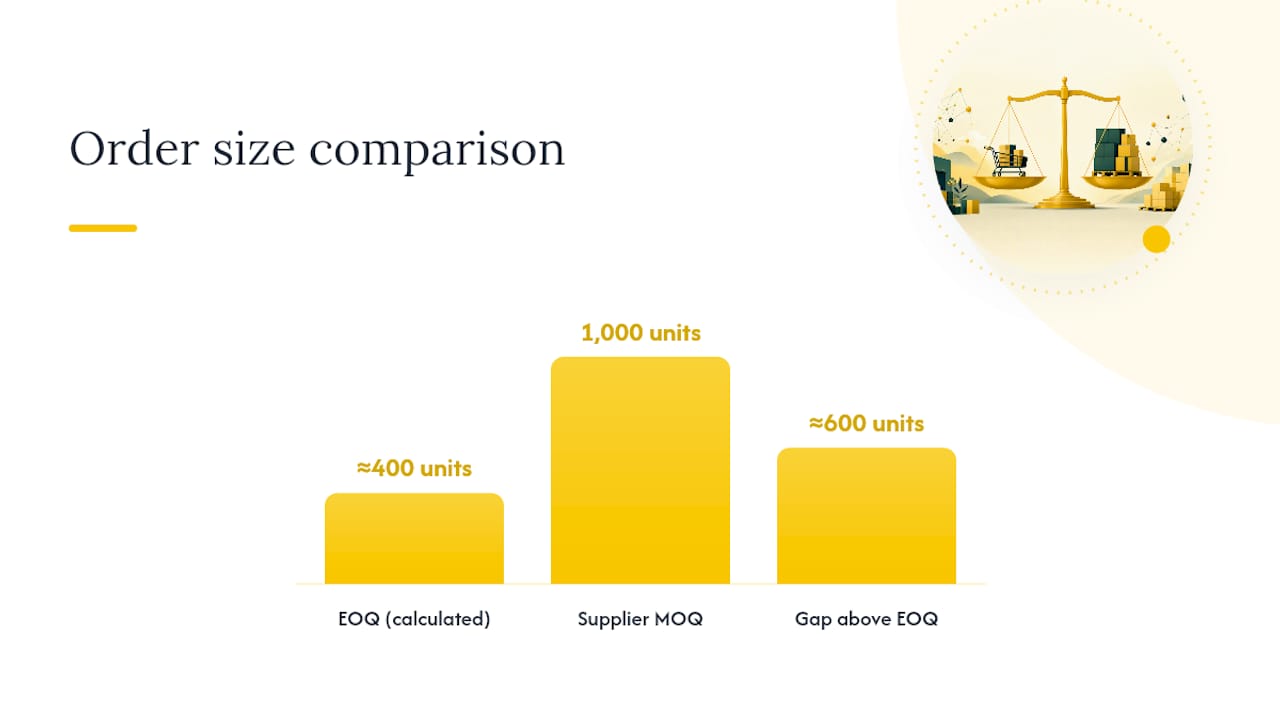
Step 4: Compare the supplier’s MOQ to your Economic Order Quantity. EOQ is calculated as the square root of (2 times D times S, divided by H), and it represents your own cost-minimizing order size, not what the supplier requires. When the supplier’s MOQ is far above your EOQ, you’re paying for their fixed costs, not optimizing your own.
Here’s a worked example:
| Variable | Value |
|---|---|
| Annual demand (D) | 2,400 units |
| Order cost (S) | order cost |
| Holding cost per unit (H) | holding cost |
| EOQ = √(2DS/H) | EOQ calculated from demand, order cost, and holding cost |
| Supplier MOQ | 1,000 units |
| Gap | units above EOQ |
In this case, the supplier wants nearly two and a half times your calculated ideal order. That gap doesn’t automatically mean walk away. It means you now have a specific number to negotiate against, and you know exactly how much extra carrying cost you’re absorbing to get the supplier’s price.
What Are Typical MOQ Ranges by Product Category?
MOQ benchmarks vary widely by category, largely tracking how much tooling, material batching, and regulatory overhead a product requires before the first unit ships.
| Product category | Typical MOQ range | Primary driver |
|---|---|---|
| Apparel and soft goods | moderate quantities, often tens to hundreds of units | Fabric roll minimums, cut-and-sew setup |
| Custom patches and embroidered goods | relatively low, batch-friendly minimums | Digitizing and stitch-out setup, not raw material |
| Injection-molded plastics | typically in the low thousands of units | Mold tooling cost, resin batch minimums |
| Printed packaging | several hundred units minimum | Plate setup, ink matching, print run efficiency |
| Electronics accessories | several hundred units minimum | Circuit board runs, component sourcing lots |
| Furniture (custom or upholstered) | smaller quantities, usually tens of units | Labor-intensive assembly, material cuts |
These category ranges reflect where tooling and material batching sit on the cost curve, and they’re a useful reality check in a sourcing conversation. If a plastics supplier quotes you 200 units, something’s off, either they’re outsourcing the molding or padding the price to cover their real fixed costs. If an apparel supplier wants 5,000 units for a first order, that’s on the high end and worth pushing back on.
Use these ranges as a starting benchmark, not a hard rule. Actual minimums shift based on complexity, the number of colors or materials, and how established the supplier’s production line already is.
How Can You Negotiate a Lower MOQ?
Negotiating MOQ works best when you understand which lever you’re pulling and what it costs the supplier to move it.
- Offer a higher per-unit price. This is the most direct trade: you’re compensating the supplier for the fixed costs they’d otherwise spread across more units.
- Commit to future orders with a letter of intent. A written commitment to place a full-MOQ order down the line often unlocks a smaller trial order now.
- Offer faster payment terms. Paying upfront or on shorter terms improves the supplier’s cash position, and that flexibility can be worth a lower minimum in return.
- Accept staggered deliveries. You place the full order but the supplier ships it in smaller batches, which meets their production economics while easing your warehouse space and cash flow.
- Work through a trading company or order aggregator. These middlemen pool smaller orders from multiple buyers to hit a factory’s MOQ, at a markup.
- Simplify your design. Fewer colors, materials, or custom components reduces the tooling and batching drivers behind the MOQ in the first place.
Pro Tip: If a supplier won’t budge on unit MOQ, ask about mixing SKUs under one dollar-value threshold instead. Many suppliers will flex on the type of minimum even when they won’t flex on the number.
Knowing when to accept a price premium versus switch suppliers comes down to volume math. If the premium erases your margin entirely, it’s time to source elsewhere.
What Legal Terms Should You Check Before Accepting an MOQ?
Minimum purchase requirements written into a formal distribution or supply agreement aren’t a suggestion. They’re enforceable contract terms, and failing to hit them can trigger real remedies, from lost exclusivity to financial penalties.
Before signing anything with a recurring minimum purchase clause, check for:
- Measurable metrics, stated as specific unit counts or dollar amounts per defined period, not vague language like “reasonable volume.”
- Staggered delivery allowances that let you spread a large commitment across multiple shipments.
- Quality holdback clauses that let you withhold partial payment if goods don’t meet agreed specifications.
- Clear remedies for non-performance on either side, so both parties know what happens if a minimum is missed.
- An exit or renegotiation clause tied to a specific date or sales threshold, giving you a way out if demand shifts.
If a distribution agreement locks you into recurring minimums over multiple years, get a contracts attorney to review the remedies section specifically. That’s the clause that determines what it actually costs you if the market changes.
A Procurement Practitioner’s Take on MOQ Decisions
Every MOQ decision is really three variables in tension: the price break you’re getting, the inventory risk you’re taking on, and the cash you’re tying up to get there. Buyers who only look at price per unit consistently underestimate how much a bloated order costs in storage, insurance, and the opportunity cost of capital sitting on a shelf. Run the six-question checklist above before every new supplier relationship, no exceptions, even when the quote looks like a great deal on paper.
Before committing to a full MOQ, always ask for a sample or a small test order first. Suppliers who refuse any accommodation for new buyers are telling you something about how they’ll handle problems later.
— Bilal
Need a Low-MOQ Supplier for Custom Patches?
If you’ve been reading through injection-molding minimums of 1,000 units and packaging runs that lock you into 500 pieces just to get a decent price, custom patches work differently. Leeembroidery keeps its minimums batch-friendly, so you’re not forced into a five-figure order just to test a design with your team or a new retail line.

You get a complimentary sample before committing to production, which means you can check stitch quality, color accuracy, and backing type before your money is on the table. Quote turnaround is fast, so you’re not waiting weeks just to find out what a run of embroidered, PVC, leather, chenille, woven, or printed patches will cost you. When you’re ready to move forward, have your artwork file, a rough quantity range, and your target turnaround in hand. Head to the custom patches page to request a quote and get a sample started.
Sources
- Minimum Order Quantity (MOQ): Definition and Negotiation Tactics (2026) – Shopify
- Minimum Order Quantity (MOQ): Formula, Tips, & Benefits | NetSuite
- What is a Minimum Order Quantity? Guide + Calculate MOQ – ShipBob
- Minimum Order Quantity (MOQ) – Workus (summary)
- Distribution agreements / commercial contracts – Douglas Legal
FAQ
What Is the Minimum Order Quantity?
The minimum order quantity is the smallest amount of product a supplier will sell you in one order, stated as either a specific unit count or a minimum dollar spend.
What Is the Difference Between EOQ and MOQ?
EOQ is the order size that minimizes your own total ordering and holding costs, calculated as the square root of (2 times demand times order cost, divided by holding cost). MOQ is the floor a supplier sets based on their production and material costs, and the two numbers often don’t match.
What Does Minimum Quantity Mean in a Purchase Order?
It means the supplier won’t process or fulfill an order below that threshold, whether expressed in units, cases, or a required dollar total.
How Do You Calculate a Sensible Reorder Quantity?
Start with your annual demand and lead time, calculate your holding and order costs, then compute your EOQ and compare it against the supplier’s stated MOQ to see how much extra inventory risk the minimum forces you to carry.
Does Lee Embroidery Offer Low Minimum Orders for Custom Patches?
Yes. Some custom patch suppliers structure their minimums to be batch-friendly for smaller buyers, and may offer complimentary samples so you can evaluate quality before committing to a larger run.