Most custom patch orders typically take several weeks from approved design to delivery, though simple woven or printed styles can ship faster, often within a couple of weeks. The three biggest factors that move this window are design complexity, order quantity, and the shipping speed you choose. Rush production and expedited shipping can shrink that total timeline significantly when you need patches fast.
TL;DR:
- Embroidered patches typically take several weeks, with denser designs and more colors adding extra production time.
- Molded PVC patches require fixed mold fabrication upfront, adding extra weeks regardless of order size.
- Proofing delays often stem from review and approval processes, where clear communication and a single approver can save days.
- Rush production shortens timelines to about a week but cannot accelerate mold fabrication for PVC patches.
- Standard shipping options influence final delivery, with expedited methods reducing transit time to a few days for urgent needs.
Table of Contents
- Typical production timelines by patch type
- What affects turnaround: design, quantity, complexity, and materials
- Proofs, approvals, and how customer review time impacts the schedule
- Rush and expedited options: what ‘rush’ usually buys you
- Shipping options and transit times
- Sample timeline scenarios
- Practical tips to shorten overall turnaround
- How a manufacturer actually schedules your order
- Get a faster, more predictable turnaround with Lee Embroidery
- FAQ
- Sources
Typical production timelines by patch type
Each patch style has its own manufacturing process, and that process sets the baseline for how fast your order can move. Embroidered patches involve stitching thousands of individual threads onto backing fabric, so dense designs with lots of color changes or fine detail naturally take longer to produce. Woven and printed patches skip heavy stitching altogether, which usually means a faster trip through the production line.
PVC and molded patches work differently. A custom mold has to be fabricated before a single patch gets made, and that tooling step is fixed regardless of order size. Chenille patches sit somewhere in between: the thick, fuzzy yarn construction requires specialized machines and careful handling, which can add a few extra days compared to standard embroidery.
- Embroidered patches: generally a few weeks depending on stitch density and detail
- Woven and printed patches: usually faster turnaround since there is little to no raised stitching
- PVC and molded patches: require additional weeks for mold fabrication before production
- Chenille patches: timelines similar to embroidered, sometimes slightly longer due to specialized equipment
Knowing which category your design falls into gives you a realistic starting point before you even request a quote.
What affects turnaround: design, quantity, complexity, and materials
Stitch count is the single biggest variable inside embroidery production. A simple logo with two or three colors runs through a machine far faster than a design with gradients, shading, or a dozen color separations, since each thread change requires a manual stop. PVC and molded patches carry a different constraint: tooling and mold fabrication happen once, up front, as a fixed block of time that cannot be compressed no matter how small your order is.
Quantity matters too, but not always in the direction people expect. Larger orders often get batched into a production run, which can actually smooth out per-unit time even though the total calendar time stretches longer. Finishing touches, like merrowed borders, laser-cut edges, or specialty backings such as Velcro or peel-and-stick, add extra handling steps that stack on top of base production time.
- Dense stitching and multiple color separations add machine time per piece
- Mold fabrication for PVC patches is a one-time fixed delay regardless of quantity
- Large batches can extend total calendar time even when per-unit efficiency improves
- Specialty borders and backings add discrete extra production steps
Pro Tip: Stick to standard backings like sew-on or iron-on when timing matters more than a specialty finish.
Proofs, approvals, and how customer review time impacts the schedule
The proof stage is where many orders quietly lose days, not because production is slow but because approval sits in someone’s inbox. Most manufacturers turn around a first digital proof within 24 to 48 hours of receiving finalized artwork. From there, plan for at least one revision round, since each round of changes typically adds another 24 to 72 hours before production can begin.
- Expect a first digital proof typically within a few days of submitting artwork
- Budget several days per revision round if changes are needed
- Assign a single approver so feedback doesn’t bounce between multiple people
- Write clear, specific revision notes to avoid a second round of guesswork
- Accept minor color or placement adjustments rather than requesting a new proof for small tweaks
Rush and expedited options: what ‘rush’ usually buys you
Rush service typically means a provider prioritizes your order ahead of the standard queue, often reducing production time to a few days and a total turnaround of about a week including proofing and shipping. What rush cannot do is eliminate fixed steps like custom mold fabrication for PVC patches, since tooling has to exist before production can start no matter how urgently you need the order.
- Expedited production often runs 48 to 72 hours instead of the standard multi-week window
- Total rush turnaround, including proofing and shipping, often takes about a week
- Custom molding and tooling steps generally cannot be rushed past their fixed lead time
- Rush pricing usually appears as a flat fee, a percentage surcharge, or a per-piece expedited rate
If your design requires a mold, ask upfront whether rush pricing even applies, since some providers cap how much they can accelerate tooling-dependent orders.
Shipping options and transit times
Once patches leave the production floor, your shipping choice determines the final stretch of the timeline. Ground shipping typically takes several business days depending on distance, while 2-day and overnight services compress that window considerably for an added cost. Bulk orders are usually boxed and dispatched as a single shipment once the full batch clears quality checks, rather than shipped in partial runs.
- Ground shipping adds the most time but costs the least
- 2-day and overnight options shrink the final leg of the schedule when deadlines are tight
- Bulk orders typically ship as one complete batch after quality inspection
Book upgraded shipping when you place your order rather than waiting until production finishes, since carrier capacity and pricing can shift closer to pickup.
Sample timeline scenarios
Seeing the stages stacked together makes planning easier than looking at ranges in isolation.
- Small embroidered order: 1 to 2 days for proof approval, roughly 2 weeks for production, plus 3 to 5 days ground shipping, landing around 3 weeks total.
- Large embroidered order: similar proof timing, but production stretches closer to 3 to 4 weeks because of batching, plus shipping, often pushing total turnaround past a month.
- PVC molded patch: proof approval in 1 to 2 days, then 1 to 3 weeks for mold fabrication before production even begins, followed by standard manufacturing and shipping, often totaling 5 to 6 weeks.
Practical tips to shorten overall turnaround
Most delays come from avoidable friction rather than the manufacturing process itself. Submitting production-ready artwork with clear color codes and dimensions from the start eliminates the back-and-forth that eats up proofing days. Limiting revisions to one focused round, with a single approver working against a fixed deadline, keeps the schedule moving instead of stalling in review.
- Submit vector artwork with exact color specifications before requesting a proof
- Designate one approver with a firm deadline to prevent revision loops
- Choose standard materials and backings that skip custom tooling when speed matters
- Use digital proofs for sign-off and reserve physical samples for final confirmation only
Pro Tip: If you’re on a tight deadline, tell your provider upfront. Many manufacturers can reorder their queue if they know your constraint before production starts, not after.
How a manufacturer actually schedules your order
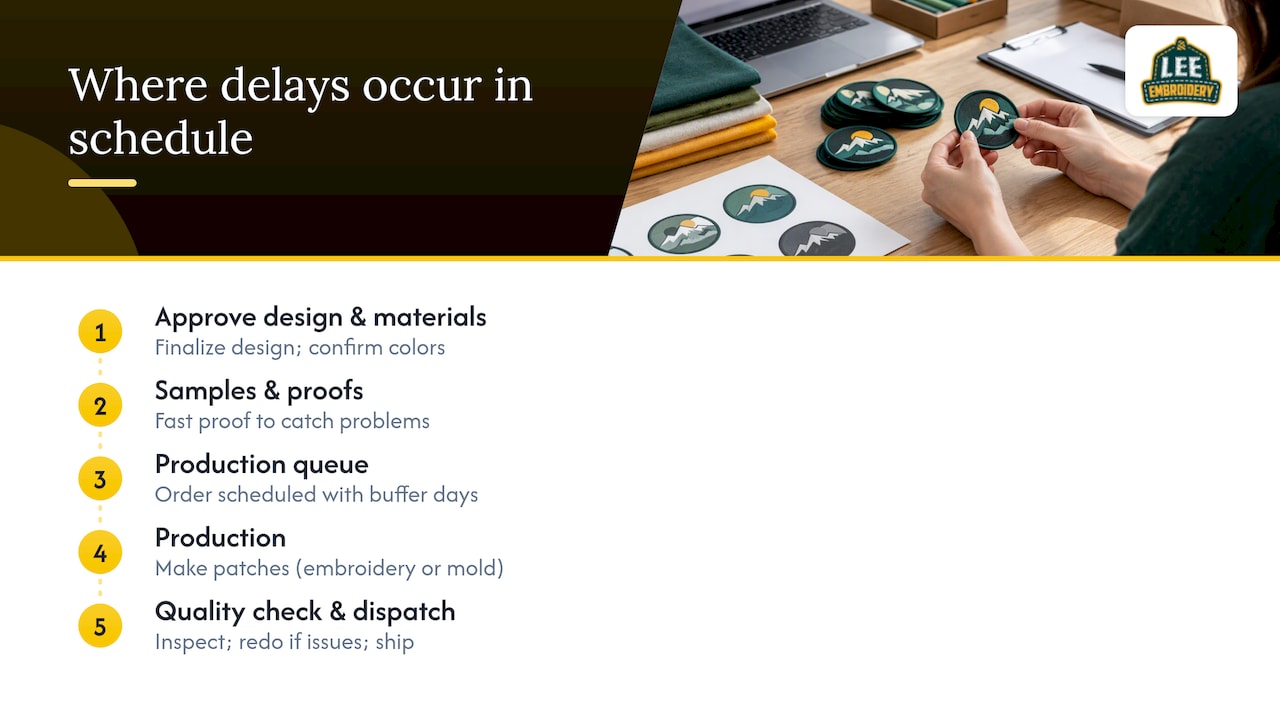
Quoted lead times almost always include padding, and that is not a dodge. Machines break, color separations take longer than expected, and quality checks catch issues that need a redo. Building in buffer days protects the delivery date you were promised rather than the best-case scenario.
The real trade-off is speed versus finish quality. Rushing dense embroidery or a complex mold can mean cutting corners on thread tension or edge finishing, and that shows up the moment a patch reaches your hands. Fast proofs and complimentary samples exist specifically to catch problems before full production starts, not after, which is the entire point of reviewing a sample instead of waiting for the finished batch to arrive.
— Bilal
Get a faster, more predictable turnaround with Lee Embroidery
We built our process around the stages that most often slow other orders down. We offer rapid quote turnaround to help you quickly find out pricing and timing, and complimentary samples to check thread quality, color accuracy, and backing choice before committing to a full production run. There are embroidered, woven, printed, PVC, chenille, and leather patch options, with backing choices including sew-on, iron-on, peel-and-stick, and Velcro, allowing you to pick a combination that avoids unnecessary tooling delays when speed matters.

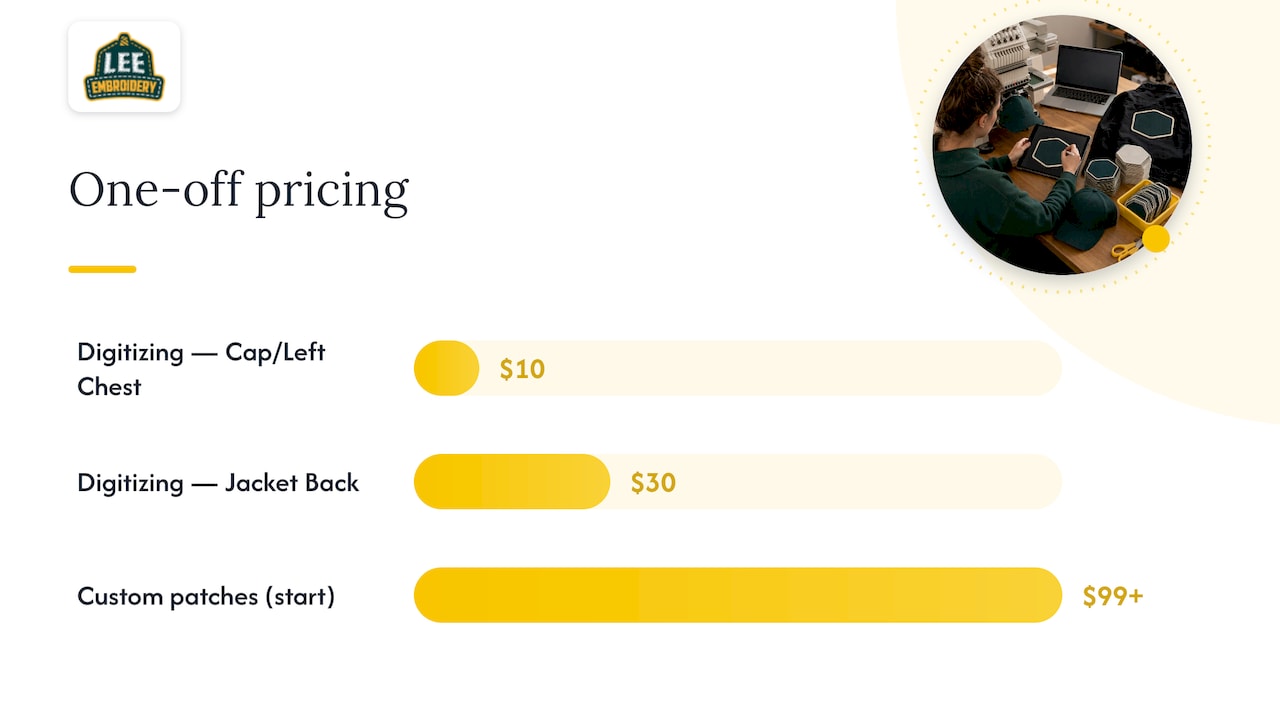
If your project needs embroidery-ready files fast, our digitizing services convert artwork for Left Chest or Cap placements at $10 one-off, or Jacket Back designs from $30 one-off. For teams managing their own proofing workflow, proofing automation tools can also help keep approval rounds organized on your end.
When you are ready to move forward, our custom patches start from $99 one-off, and you can request your free quote and samples directly through our site to get your timeline locked in today.
FAQ
How much does it cost to have patches made?
Pricing depends on the patch type, size, and quantity you choose. Our custom patches start from $99 one-off, while embroidery digitizing services run $10 one-off for Left Chest or Cap designs and from $30 one-off for Jacket Back placements.
What are common mistakes when using iron-on patches?
The most frequent mistake is skipping a proper heat press or iron setting test, which leads to patches peeling off after a wash or two. Applying an iron-on patch to stretchy, textured, or waterproof fabric also tends to weaken adhesion since the backing needs a flat, heat-tolerant surface to bond properly.
What are common patch sizes?
Patch sizes vary widely based on placement, with small emblem patches often around 2 to 3 inches and larger back patches commonly reaching 10 inches. The right size usually comes down to where the patch will be worn, such as a left chest emblem versus a jacket back design.
How long do iron patches last?
A well-applied iron-on patch can last for years of regular wear and washing when it has been properly heat-sealed to a compatible fabric. Longevity depends heavily on application quality and fabric type, since high-friction areas or frequent hot washing can shorten its lifespan compared to a sewn-on patch.
How long does a typical patch order take from start to finish?
Most orders take 2 to 4 weeks for embroidered patches or 7 to 14 business days for woven and printed styles, factoring in proofing, production, and standard shipping. Rush options can shrink that window to around 5 to 7 business days total when timing is critical.