Choose twill when you want bold, large shapes or letters that sit flat, hold their form and keep costs down. Choose fully embroidered when you want a premium, dimensional finish with no fabric showing, or when your artwork has fine detail that needs thread to carry it. The word “twill” means two slightly different things in this debate, so the sections below take each one in turn: twill appliqué (often called tackle twill) on garments, and patches where the twill base is left partly visible instead of covered edge to edge with thread.
TL;DR
- Twill appliqué sews cut fabric shapes or letters onto a garment. It is flat, bold and usually the lower-cost route for big lettering.
- Fully embroidered means thread covers the entire surface. It looks richer and more textured, and it costs more because it uses more thread.
- Partly embroidered patches leave twill exposed as part of the design. That saves thread and can add a color, but the backing cloth shows.
- Pick by artwork: big, simple shapes suit twill; small details, gradients and premium branding suit full coverage.
- Not sure? Request a free sample and compare both in your hands before you commit to a bulk run.
Table of Contents
- What “twill” means in this comparison
- How they look and feel
- Cost and production time
- Durability and care
- Which one fits your project
- Getting your colors right
- Prepare your artwork
- A cleaner way to decide
- Perspective: what we see in practice
- Get it made with Lee Embroidery
- FAQ
- Sources
What “twill” means in this comparison
Twill is a fabric with a tight diagonal weave. It turns up in two places in custom decoration, and mixing them up is the most common reason people feel confused.
Twill as the design (tackle twill)
Tackle twill is the application of polyester or cotton twill, felt or leather, sewn permanently in place with zigzag or running stitches to form individual shapes or letters on a garment. Think of the block letters on a varsity jacket, a team jersey or a sorority sweatshirt. The fabric piece is the design. The stitching mainly secures its edges.
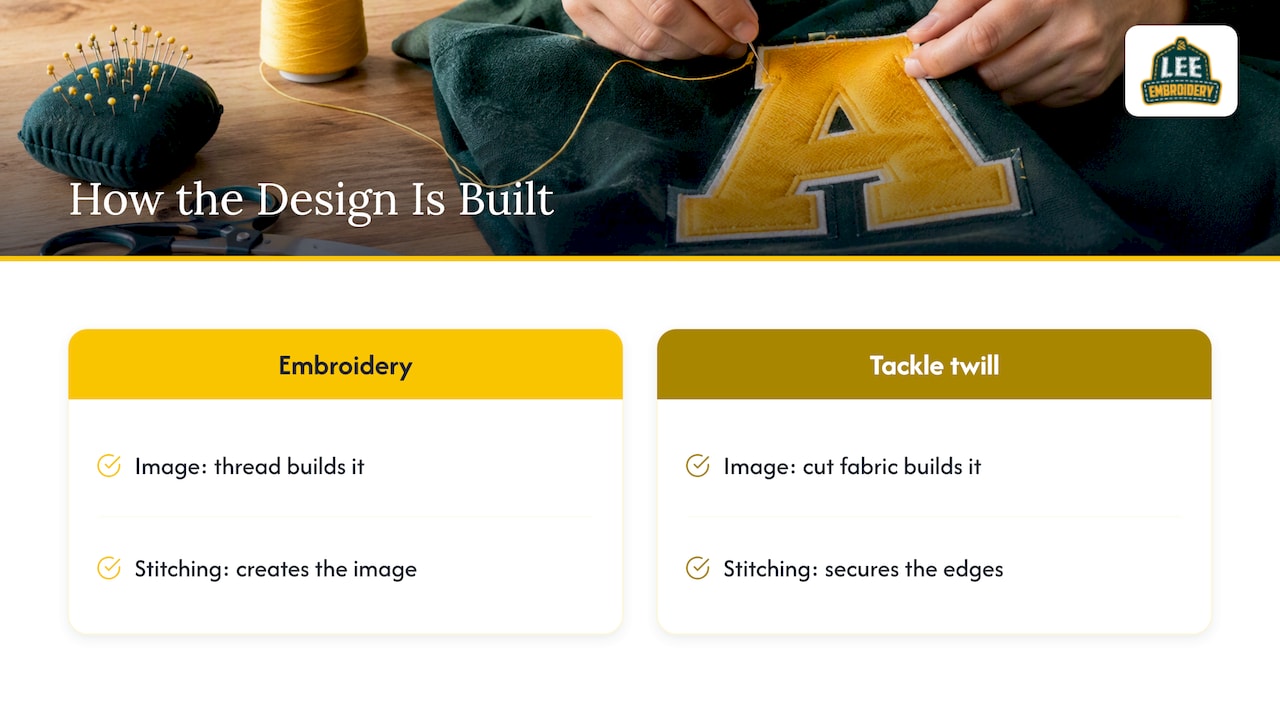
That is the key contrast with embroidery. In embroidery, thread builds the image. In tackle twill, cut fabric builds the image and thread holds it down.
Twill as the base of a patch
Most embroidered patches are stitched onto a twill base. The base is a tight, firm cloth that can carry dense stitching without puckering, and polyester twill is the most common choice because it resists shrinking and holds color. Cotton twill is also used and has a softer, more vintage look.
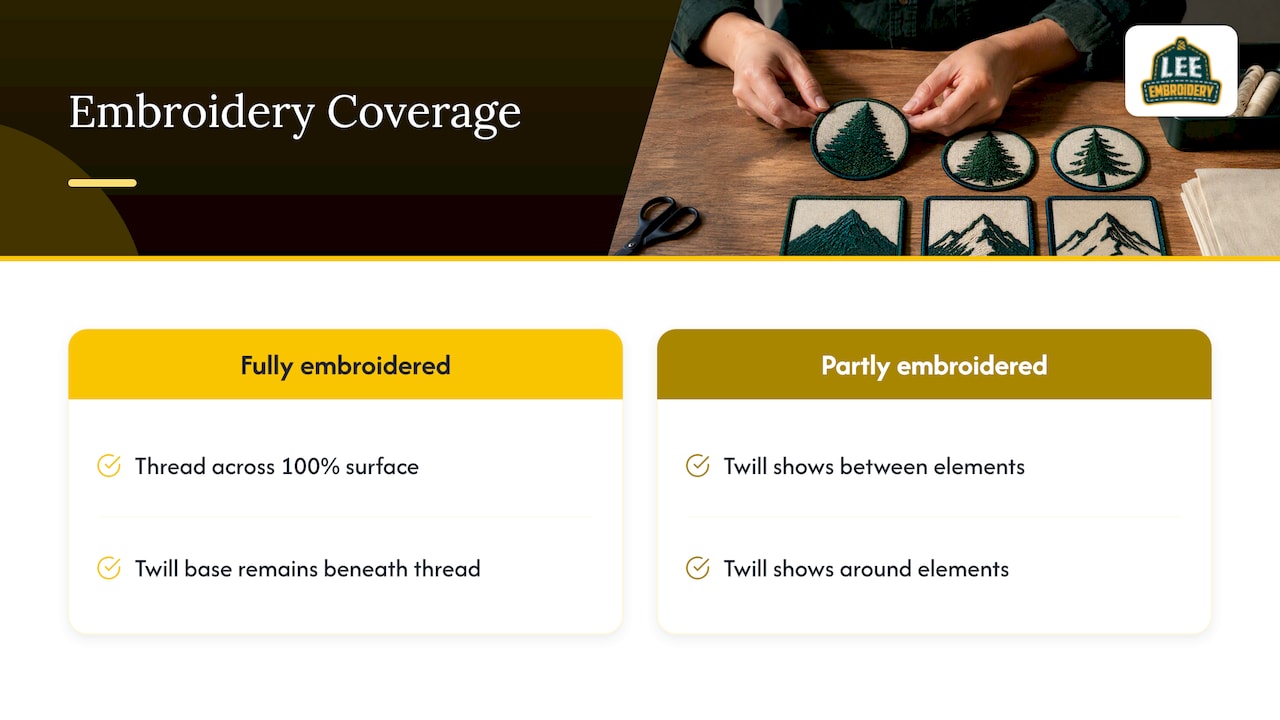
How much of that base you cover is the real choice. A fully embroidered patch has thread across 100% of the surface. A partly embroidered patch lets the twill show between or around design elements. The base is always there. Whether you see it is a design decision.
How they look and feel
Twill appliqué: flat, bold and clean
Twill letters have a smooth, matte surface with a stitched border. Because the color comes from a solid piece of fabric, large areas look even and saturated, with no stitch direction showing. The finish is low-profile, which is why it works for oversized numbers and names on athletic wear.
The limit is detail. You cannot cut a tiny script or a thin line out of fabric and keep it clean, so twill suits chunky, simple forms.
Fully embroidered: raised, rich and detailed
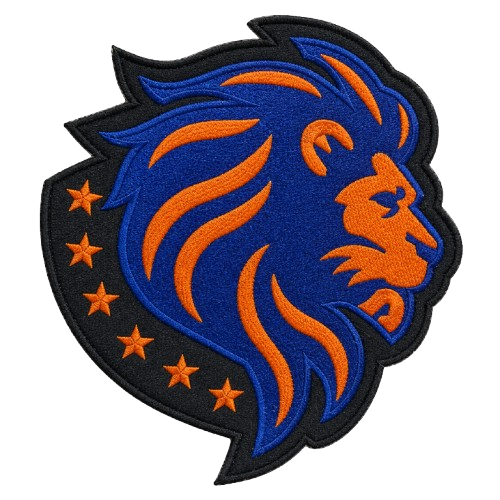
Full coverage gives you a thick, textured surface with visible stitch direction that catches light. Thread can render smaller details, layered colors and fine outlines more precisely than cut fabric can. People often read this finish as the more premium one, which is why many brands choose it for logos that represent them at their best.
Partly embroidered: twill as a design color
Leaving twill exposed gives you an extra “color” for free and can make fine elements easier to read, since a thin stitched line over fabric can be clearer than the same line lost in dense fill. The trade-offs are practical. The exposed base needs to match your color intent, and if adhesive is used on the reverse, there is a risk of it showing through the uncovered cloth. If you want a no-compromise look, cover the whole surface.
| Feature | Twill appliqué | Partly embroidered | Fully embroidered |
|---|---|---|---|
| Main material | Cut twill fabric | Thread on exposed twill | Thread across whole surface |
| Surface | Flat, matte | Mixed: raised thread, flat fabric | Raised, dense, textured |
| Fine detail | Limited | Good | Best |
| Large solid areas | Excellent | Good | Good, but thread-heavy |
| Thread use | Low (edge stitching) | Moderate | High |
| Typical use | Letters, numbers, bold shapes | Logos with open space | Premium logos, detailed artwork |
Cost and production time
The cost logic is simple. Fully embroidered pieces generally cost more because they use more thread, and more thread also means more machine time. Partly embroidered pieces cost less because the exposed twill replaces stitches. For garments, using twill in appliqué saves stitches, time and money compared with filling the same area with thread.
A worked example: imagine a 10-inch block letter on a jacket back. Filling that letter with thousands of stitches is slow and heavy, and the dense fill can pull the garment. Cutting the letter from twill and edge-stitching it uses a fraction of the thread. Now imagine a 3-inch logo with a small tagline and a gradient. Twill can’t cut that cleanly, so thread is the only sensible option, and the cost is justified by the result.
Two habits keep budgets under control:
- Decide the finish before you request a quote, so each price compares like with like.
- Ask for the same design priced at full coverage and with exposed twill. The difference tells you what the premium look costs on your specific artwork.
Durability and care
Both methods are built to last when done properly, and the usual failure is the attachment, not the decoration.
- Twill appliqué becomes part of the garment. It’s sewn on and generally heat-sealed after sewing, so large lettering holds its shape through repeated washing. This is how team uniforms survive a season of laundry. For the thread and fabric logic behind that, see the explanation of tackle twill.
- Fully embroidered patches are dense, so the thread is the wear surface. Tight stitching and a clean border protect the edge, which is where fraying starts. If edges are your concern, our guide to fixing fraying patch edges matches finishes to materials.
- Partly embroidered patches have an exposed base, so choose a backing and border that suit regular laundering.
For patches, how you attach them matters as much as how they are made. Sew-on is the most permanent, iron-on and peel-and-stick suit lighter use, and hook-and-loop suits swap-able uniforms. Our breakdown of patch backing types and the page on adhesive types help you match backing to garment before you order.
For washing, turn garments inside out, use a gentle cycle and avoid high-heat drying on anything with an iron-on backing. Our patch washing instructions for uniforms cover this in more detail. Check the care label of the garment itself too, since the fabric underneath often sets the limit.
Which one fits your project
Pick twill appliqué when
- You need large letters, numbers or simple shapes, such as team names and numerals.
- You are decorating a lot of pieces and thread cost would add up.
- You want a flat, athletic or collegiate look.
- The design has few colors and no fine lines.
Pick fully embroidered when
- Your logo has small text, thin outlines or several close colors.
- The piece represents your brand to customers, such as a staff uniform or retail merchandise.
- You want a dimensional, high-end finish with no exposed backing.
- Appearance matters more than shaving a few cents per unit.
Pick partly embroidered when
- The design has natural open space and you want the base to act as a color.
- You want some embroidered texture at a lower price.
- The patch will be sewn on, so adhesive show-through is not a concern.
If you are also weighing other patch constructions, our comparisons of chenille vs. embroidered patches and PVC vs. embroidered patches go deeper on those trade-offs. For caps in particular, read hat patches vs. embroidery.
Getting your colors right
With twill you choose from available fabric colors, while thread offers a broad palette that can be matched to brand colors. If a brand color has to look the same across materials, work from a reference chart and ask for a physical sample. This guide to Pantone color accuracy shows why matching to a standard, rather than by eye, keeps color consistent across different surfaces and finishes.
Prepare your artwork
A clean file prevents most surprises. Whichever finish you pick:
- Send vector artwork or a high-resolution image.
- Keep text legible at the final size. Tiny letters turn muddy in thread.
- Limit the number of colors where you can, which helps both cost and consistency.
- Say clearly which areas should be thread and which should show the base.
If your design is going on garments rather than patches, it needs to be converted into stitch instructions first. That conversion is called digitizing, and quality here decides how the finished piece looks. Poorly digitized files cause puckering, gaps and rough edges.
A cleaner way to decide
Ask three questions:
- Is the artwork simple and large? Twill is likely enough.
- Does it have fine detail or need to look premium? Go fully embroidered.
- Is there open space in the design? Consider exposed twill and compare the quote.
Then test it. Looking at a photo is no substitute for holding a sample, feeling the edge and bending it.
Perspective: what we see in practice
Most of the reorders we want to avoid start the same way: someone picked a finish from a screen, then disliked it in hand. We see that fully embroidered patches win when a logo has detail and has to look the part, and that exposed twill is a smart choice when the artwork has room to breathe. We also see that the best results come from choosing the backing and border together with the finish, not after it. Our advice is to order a sample first, check the edge, the color and the feel, and only then approve a bulk run. It is a small step that saves a lot of regret.
— Bilal
Get it made with Lee Embroidery
We make embroidered patches in full or partial coverage, along with woven, chenille, PVC, printed and leather options. You choose the shape, border and backing, and we offer rapid quotes, complimentary samples, bulk capability and free shipping. Custom patches start from $99. If your design is for garments, our embroidery digitizing service is $10 for a left chest design, $10 for a cap and from $30 for a jacket back. Send your artwork and ask for a free quote.
FAQ
Does tackle twill mean stitched?
Partly. Tackle twill is cut fabric (twill, felt or leather) that is sewn onto a garment with zigzag or running stitches, and it is generally heat-sealed afterward. The stitching secures the piece, but the fabric forms the design, which is different from embroidery where the thread forms the design.
Is twill cheaper than fully embroidered?
Usually, for large, simple designs. Full embroidery uses more thread, so it generally costs more, while twill appliqué replaces many stitches with a piece of fabric. For small, detailed artwork the gap narrows, because twill can’t reproduce the detail anyway.
What fabric are embroidered patches made on?
Most use a twill base, typically polyester for its resistance to shrinking and color retention, though cotton and poly-cotton twill are also used. Felt, canvas and mesh appear for specialty needs. The base is the same whether the patch is fully or partly embroidered.
How do I wash garments with twill or embroidered decoration?
Turn the garment inside out, wash gently and skip high-heat drying, especially with iron-on backings. Follow the garment’s care label first. Our washing guide covers uniforms in detail.
Which is better for a team uniform?
Twill suits big names and numbers because it is flat, bold and economical across many pieces. A fully embroidered patch suits the crest or logo where detail counts. Many teams use both on the same uniform.
Sources
- Embroidery | SanMar U
- Standard twill options for appliqué for embroidery | Stahls
- Pantone color accuracy for fleet wraps and brands | NJ Vinyl Wrapz