Expect to pay within a typical range per patch, with most orders influenced by style, size, and quantity. Quantity and stitch coverage are the two biggest levers on price. A small run of intricate embroidered patches sits at the top of that range; a bulk order of simple printed patches sits near the bottom. Everything else, from backing to borders, adjusts the number from there.
TL;DR:
- The cost of custom patches heavily depends on quantity, with prices dropping significantly as orders increase from 10 to 1,000 units due to spread setup fees.
- Embroidered and woven patches generally cost between $0.47 and $4.00 per piece, but specialty options like leather or bullion can surpass $2.00, reaching over $10.00.
- Design complexity, including stitch density, color count, and edges, directly increases manufacturing time and cost, especially for detailed or multi-color artwork.
- Quantity and design simplification are the most effective ways to reduce costs, with bulk orders and limiting stitch count delivering the biggest savings.
- Getting an accurate quote requires clear details like size, quantity, patch style, backing, and artwork; consulting manufacturers beforehand helps avoid unexpected expenses.
Table of Contents
- How Much Do Custom Patches Cost by Style?
- What Does a Custom Patch Cost at 10, 100, or 1,000 Units?
- What Actually Drives the Price of a Patch?
- How Do You Get an Accurate Patch Quote?
- How Can You Lower Your Custom Patch Cost?
- Why Talk to a Patch Manufacturer Before You Design?
- What Buyers Get Wrong About Patch Pricing
- Ready to Get Your Custom Patch Quote?
- Sources
- FAQ
How Much Do Custom Patches Cost by Style?
Not all patches are built the same way, and the manufacturing method behind each style explains most of the price gap you’ll see between quotes. Embroidered patches, the most requested style for teams and brands, typically run $0.47 to $4.00 per piece because thread coverage and machine time scale with design complexity. Woven patches land in a similar band, often $0.47 to $4.00, and suit designs with fine text or thin lines that embroidery thread can’t render cleanly.
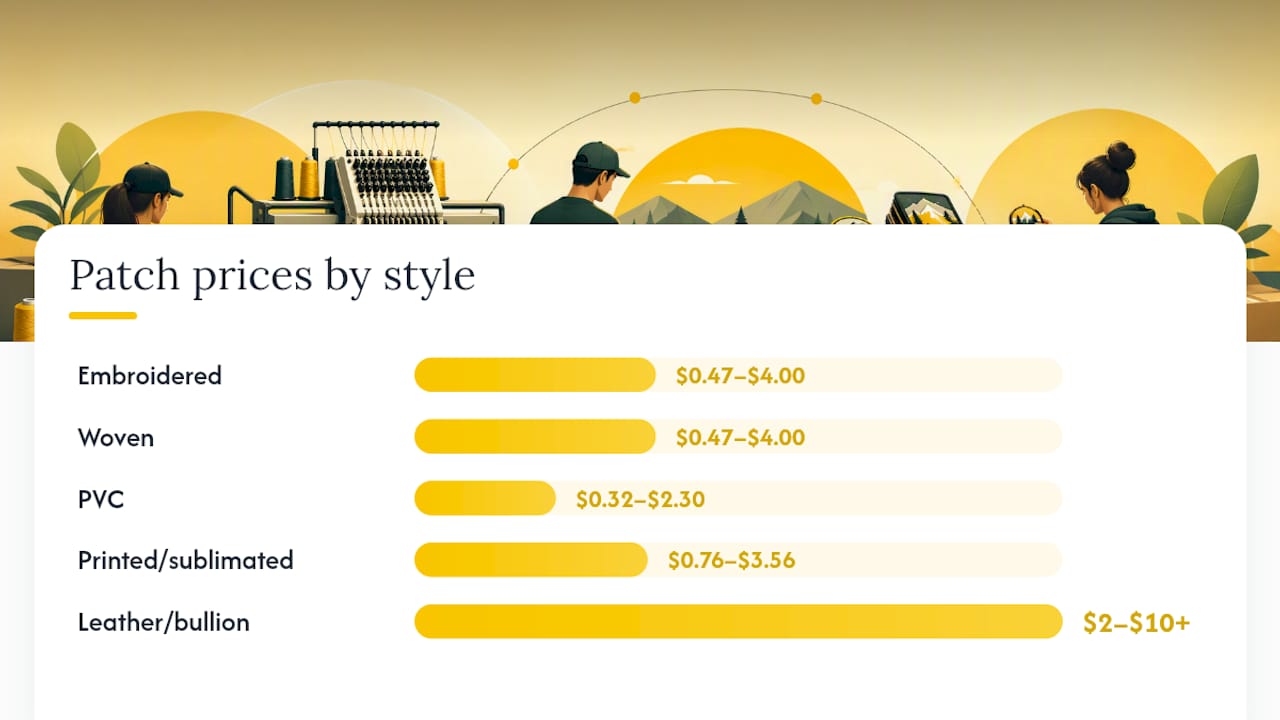
PVC patches, molded from rubber-like material, tend to be less expensive since they skip stitching entirely and rely on injection molds instead. Printed or sublimated patches follow a close price range, offering full-color photographic detail without the labor cost of thread work. Chenille patches, the fuzzy varsity-letter style, cost more because of the raised pile fabric and heavier backing required.
Leather and bullion patches sit at the premium end, frequently reaching $2.00 to $10.00 or more per piece, according to pricing data compiled by MaggieFrameStore. Here’s the breakdown at a glance:
- Embroidered: $0.47–$4.00 per patch, priced by stitch density
- Woven: $0.47–$4.00 per patch, ideal for fine detail
- PVC: $0.32–$2.30 per patch, molded rather than stitched
- Printed/sublimated: $0.76–$3.56 per patch, best for photorealistic art
- Chenille: priced above standard embroidery due to raised pile material
- Leather/bullion: $2.00–$10.00+ per patch, a specialty premium tier
If your design has gradients, shading, or more than six colors, printed or PVC options usually deliver the same visual impact for less than embroidery would cost.
What Does a Custom Patch Cost at 10, 100, or 1,000 Units?
Quantity changes the math more than almost anything else you control. Setup costs, including digitizing your artwork into a stitch file, get spread across every unit in the order. Order ten patches and you absorb the whole setup fee yourself. Order a thousand and that same fee barely registers in the per-piece price.
Supplier pricing examples show just how steep that curve is. A standard 3 inch embroidered patch can run about $8.00 each at 10 units, drop to roughly $2.88 at 100 units, and fall as low as $0.33 at 1,000 units, based on tiered pricing examples from MaggieFrameStore. PVC and printed patches follow a gentler curve since they carry less setup overhead to begin with.

Most manufacturers set a practical minimum order somewhere between 10 and 50 pieces, since anything smaller rarely justifies the setup work involved. Single sample patches usually cost more per piece than any bulk tier, which is exactly why free sample programs matter so much before you commit to a full run.
What Actually Drives the Price of a Patch?
Stitch density is the single biggest labor cost in embroidery. A patch densely packed with fill stitching takes longer on the machine than a larger patch with open background space, so a small, detailed design can cost more than a bigger, simpler one. Size matters too, but mostly because it correlates with how much surface area needs covering.
Color count adds up fast. Each thread color requires a separate machine pass, so a five-color logo costs more to produce than a two-color one, even at identical size. Metallic or specialty threads add a further surcharge because they run slower through the machine and require more careful handling. Backing choice shifts cost as well: iron-on and sew-on backings sit at the affordable end, while Velcro and peel-and-stick options typically add a few cents per piece. Merrowed borders (the classic stitched edge) usually cost less than laser-cut or embroidered borders, which take extra passes to finish cleanly. Rush turnaround, often needed inside two weeks, commonly adds a percentage surcharge on top of standard pricing. Digitizing your artwork into an embroidery file is frequently a one-time setup fee, sometimes waived on larger orders.
How Do You Get an Accurate Patch Quote?
A vague description gets you a vague quote. Give a supplier these details up front and you’ll get a number that actually holds once you place the order:
- Finished size (width and height in inches)
- Quantity you’re ordering, or a range if you’re still deciding
- Patch style you want (embroidered, PVC, woven, printed, leather, or chenille)
- Backing type (iron-on, sew-on, Velcro, or peel-and-stick)
- Artwork or color reference, ideally a vector file or clear image with Pantone codes
- Border and edge preference (merrowed, laser cut, or embroidered)
Most reputable suppliers respond with a digital proof before production starts, so you can check placement, colors, and stitch coverage before anything hits the embroidery machine. Some also offer instant online quote tools that estimate cost from an uploaded file, though a human quote is usually more accurate for complex art. Expect to pay for the order upfront or with a deposit, and factor shipping into your total, since larger bulk shipments sometimes qualify for reduced freight rates per unit.
How Can You Lower Your Custom Patch Cost?
Quantity is still the most reliable lever you have. Bumping an order from 100 to 500 units often cuts your per-piece cost by half or more, and the price curve flattens out considerably past the 500 mark, so ordering extra for future use frequently pays for itself.
Design choices matter almost as much:
- Limit your palette to three or four thread colors instead of seven or eight
- Reduce solid fill areas in favor of open background, which cuts stitch time directly
- Simplify jagged or highly detailed edges into cleaner shapes
- Choose printed or PVC construction over embroidery for photo-realistic or gradient designs
- Submit your order with standard lead time rather than rush turnaround to skip the surcharge
Pro Tip: Order 10 to 15 percent more units than you think you need. The incremental cost per extra patch at that point is usually pennies, and running out mid-distribution almost always costs more than the initial overage would have.
Why Talk to a Patch Manufacturer Before You Design?
Some patch manufacturers work across embroidered, woven, PVC, leather, and chenille patches, with full customization on backing, borders, and shape. That range matters because the cheapest style for one design is often the most expensive for another, and a manufacturer who works across all of them can steer you toward the option that fits your budget and your art.
Complimentary samples and rapid quote turnaround let you see and touch the actual product before committing to a bulk order, which removes most of the guesswork buyers face when comparing embroidery versus PVC versus woven construction.
Reaching out makes the most sense when your design has fine detail that might not translate to stitching, when you’re working against a tight event deadline, or when you simply want a sample in hand before signing off on 500 units.
What Buyers Get Wrong About Patch Pricing
The most common mistake is judging cost by size alone and ignoring stitch coverage, which is why a small, detailed patch can quote higher than a bigger, simpler one. The second is skipping the setup fee question, then getting surprised when a 10 unit order costs more per piece than expected.
Match your spending to the patch’s job: retail merchandise justifies premium embroidery, while event giveaways or internal swag often do fine with printed or PVC construction.
— Bilal
Ready to Get Your Custom Patch Quote?
Some patch manufacturers cover embroidered, PVC, leather, woven, and chenille patches under one roof, with control over shape, backing, and border style, so you’re not stuck choosing a manufacturer based on which single technique they happen to specialize in.

Before you request a quote, have your finished size, target quantity, backing preference, and artwork file ready. That short list is enough for Leeembroidery to turn around a fast, accurate quote, and you can also request a complimentary sample first to check stitch quality and color match before committing to a bulk run. Head to the Leeembroidery custom patches page to submit your details and get pricing back quickly, whether you’re ordering a dozen patches for a small team or a thousand for a full product launch.
Sources
Pricing ranges and quantity examples throughout this guide draw from MaggieFrameStore’s patch pricing breakdown, industry supplier listings like TJ M Promos on BBB, and example vendor pricing pages such as TJ M Promos.
- How Much Do Custom Patches Cost: Key Factors, Pricing Strategies, and Savings Tips — MaggieFrameStore
FAQ
How much do patches usually cost?
Most custom patches cost between $0.30 and $5.00 per piece, with the final number depending on style, size, and order quantity. Embroidered and woven styles typically run $0.47 to $4.00 per patch, while PVC often costs less.
How do I get a custom patch made?
Send a manufacturer your artwork, desired size, quantity, and backing preference, and they’ll return a digital proof along with a price quote. Leeembroidery also offers complimentary samples so you can check quality before placing a bulk order at Leeembroidery.
How much should I charge to sew on a patch?
Sewing on a patch is a separate service from manufacturing one, and rates vary by local tailor or shop, so there’s no single industry standard figure to quote. Many patch buyers choose iron-on or peel-and-stick backing specifically to avoid needing separate sewing labor.
How much is a custom iron-on patch?
Iron-on backing typically falls at the lower end of standard patch pricing since it adds minimal cost over the base patch price. A 3 inch embroidered iron-on patch can run roughly $8.00 each at 10 units and drop to about $0.33 each at 1,000 units, depending on order size.