A small left-chest logo typically runs $10 to $25 to digitize, a medium design $20 to $45, and a large or highly detailed piece $40 to $80 or more. Most shops bill this as a one-time flat fee or by the thousand stitches, and the biggest swing factor by far is how much stitching and detail your artwork actually demands.
TL;DR:
- Small, simple logos generally cost $10 to $25 to digitize, while complex artwork or dense designs can range from $40 to over $80.
- Per-1,000-stitch pricing varies from $1 to $4, favoring designs with fewer stitches and less detail, while flat-rate tiers provide predictable costs based on size categories.
- The most significant cost driver is stitch count, with a design’s complexity, number of colors, and specialty techniques increasing the cost accordingly.
- Estimating stitch count beforehand helps identify if a quote is fair, especially since larger, dense designs can easily surpass the flat-tier price range.
- Requesting a stitch count estimate, revision policy, and file ownership details upfront helps prevent unexpected costs and ensures file quality before production.
Table of Contents
- How Much Does Embroidery Digitizing Cost by Design Type?
- Per-1,000 Stitches or Flat-Rate Tiers: Which Pricing Model Costs Less?
- What Actually Drives Embroidery Digitizing Prices?
- How Do You Estimate Stitch Count Before You Get a Quote?
- What Extra Fees Should You Confirm Before Ordering?
- How Can You Lower Your Digitizing Cost Per Item?
- Why Most Buyers Budget This Wrong
- Get a Digitizing Quote and Sample From Lee Embroidery
- Sources
- FAQ
How Much Does Embroidery Digitizing Cost by Design Type?
The fastest way to sanity check a quote is to compare it against what similar jobs typically run. Small, simple logos cost less because they need fewer stitches and less manual cleanup. Complex artwork with fine text, gradients, or dense fill areas pushes the digitizer’s time up, and price follows.
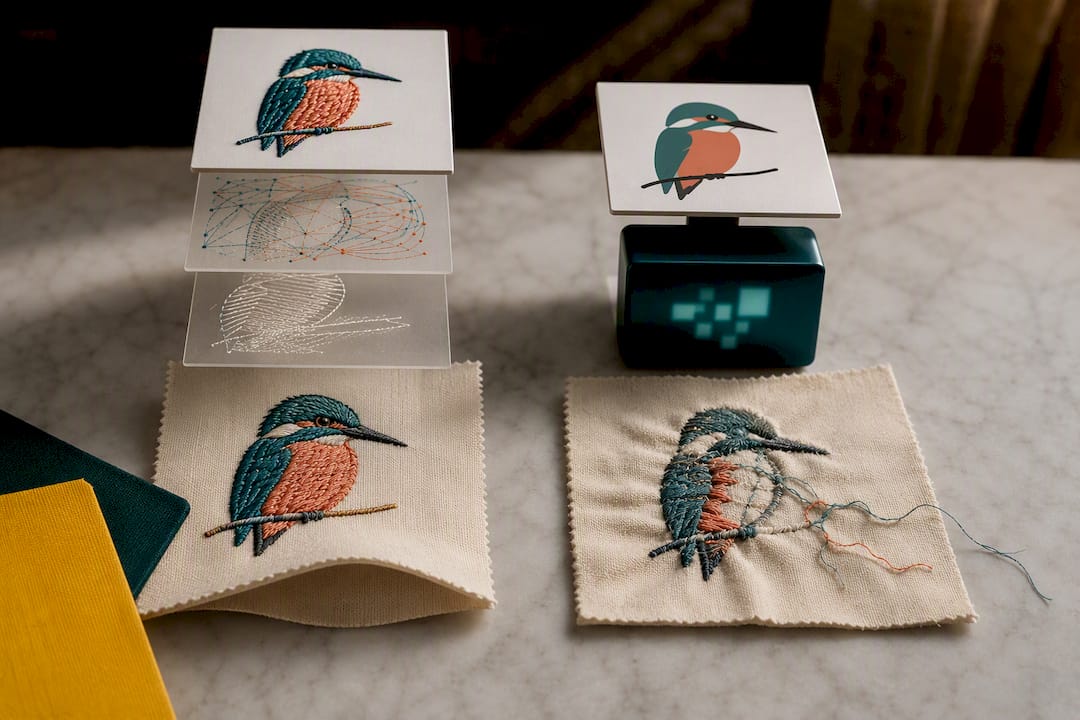
There’s also a real difference between manual digitizing and auto-digitizing software. A trained digitizer manually places stitch paths, sets underlay, and adjusts for fabric stretch. Auto-digitizing software guesses at all of that from a flat image, which is why it’s cheaper (or free) but frequently produces files that pucker, gap, or jam a machine mid run.
Here’s how typical digitizing fee bands break down by job type:
Cap digitizing sits in its own category because the digitizer has to account for the curved surface and hoop tension, which is why even a small cap logo can cost as much as a medium flat design. Jacket backs cost more mostly because of sheer stitch volume, not extra difficulty.
Per-1,000 Stitches or Flat-Rate Tiers: Which Pricing Model Costs Less?
Every embroidery digitizing service prices its work one of two ways, and knowing which one you’re looking at changes how you read a quote.
- Per-1,000 stitches. The shop charges roughly $1 to $4 for every 1,000 stitches in your design. A 10,000-stitch logo at $2 per 1,000 comes to $20. This model rewards simple, low-density designs and penalizes dense fill work, so it tends to favor buyers with lighter artwork.
- Flat-rate tiers. The shop sets a fixed price for a size category, such as $15 for “small logo” or $45 for “jacket back,” regardless of exact stitch count within that band. This is more predictable for budgeting but can feel unfair if your design lands at the low end of a tier.
- Minimums and entry fees. Many shops set a floor of $10 to $15 per design no matter how small the job is, since setup time doesn’t shrink much even on a tiny logo. Always ask whether the quoted price includes this minimum or sits on top of it.
Flat tiers work best if you order the same style repeatedly and want to forecast costs without recalculating stitch counts each time. Per-stitch pricing works better for one-off jobs where your artwork is genuinely simple and you want to avoid overpaying a flat minimum.
What Actually Drives Embroidery Digitizing Prices?
Stitch count is the single biggest factor in your final fee, because it determines machine run time, thread consumption, and the amount of manual path work the digitizer has to do. Everything else on this list either adds stitches or adds labor.
- Stitch count. More stitches mean more machine minutes and more thread, so cost scales with it almost linearly.
- Art complexity. Fine text under a quarter inch, overlapping shapes, and color gradients all require extra digitizing steps to keep the stitching clean.
- Number of colors. Each color change means a thread stop, and digitizers have to sequence colors to minimize machine stops without sacrificing the design’s look.
- Placement and fabric. Caps need curved-surface compensation; stretchy knits and thin performance fabrics need extra underlay and stabilizer planning to prevent puckering.
- Specialty techniques. 3D puff requires foam-height calculations and a different stitch sequence; appliqué needs placement and tack-down stitches; chenille needs a looped-stitch path most standard files don’t include.
- Turnaround and region. Rush jobs and shops in higher-cost metro areas typically charge more per design than standard-turnaround, lower-overhead providers.
How Do You Estimate Stitch Count Before You Get a Quote?
Stitch count isn’t just about how big your logo looks. A 3-inch by 3-inch design that’s mostly outline might run 3,000 stitches, while the same size filled solid could hit 10,000, because filled areas and every color change add stitches that outline work simply doesn’t need.
Here’s a rough method to estimate before you ever request a quote:
- Measure your design’s finished dimensions in inches, then estimate what percentage of that area is solid fill versus outline or open space.
- Apply a rough density rate. Filled areas typically run 800 to 1,200 stitches per square inch; outline and light detail run far lower, closer to 100 to 300 stitches per inch of line.
- Add stitches for color changes and specialty elements, since each thread stop and each puff or appliqué section adds its own stitch block on top of the base design.
Typical stitch bands run 1,000 to 5,000 for small, simple designs; 5,000 to 25,000 for medium designs; and 25,000 to 100,000-plus for large, dense pieces, according to stitch-count guidance from StitchCraft. Your quote should fall in line with whichever band your design lands in.
Three quick worked examples:
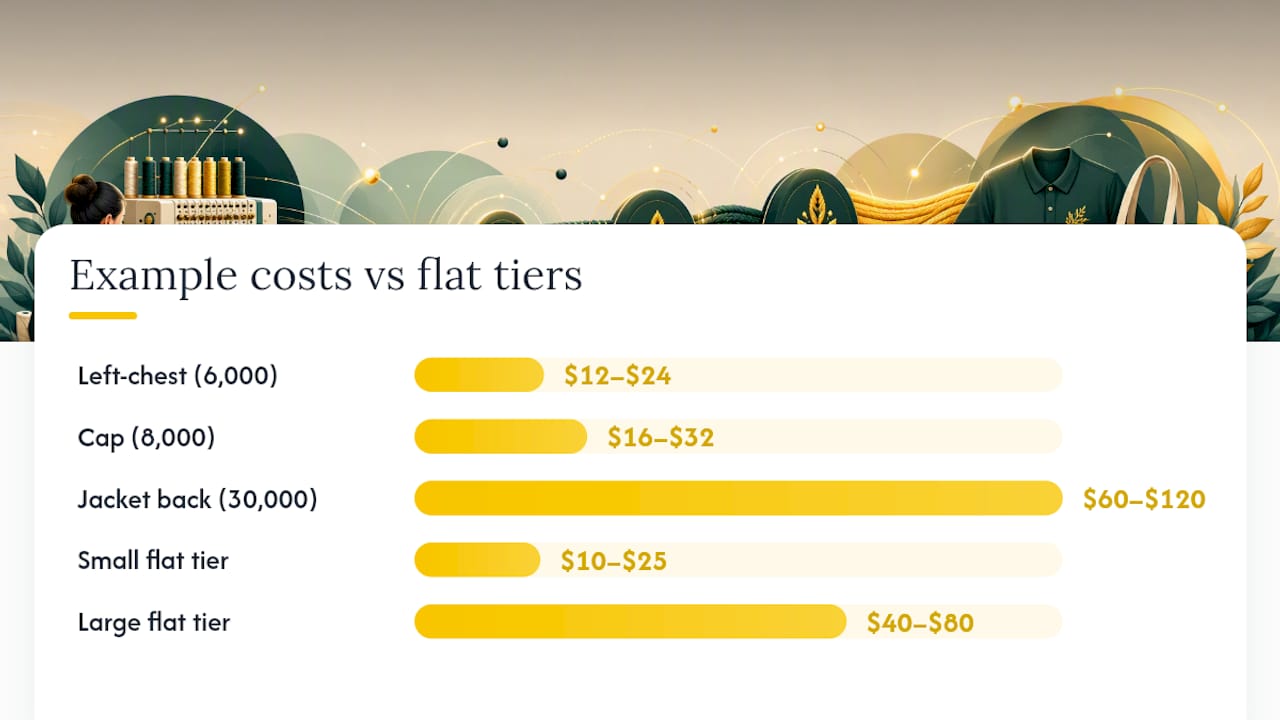
A left-chest logo at 6,000 stitches costs $12 to $24 at $2 to $4 per 1,000 stitches, or lands in the $10 to $25 flat-tier band for small logos. A cap logo at 8,000 stitches runs $16 to $32 per-stitch, or fits the $10 to $25 flat tier most shops set for caps. A jacket back at 30,000 stitches costs $60 to $120 per-stitch, well above the $40 to $80 flat-tier range many shops quote for large designs, which is why flat tiers often save money on big jobs.
What Extra Fees Should You Confirm Before Ordering?
A clean quote should spell out turnaround, revision policy, and file ownership before you pay anything. Skipping this step is how a $20 logo turns into a $50 headache.
- Turnaround windows. Standard turnaround runs 24 to 48 hours at most shops; rush or same-day service commonly adds $5 to $20 or a percentage premium on top of the base fee.
- Revisions. Minor tweaks like resizing or a color swap are usually free within the first round; a full redesign or a change after production has started often carries a separate charge.
- File formats and rights. Confirm you’re getting a production-ready format (DST, PES, or EMB, depending on your machine) and that you own the file outright for future reorders.
- Small-print fees. Watch for per-design minimums that apply even to tiny logos, cancellation fees if you pull an order mid-digitizing, and rework charges if the first file doesn’t sew out cleanly.
Rock-bottom automated files sometimes skip underlay and stitch compensation entirely, which causes puckering and thread breaks that cost you more in wasted fabric than you saved on the file.
How Can You Lower Your Digitizing Cost Per Item?
Digitizing is a one-time fee per design, so the file you pay for today gets reused on every future reorder without a second charge. That single fact is the most useful budgeting lever a small business has.
Run the math on two scenarios: a 20-piece order and a 200-piece order, both using a $30 digitizing fee. On the small run, digitizing adds $1.50 to the cost of each piece. On the large run, that same fee adds just $0.15 per piece. The file doesn’t change. Only how many times you spread the cost across does.
A few ways to keep the fee itself lower:
- Cut colors and fill. Fewer thread changes and less solid fill area mean fewer stitches, which lowers both the digitizing fee and the embroidery run time.
- Simplify small text. Enlarging tiny lettering or converting it to a bolder font reduces the stitch density needed to keep it legible.
- Choose manual digitizing for anything customer-facing. Auto-digitizing can work for a quick internal test sew, but a manually digitized file sews out cleaner on caps, jackets, and stretch fabrics.
Pro Tip: Always ask your digitizer for a stitch-count estimate before you approve the file, and save the finished digitizing file yourself. Reordering the same logo later should cost you nothing but production, not another design fee.
Why Most Buyers Budget This Wrong
Most advice on embroidery digitizing cost treats the digitizing fee like it’s the whole price tag. It isn’t. The fee you pay upfront covers file creation, but machine time, thread, stabilizer, and finishing all stack on top of it once you move to production, and buyers who forget that get blindsided at checkout.
The bigger blind spot, though, is stitch count. Buyers fixate on the dollar figure in a quote without ever asking how many stitches back it up. A $15 quote on a 15,000 stitch design should raise your eyebrows, not relax you. That number is either a mistake or a warning sign about file quality.
If there’s one habit worth building, it’s this: request the stitch count before you request the price. Once you know the stitch band your design falls into, you can tell instantly whether a quote is fair, cheap for a reason, or padded. That single question does more for your budget than any amount of shopping around.
— Bilal
Get a Digitizing Quote and Sample From Lee Embroidery
Comparing pricing models and stitch counts only gets you so far when what you actually need is a finished file that sews out clean the first time. Some embroidery digitizing services offer rapid quote turnaround and complimentary samples, allowing you to assess stitch quality before committing to a full production run.

When you request a quote, ask for three things upfront: a stitch-count estimate for your design, the shop’s revision policy in writing, and confirmation of which file formats you’ll own once digitizing is done. Leeembroidery’s Left Chest, Cap, and Jacket Back digitizing services list pricing plainly, starting at $10 for left-chest and cap work and from $30 for jacket backs, so you know the number before you commit. Once your file is ready, it carries straight into production for custom patches built from the same design. Head to the digitizing page and request your free sample today.
Sources
The price bands and stitch-count math in this guide draw on current market rate tables and pricing breakdowns from working embroidery and digitizing shops. The Embroidery Pricing Calculator from Needle Down supplied the fee bands by design type and the specialty-technique cost notes. The digitizing cost guide from DigitizingU provided the per-1,000-stitch and flat-tier pricing models along with turnaround norms. The stitch count guide from StitchCraft backed the stitch-count bands used in the estimation examples.
- Embroidery Pricing Calculator: Rates, Costs, and Tables | Needle Down
- Embroidery digitizing cost guide | DigitizingU
- Cross Stitch Count Guide: How Many Stitches Do You Need? | StitchCraft
FAQ
Can I Digitize Embroidery for Free?
Some free auto-digitizing software exists, and a handful of shops offer free digitizing when bundled with a large patch or apparel order. Free files usually skip underlay and stitch compensation, so they’re best treated as test runs rather than production-ready files.
How Hard Is It to Digitize for Embroidery?
Manual digitizing takes real skill because the digitizer has to set stitch direction, underlay, and density to match the fabric and design, not just trace an outline. That’s why professional digitizing carries a fee even for small designs, typically $10 to $25 for a simple logo.
Can AI Do Embroidery Digitizing?
AI and auto-digitizing tools can generate a rough stitch file from an image quickly, but they still struggle with fabric-specific adjustments like stretch compensation on knits or curve handling on caps. Most shops still recommend manual review or full manual digitizing for anything going into production at volume.
How Much Does It Cost to Embroider 1,000 Stitches?
Standard per-stitch pricing runs about $1 to $3 per 1,000 stitches for the digitizing fee itself, separate from actual embroidery production costs. A 10,000-stitch logo at that rate would cost roughly $10 to $30 to digitize before any stitching happens.
What Does Embroidery Digitizing Cost at Lee Embroidery?
Leeembroidery prices left-chest and cap digitizing at $10 each, and jacket-back digitizing starts at $30, all listed on the embroidery digitizing page. Every quote includes a complimentary sample so you can check stitch quality before ordering production runs.