Sew-on backing gives you the strongest, most wash-resistant bond, so choose it for uniforms and gear that gets heavy use. Heat-seal (iron-on) works fast and permanently on most cotton and polyester blends. Peel-and-stick suits quick, temporary placements. Velcro (hook-and-loop) is your answer when patches need to come off and go back on.
TL;DR:
- Sew-on patches provide the highest durability for high-wear applications, as stitching offers a mechanical bond resistant to washing and heat.
- Heat-seal backing is suitable for quick, permanent attachment on cotton or polyester but requires waiting approximately 48 hours for full adhesiveness before washing.
- Peel-and-stick patches are fast to apply but weaker against laundering, heat, and solvents, making them less ideal for frequent washing or heavy use.
- Adhesive performance varies significantly with patch material; porous fabrics accept heat-seal better, while non-porous surfaces like PVC and leather often require sewing or surface preparation.
- Combining heat-seal with a perimeter stitch enhances longevity on uniforms and jackets, especially when patches face daily handling and washing.
Table of Contents
- 1. What are the main patch backing and adhesive types?
- 2. How does patch material change your adhesive choice?
- 3. What are the application steps for each backing method?
- 4. Why do patches peel, and how do you fix it?
- 5. What causes an adhesive to bond in the first place?
- 6. Are patch adhesives safe to use and handle?
- 7. How should you store patches to protect adhesive strength?
- 8. Which adhesives work best across different fabric textures?
- 9. How does Lee Embroidery help you choose the right backing?
- 10. How do you order the right backing from Lee Embroidery?
- 11. Where can you find the technical data behind these adhesives?
- Sources
- FAQ
1. What are the main patch backing and adhesive types?
Every patch backing works a little differently, and knowing the mechanism helps you predict how it will hold up on the fabric you actually have.
Heat-seal backing uses a heat-activated adhesive film, often called thermofoil, that bonds when pressure and heat are applied. Manufacturers typically offer two versions: one built for a household iron and one built for a commercial heat press, and the BSN heat-seal technical documentation lists specific temperatures and dwell times for each, along with a recommendation to run a test piece before committing to a full batch.
Sew-on backing skips adhesive chemistry entirely. The patch gets stitched to the garment, either around the edge or across the full surface, which gives you the highest mechanical strength of any method.
Peel-and-stick patches use a pressure-sensitive adhesive layer that bonds on contact. It is the easiest option to apply, but it trades that convenience for lower resistance to washing, heat, and solvents.
Velcro backing is a two-piece system: a hook side and a loop side. Usually the loop goes on the patch and the hook (or vice versa) gets sewn onto the garment, letting you swap patches in and out without damaging either surface.
- Heat-seal: bonds with heat and pressure, permanent once cured, works best on flat, uncoated fabric.
- Sew-on: stitched attachment, highest durability, fits almost any surface that can take a needle.
- Peel-and-stick: pressure-sensitive, fast to apply, weaker against washing and heat.
- Velcro: removable hook-and-loop pairing, ideal for patches you plan to reposition.
One caveat worth flagging early: PVC and leather patches do not always play well with standard adhesives. Non-porous surfaces and oily leather finishes can resist bonding unless you prep the surface first or skip adhesive altogether in favor of stitching.
2. How does patch material change your adhesive choice?
The backing that works beautifully on an embroidered patch can fail completely on PVC or leather, because each material has a different surface for the adhesive to grip.
Embroidered patches, made from woven cotton or polyester threads, generally accept heat-seal backing well since the fabric surface is porous enough for the adhesive to key into. If the garment gets washed often or has a textured weave, sew-on is the safer bet for long-term hold.
PVC patches present a tougher case. Many are attached with strong specialty adhesives or sewn directly, since their molded rubber surface does not always bond the same way fabric does. Heat is also a risk: enough of it can warp the PVC itself, so confirm application temperature with the manufacturer before pressing.
Leather patches are the trickiest of the three. Oily or finished leather surfaces often reject adhesive entirely, which is why sewing is usually the safest attachment method. Light surface preparation, like a clean wipe with the right solvent, can sometimes improve adhesion, but it is not a guarantee.
Coated or technical fabrics deserve their own caution. Water-repellent shells, silicone-coated jackets, and deep-pile fleece can all block a bond that would work fine on plain cotton. Always test before running a full order.
- Embroidered patches: heat-seal for light use, sew-on for frequent washing or textured fabric.
- PVC patches: strong adhesive or sewing, confirm heat tolerance with the manufacturer.
- Leather patches: sew-on is generally the most reliable, with adhesive as a secondary option only after surface prep.
- Coated or technical fabrics: test first, since repellents and coatings can prevent bonding altogether.
For team uniforms, jackets, or anything that sees daily wear, combining heat-seal with an edge stitch gives you the speed of adhesive backing plus a mechanical backup that keeps the patch from lifting at the corners.
Pro Tip: Always press or sew a sample patch onto a scrap of the actual garment fabric before committing to a full production run, since the same backing can perform completely differently on a coated shell versus plain cotton.
3. What are the application steps for each backing method?
Getting the technique right matters as much as picking the right backing in the first place. Here is how to approach each one.
- Heat-seal: Iron or heat-press the base fabric flat first, place the patch, and cover it with silicone protective paper before applying heat. The BSN technical documentation lists separate temperature and dwell-time settings for iron application (Type H) and heat-press application (Type I), and recommends a test run before full production. Full adhesive strength develops over time rather than instantly.
- Sew-on: Position the patch carefully since stitching is hard to undo cleanly, then use a running stitch for lightweight patches or a whip stitch for thicker embroidery or PVC. Reinforce heavy patches with a double pass around the perimeter and finish edges neatly to prevent fraying.
- Peel-and-stick: Clean and dry the surface completely, then press the patch firmly and hold for several seconds to activate the bond. Avoid machine washing when you can, and if you must wash the garment, turn it inside out and use a gentle cycle.
- Velcro: Match the hook side to the loop side carefully, checking that loop density is high enough for the load the patch will carry. Sew both pieces on for permanent placements, or use an industrial adhesive backing when sewing is not practical, though sewing generally holds better under repeated removal and reattachment.
Statistic Callout: The BSN heat-seal technical PDF notes that heat-seal adhesive reaches full adhesiveness after 48 hours, which is why waiting before the first wash matters more than most people expect.
For uniforms, jackets, or anything that takes daily abuse, specifying heat-seal plus a perimeter stitch at the order stage gives you a fast initial bond and a mechanical backup that keeps the patch anchored through years of washing.
4. Why do patches peel, and how do you fix it?
Durability comes down to backing type. Sew-on holds up best through repeated washing, while heat-seal and peel-and-stick both prefer gentler cycles and lower water temperatures to stay intact.
- Heat-seal lifting at the edges: Re-press the spot with protective paper and fresh heat, then add a light edge stitch if it happens again.
- Peel-and-stick corners curling: A small amount of fabric-safe adhesive can help temporarily, but treat it as a stopgap rather than a permanent fix.
- Recurring lift on high-wear items: Ask the manufacturer about switching to sew-on or a combined heat-seal-plus-stitch backing for the next order.
- Before any full wash: Test on a spare fabric swatch or an inconspicuous area first, then wait through the recommended cure time before laundering the whole garment.
5. What causes an adhesive to bond in the first place?
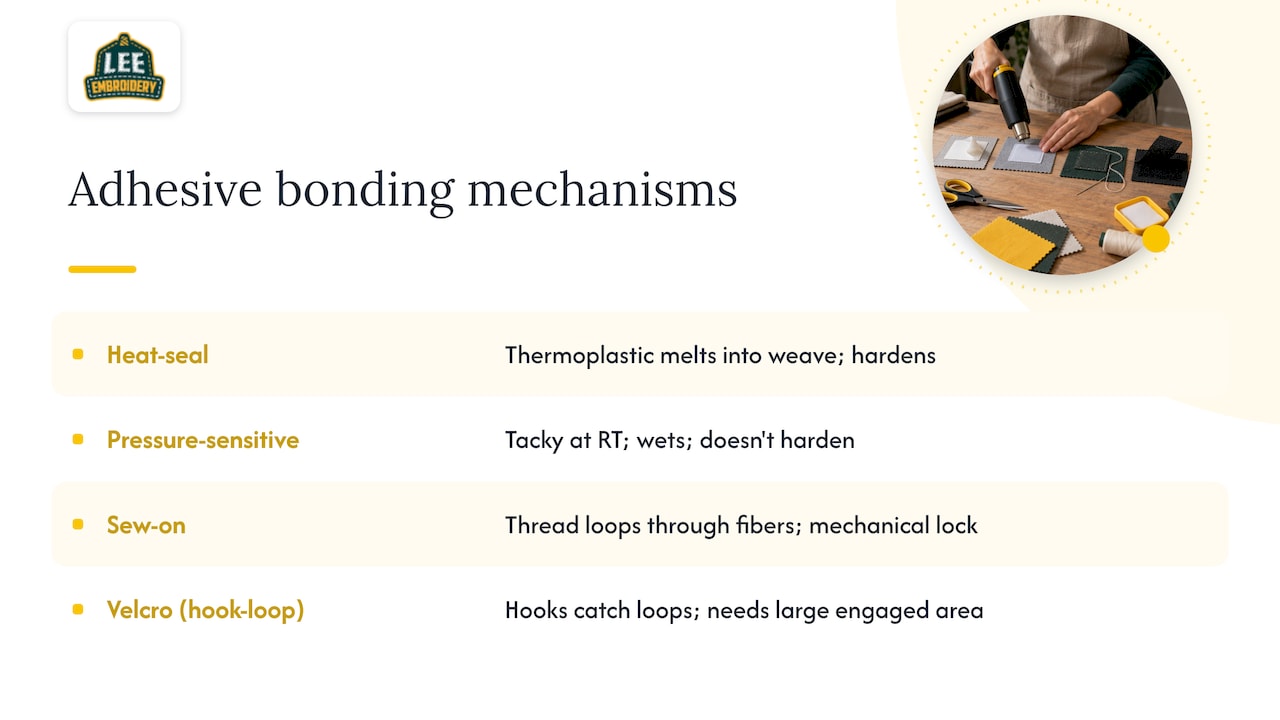
Adhesive bonding is a chemistry problem before it is a craft problem. Heat-seal films work through a thermoplastic layer that softens under heat, flows into the texture of the fabric surface, and then hardens again as it cools, mechanically gripping the threads it has settled into. That is why a flat, porous weave bonds far better than a slick or coated one: the adhesive has nothing to grip on a repellent finish.
Pressure-sensitive adhesives, the kind used in peel-and-stick patches, work differently. They stay tacky at room temperature and rely on light pressure alone to wet out across the surface and form a bond, without needing heat to activate. That immediacy is convenient, but it also means the bond never fully hardens the way a heat-cured adhesive does, which is part of why peel-and-stick options tend to loosen faster under stress or heat from a dryer.
Sew-on and Velcro backings skip adhesive chemistry entirely and rely on mechanical interlocking instead: thread looping through fabric fibers, or hundreds of tiny hooks catching loops. That is a large part of why they tend to outlast adhesive-based methods on items that get washed or handled often. Retention on a hook-and-loop pairing depends heavily on engaged surface area and loop density, and a full-perimeter sewn attachment consistently holds up better under shear and peel forces than a small adhesive-backed Velcro square.
6. Are patch adhesives safe to use and handle?
Most adhesive backings used on embroidered, PVC, and woven patches are solid at room temperature and only become workable under heat or pressure, which limits your exposure compared to liquid or spray adhesives. Still, a few practical points are worth keeping in mind.
Heat-seal application involves an iron or heat press, so proper ventilation in the workspace is a reasonable precaution, especially with PVC or synthetic-backed patches where heating any plastic material can release some odor. Working in a ventilated room and avoiding prolonged direct contact with a hot press head are simple habits that reduce any concern.
Peel-and-stick adhesives are pressure-sensitive rather than solvent-based, so they carry less handling risk day to day, though it is still sensible to avoid prolonged skin contact with any exposed adhesive edge. If you are removing old adhesive residue from a garment before reapplying a new patch, a dedicated adhesive-removal product designed for fabric, such as those detailed by CryoMode’s adhesive residue guidance, is a safer route than harsh household solvents that can damage the fabric underneath.
7. How should you store patches to protect adhesive strength?
Adhesive backings are sensitive to their environment even before you apply them, and poor storage can quietly ruin a batch before it ever reaches a garment.
Heat and humidity are the two biggest threats to heat-seal film. Store patches in a cool, dry space away from direct sunlight or heating vents, since warmth can cause premature tackiness or an uneven bond once you finally apply heat. Peel-and-stick patches are even more sensitive: exposure to heat or dust before application can weaken the pressure-sensitive layer, so keeping them in their original packaging until you are ready to use them protects the bond you are counting on.
Humidity matters for sew-on and Velcro backings too, though for a different reason: damp storage can encourage mildew on the patch material itself, particularly with leather or PVC. A sealed container with a moisture-absorbing packet is a simple fix for anyone storing patches in bulk for an extended period.
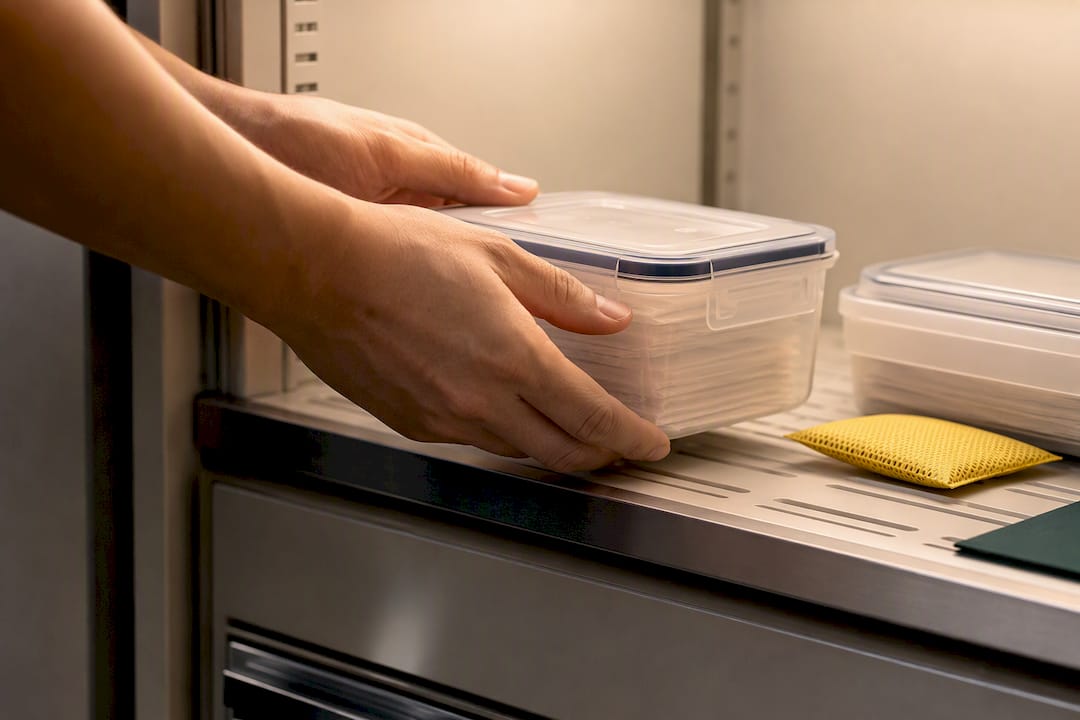
If you are ordering a large batch for a future event or uniform rollout, ask your manufacturer how the patches were packaged for shipping and how long the adhesive backing is expected to hold its properties in storage before you plan to apply it.
8. Which adhesives work best across different fabric textures?
Fabric texture changes everything about how an adhesive performs, which is why the same backing can be a perfect fit on one garment and a poor one on another.
Smooth, tightly woven fabrics like cotton twill or polyester blends give heat-seal adhesive the flattest, most consistent surface to bond to, which is why most embroidered patches ship with heat-seal as a default option. Looser or textured weaves, like canvas or ripstop, can still accept heat-seal, but the bond may not reach every fiber evenly, making a supporting stitch a smart addition.
Deep-pile fabrics such as fleece or faux fur are a different story. The adhesive often cannot reach the base fabric through the pile, so sew-on is close to the only reliable option. Technical fabrics with a water-repellent or silicone coating carry the same problem: the coating is specifically designed to resist things sticking to it, adhesive included.
Leather and PVC sit at the far end of the spectrum. Both are non-porous, and PVC patches are frequently attached with either a strong specialty adhesive or sewing rather than a standard heat-seal film. Whatever the fabric, a quick test patch on an inconspicuous area remains the most dependable way to confirm a bond before committing to a full run.
9. How does Lee Embroidery help you choose the right backing?
Custom patch manufacturers typically offer embroidered, PVC, and leather patches, with backing options including sew-on, heat-seal, peel-and-stick, and Velcro available. Samples and rapid quote turnaround can help test a backing on your actual fabric before committing to a bulk run, which matters given how much backing performance depends on the specific garment.
As a general pattern, sew-on suits uniforms and heavy-use gear, heat-seal fits fast turnarounds on cotton and polyester blends, and Velcro works when patches need to come off and go back on.
— Bilal
10. How do you order the right backing from Lee Embroidery?
Picking the right backing gets a lot easier when you can hold a real sample in your hand instead of guessing from a spec sheet. Ordering processes for custom patches often allow choosing patch type, specifying preferred backing on the order form, or requesting samples first to test on your own fabric.

- Start at the Custom Patches landing page to compare patch types and backing options.
- Browse specific product pages like Embroidered Patches, PVC Rubber Patches, or Leather Patches for material-specific backing notes.
- Request a complimentary sample before your bulk order to confirm the backing holds up on your garment.
- Get a rapid quote once you have settled on patch type, backing, and quantity, with quality checks built into production before your order ships.
11. Where can you find the technical data behind these adhesives?
For exact application temperatures and dwell times, check the BSN heat-seal technical PDF. For hook-and-loop strength and fastener specs, see the Halco hook-and-loop technical data sheet. Always confirm exact wash and temperature ratings with your manufacturer before a production run.
Sources
FAQ
What is the strongest adhesive for patches?
Sew-on backing is the strongest attachment method overall since it relies on stitching rather than adhesive chemistry, giving it the highest resistance to washing and daily wear. Heat-seal comes close on suitable fabrics once it reaches full adhesiveness, which the BSN technical documentation notes takes about 48 hours after application.
Why does my patch keep peeling off?
Peeling usually happens when the adhesive was applied at the wrong temperature, the fabric surface was coated or textured in a way that resisted bonding, or the garment was washed before the adhesive finished curing. Re-pressing the spot with protective paper or adding an edge stitch typically solves recurring lift.
Can you iron on a patch to leather or PVC?
Standard heat-seal film often does not bond reliably to leather or PVC, since both are non-porous and PVC can warp under heat. Sewing is generally the safer method for these materials, with a specialty adhesive as a secondary option only after checking with the manufacturer.
How long should you wait before washing a new patch?
For heat-seal patches, waiting at least the manufacturer’s recommended curing period protects the bond, since the BSN technical PDF notes full adhesiveness develops around 48 hours after application. Sew-on patches do not need a waiting period since the attachment is mechanical rather than chemical.
Is Velcro backing strong enough for heavy patches?
Velcro can hold heavy patches securely when the loop density is high enough and the hook-and-loop pieces are sewn on rather than adhesive-backed, since the Halco technical data sheet notes standard nylon hook-and-loop offers high peel and shear strength. For maximum load, choose sewn Velcro over small adhesive-backed squares.