Velcro patches can be reliably strong for many durable uses, but the right choice depends on which force is working against them. Peel, shear, and tension are the three metrics that matter, and a standard medium-profile fastener holds around 4.2 pounds per inch of width in peel, roughly 12 PSI in shear, and about 7.5 PSI in tension. Identify your dominant force first, and lean toward sew-on backing when the patch faces repeated use or harsh conditions.
TL;DR:
- Velcro peel strength averages around 4.2 pounds per inch of width, making peel the weakest force among peel, shear, and tension.
- Adhesive-backed patches typically reach about 80% of their full bond strength within one hour and require 24 to 30 hours to fully cure.
- Sew-on patches are preferable for harsh environments or frequent washing since they do not depend on adhesives that degrade over time.
- Metal, glass, and high-energy plastics provide the best adhesion for patch backing, while low-energy plastics like polyethylene resist bonding and need mechanical fastening.
- When selecting Velcro for a specific application, identify the dominant force, estimate the load with safety margins, and consider the surface compatibility and environment.
Table of Contents
- Peel, shear, and tension: definitions, units, and example values
- Adhesive chemistries and backing options for patches
- How to pick the right strength and cycle rating
- Substrate compatibility and surface preparation
- Sew-on versus adhesive-backed durability
- How Lee Embroidery approaches strength-focused patch production
- Get a sample before you commit to a backing
- Sources
- FAQ
Peel, shear, and tension: definitions, units, and example values
Peel strength measures resistance when one side is lifted away at an angle, the way a patch corner catches on a doorframe or backpack strap. Shear strength measures resistance when two surfaces slide past each other while pressed together, common on a jacket sleeve brushing against a car door. Tension strength measures straight pull-apart force, like a patch mounted flat against a wall bracket getting yanked directly outward.
VELCRO® Brand’s own technical guidance gives reference figures for standard medium-profile fasteners that help translate a spec sheet into real-world expectations:
- Peel strength: around 4.2 pounds per inch of width (PIW), tested to a method like ASTM D5170.
- Shear strength: roughly 12 PSI, the force resisting sideways sliding under compression.
- Tension strength: about 7.5 PSI, the force resisting a direct pull straight off the surface.
Peel is usually the weakest of the three, which is why a patch that survives daily wear can still fail at a lifted edge. ASTM testing averages peak values across multiple pulls rather than relying on a single reading, since peel results vary from sample to sample.
Adhesive chemistries and backing options for patches
Adhesive-backed patches rely on one of three chemistries: rubber-based, acrylic, or heat and solvent-activated adhesives. Each behaves differently under load and temperature, and manufacturer adhesive guides lay out the cure timeline installers should plan around before trusting the bond to full weight.
- Rubber-based adhesives bond quickly but soften in heat, making them a poor fit for engine bays or direct sun exposure.
- Acrylic adhesives hold up better across a wider temperature range and resist aging longer than rubber-based formulas.
- Heat or solvent-activated adhesives need a curing step but produce the strongest permanent bond among adhesive-backed options.
Pressure-sensitive, iron-on, and sew-on are the three backing families, and substrate compatibility narrows the choice fast. Sew-on skips adhesive chemistry altogether, which is why it survives washing, UV, and humidity better than any stick-on option.
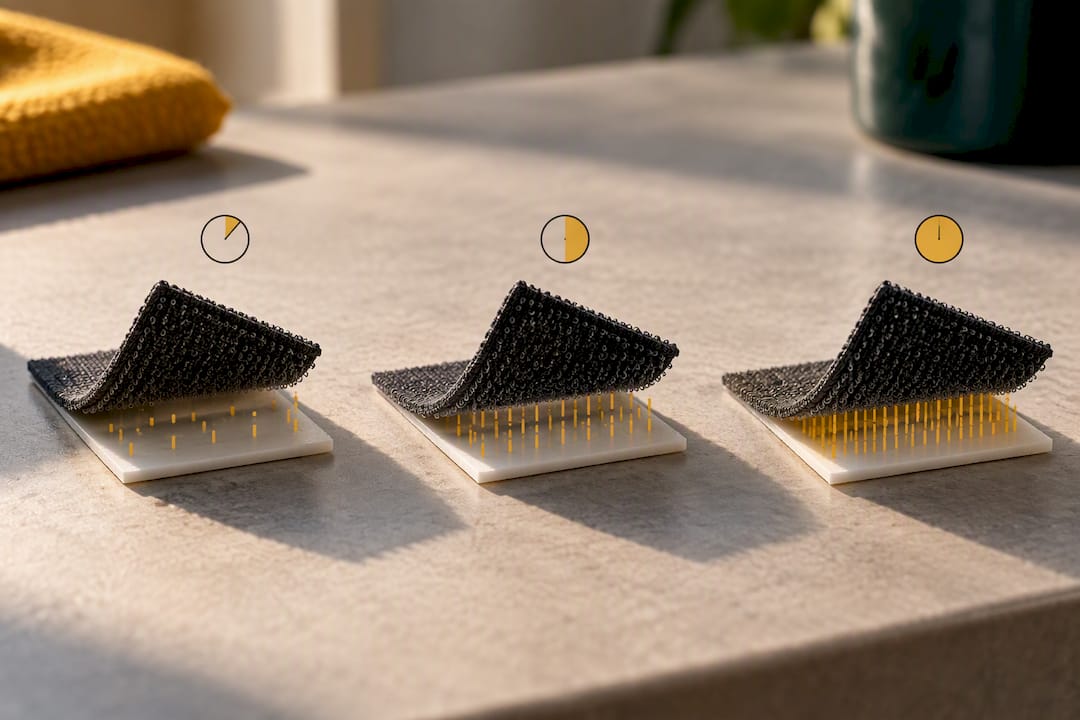
Adhesive-backed fasteners reach about 80% of their bond strength within roughly an hour, but full strength takes 24 to 30 hours to develop, according to VELCRO® Brand’s own adhesive guide. That window matters: a patch loaded before it cures is a patch that fails early.
How to pick the right strength and cycle rating
Specifying a hook-and-loop fastener for a real application comes down to three steps, and skipping any one of them is how patches end up under-rated for the job.
- Identify the dominant force. Ask whether the patch will mostly get lifted (peel), slid (shear), or pulled straight off (tension), since a patch rated well for one can still underperform in another.
- Estimate working load and contact area, then apply a safety factor. Divide the expected load by the contact area to get a required PSI or PIW figure, then size up rather than cutting it close.
- Set a cycle life target. Apparel that opens and closes daily needs a higher-cycle grade than a patch that gets mounted once and left alone.
A 2-pound backpack patch facing occasional peel from a loose strap needs far less holding power than a ceiling-mounted item fighting constant tension against gravity, even though both might look similar on paper.
Pro Tip: When in doubt between two grades, size up one level rather than down, since real-world peel forces are almost always higher than the calculated estimate.
Substrate compatibility and surface preparation
Not every surface accepts adhesive-backed hook-and-loop the same way. Metal, glass, and medium-to-high-energy plastics bond reliably, while polyethylene, polypropylene, and some textured or oily surfaces resist adhesion no matter how heavy-duty the strip. Manufacturer datasheets flag these low-energy plastics specifically as candidates for mechanical fastening instead.
- Degrease the surface with isopropyl alcohol before applying any adhesive-backed patch.
- Roughen slick or glossy substrates lightly to give the adhesive something to grip.
- Apply within the ideal window, generally 65 to 75°F and 40 to 65% relative humidity, per adhesive guide recommendations.
- Let the bond cure fully before loading the patch, rather than testing it right after installation.
Pro Tip: Round the corners of adhesive-backed patches and press firmly from the center outward, since square edges are where peel failure almost always starts.
Sew-on versus adhesive-backed durability
Sew-on wins outright when UV exposure, heat, repeated washing, or high-cycle use is involved, since it never depends on a chemical bond that can degrade. Independent testing from Practical Sailor found that textile hook-and-loop products age poorly under UV and humidity, and recommended sew-on installation for marine and other harsh environments.
- Choose sew-on for garments, outdoor gear, tactical equipment, and anything washed regularly.
- Adhesive-backed is acceptable for temporary interior mounts, low-load displays, or short-term signage.
- Clean loop panels periodically with a stiff brush, since trapped lint and debris are what usually cause grip to fade over time.
The hook side typically outlasts the loop side for exactly that reason: loops collect debris faster than hooks shed it.
How Lee Embroidery approaches strength-focused patch production
Some custom patch providers build embroidered, PVC, and leather patches with a choice of sew-on or Velcro backing, so the attachment method matches the job rather than defaulting to whatever is easiest to produce. Some companies offer complimentary samples and a rapid quote turnaround, which gives you a chance to test peel and shear resistance on your actual material before committing to a bulk run. This sample-first workflow helps answer specification questions, including sew-on versus adhesive, with a patch in hand instead of a guess on paper.
— Bilal
Get a sample before you commit to a backing
You do not have to choose a backing blind. Companies may ship complimentary samples so you can test peel and shear resistance on your own gear before ordering, with quote turnaround fast enough to keep a project moving.

If your application faces repeated cycles, heat, or moisture, tell us the dominant force and expected use, and we will point you toward sew-on or a heavy-duty adhesive backing accordingly. Browse Custom Patches for all backing options, or go straight to embroidered patches if sew-on durability is the priority. For logo digitizing on a Left Chest, Cap, or Jacket Back placement, pricing starts at $10 for Left Chest and Cap, and from $30 for Jacket Back.
Sources
- How do VELCRO® Brand fasteners work? | VELCRO® Brand
- VELCRO® Brand adhesive guide (Anixter PDF)
- Getting a grip on Velcro — Practical Sailor
- ASTM D5170 — Standard Test Method for Peel Strength of Hook and Loop Touch Fasteners
FAQ
How many pounds can Velcro hold?
It depends on the strip and the force direction, not a single weight rating. Manufacturer datasheets list heavy-duty adhesive-backed strips holding roughly 10 to 15 pounds per strip depending on size and substrate, with some rated up to about 7 kilograms per 50mm by 100mm strip.
How strong is Velcro compared to other fasteners?
Strength varies by grade and force direction rather than a single number. A standard medium-profile fastener holds around 4.2 PIW in peel, 12 PSI in shear, and 7.5 PSI in tension, and heavy-duty grades exceed those figures substantially.
What surfaces do Velcro patches stick to best?
Metal, glass, and medium-to-high-energy plastics bond reliably with adhesive-backed hook-and-loop. Low-energy plastics like polyethylene and polypropylene resist adhesion and typically need sewing or a specialized adhesive instead, per manufacturer compatibility notes.
Are Velcro patches iron-on?
Some patches use a heat-activated iron-on backing, but that is separate from Velcro attachment itself. Lee Embroidery offers sew-on, iron-on, and Velcro backing options, so you can choose the method that fits your fabric and durability needs on the custom patches page.
Should I choose sew-on or adhesive-backed for heavy use?
Sew-on holds up better against UV, heat, washing, and repeated cycles, based on independent aging tests. Adhesive-backed options work fine for temporary or low-load interior mounts where the patch will not face regular wear.