Sew-on, iron-on, hook-and-loop, peel-and-stick, no backing, and specialty options like PVC or magnetic cover nearly every custom patch’s need. The right pick comes down to one simple rule: match permanence, fabric, laundering habits, and whether you want to move or reuse the patch later.
TL;DR:
- Sew-on backing provides the highest durability and is ideal for uniforms and heavily washed garments, but requires stitching which can be time-consuming.
- Iron-on backing offers quick application suitable for heat-tolerant fabrics, though its bond may weaken with excessive laundering or incompatible materials.
- Hook-and-loop fasteners are best for patches needing frequent removal or repositioning, but require maintenance, such as cleaning lint from the fastener.
- Peel-and-stick adhesives are designed for short-term use and can fail quickly if subjected to repeated washing or oils, emphasizing the need for testing before bulk orders.
- Combining heat-seal backing with a perimeter stitch is the safest choice for heavy-use garments, reducing the risk of patch detachment over time.
Table of Contents
- 1. What each backing type is and how it attaches
- 2. Pros, cons, and practical limits for each backing
- 3. How to choose the right backing for your project
- 4. Installation, removal, and care best practices
- 5. Why a professional maker matters for backing selection
- 6. What professionals recommend for heavy-use garments
- 7. Get the right backing on your next patch order
- 8. Research and manufacturer guidance behind this guide
- Sources
- FAQ
1. What each backing type is and how it attaches
Every backing does the same basic job, holding your design to fabric, but each one gets there differently, and that difference shapes how well it performs over time.
- Sew-on backing: a plain twill or felt backer stitched directly through the garment; the go-to for uniforms, jackets, and anything that takes a beating.
- Iron-on (heat-seal) backing: a heat-activated adhesive film that bonds when pressed with an iron or heat press; popular on caps, bags, and soft goods where sewing isn’t practical.
- Hook-and-loop (Velcro) backing: a two-piece fastener, one side on the patch, one sewn to the garment, letting you swap patches in seconds.
- Peel-and-stick adhesive backing: a pressure-sensitive film with a paper liner, pressed on by hand for events, samples, or short-term branding.
- No backing (pin or clutch): a metal pin or butterfly clutch pushed through fabric, used for badges, lapels, and temporary displays.
- Magnetic backing: a thin magnet paired with a metal plate behind the fabric, ideal when you can’t puncture the garment at all.
- Plastic/PVC backing: molded rubber or vinyl patches with an integrated backing, usually sewn or adhered, common on tactical gear and outdoor apparel.
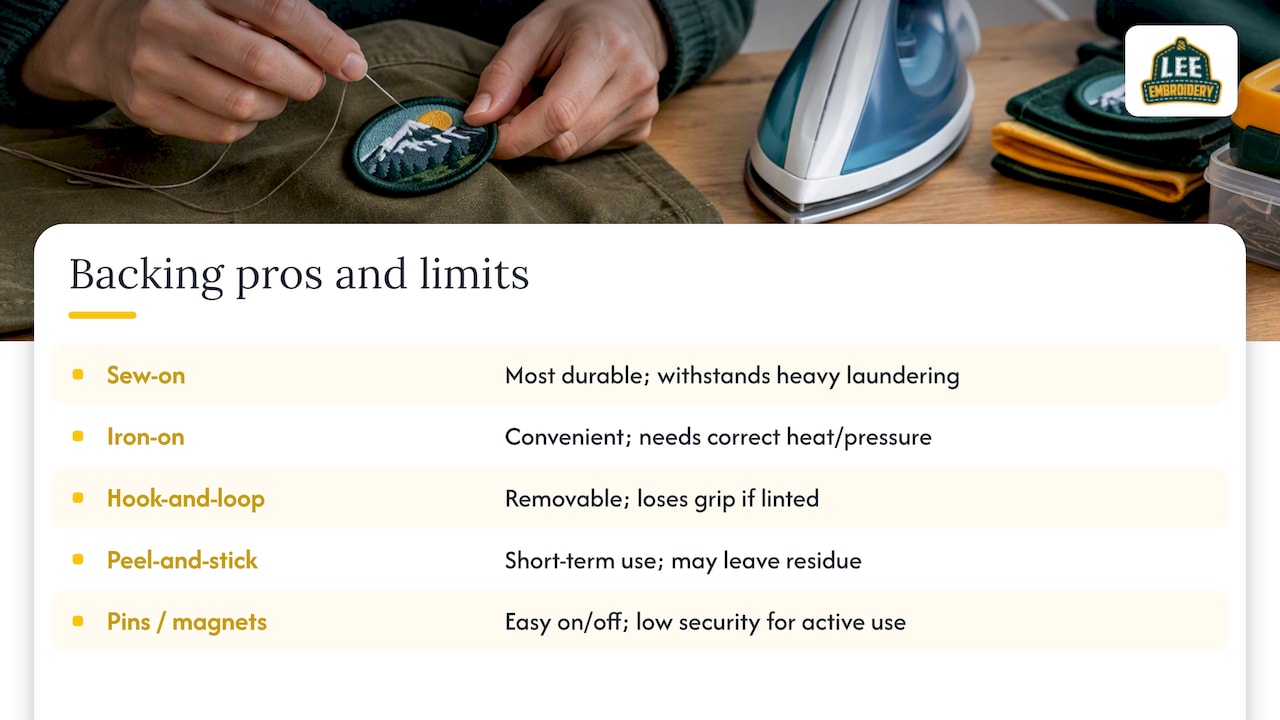
Durability tracks closely with method. Sew-on holds through extended periods of washing, iron-on depends heavily on fabric type and heat exposure, Velcro lasts if you maintain it, and peel-and-stick is built for short-term use. Pins and magnets trade longevity for convenience, and PVC backings add rigidity but restrict how thin or flexible the patch can be.
2. Pros, cons, and practical limits for each backing
Knowing what a backing is doesn’t tell you where it breaks down. The trade-offs matter more once a patch hits real-world wear.
Sew-on is considered the most durable option because the thread mechanically locks the patch to the fabric rather than relying on chemistry. It’s well-suited for uniforms, team gear, or items exposed to heavy-duty laundering.
Iron-on backing wins on convenience: no needle, no thread, just heat and pressure. But research into thermoplastic bonding shows that success depends on matching temperature, pressure, and dwell time to the material, and a poor match can damage delicate or coated fabrics or cause the bond to fail outright. For heavy-use uniforms, a perimeter stitch around the edge backs up the heat bond and prevents peeling at the corners.
Hook-and-loop earns its keep when patches need to move between garments, think interchangeable name tags or modular gear. The catch is maintenance: fasteners left open during washing collect lint and lose grip over time.
Peel-and-stick adhesive is built for short runs. Studies on adhesive selection for wearable textiles found that peel stability often predicts real-world performance better than peak peel strength, meaning a “stickier” adhesive on paper can still fail faster than one with a more consistent hold. Adhesive residue is the other downside, especially on fabrics that trap oils.
Pins, clutches, and magnets skip attachment problems entirely but sacrifice security. They’re fine for a trade show badge, less fine for something that needs to survive a hike. PVC and other molded backings add shape and heft that embroidered patches can’t match, but that rigidity means they almost always require sewing or a strong adhesive rather than heat-seal alone.
Pro Tip: Ask for a peel-test reference or sample before committing to adhesive backing on a large order, the number on a spec sheet rarely tells the whole story.
3. How to choose the right backing for your project
A short checklist beats guesswork every time. Work through these points before you finalize an order.
- Permanence: decide if the patch needs to stay put for years or just for an event.
- Fabric compatibility: check whether the garment can handle heat (for iron-on) or needle holes (for sew-on).
- Laundering frequency: frequent washing favors sew-on or a hybrid heat-bond-plus-stitch approach.
- Heat and industrial cleaning exposure: commercial laundering can weaken adhesives that hold up fine at home.
- Reusability: choose hook-and-loop if the patch needs to move between garments or team members.
A few quick mappings make this easier: uniforms call for sew-on or a sew-plus-heat combination, caps typically do well with heat-seal or sew-on, temporary giveaways fit peel-and-stick or pin backings, and modular patches belong on hook-and-loop.
Before placing an order, ask your manufacturer three things: what fabric the patch is going on, how the garment gets washed, and what edge finish (merrowed, embroidered, laser cut) pairs best with your chosen backing. Those three answers usually settle the decision.
4. Installation, removal, and care best practices
Getting the backing right is only half the job, applying and maintaining it correctly is what makes it last.
- Test heat-seal patches on a scrap of the actual fabric first, overheating can scorch material or weaken the bond.
- For heavy-use garments, combine heat-seal with a perimeter stitch rather than relying on adhesive alone.
- Use a zigzag or whipstitch with polyester thread for sew-on patches, and reinforce corners where stress concentrates.
- Close hook-and-loop fasteners before washing to stop lint buildup, a habit Velcro’s own product guidance recommends for preserving grip.
- Remove peel-and-stick residue with a citrus-based cleaner and spot-test on an inconspicuous area first.
Research context: adhesive formulation changes the reliable temperature window for heat seals, and nanocomposite sealant studies show that even small changes in material composition shift how a seal peels and fails under stress. That’s a big part of why two iron-on patches from different suppliers can behave so differently on the same jacket.
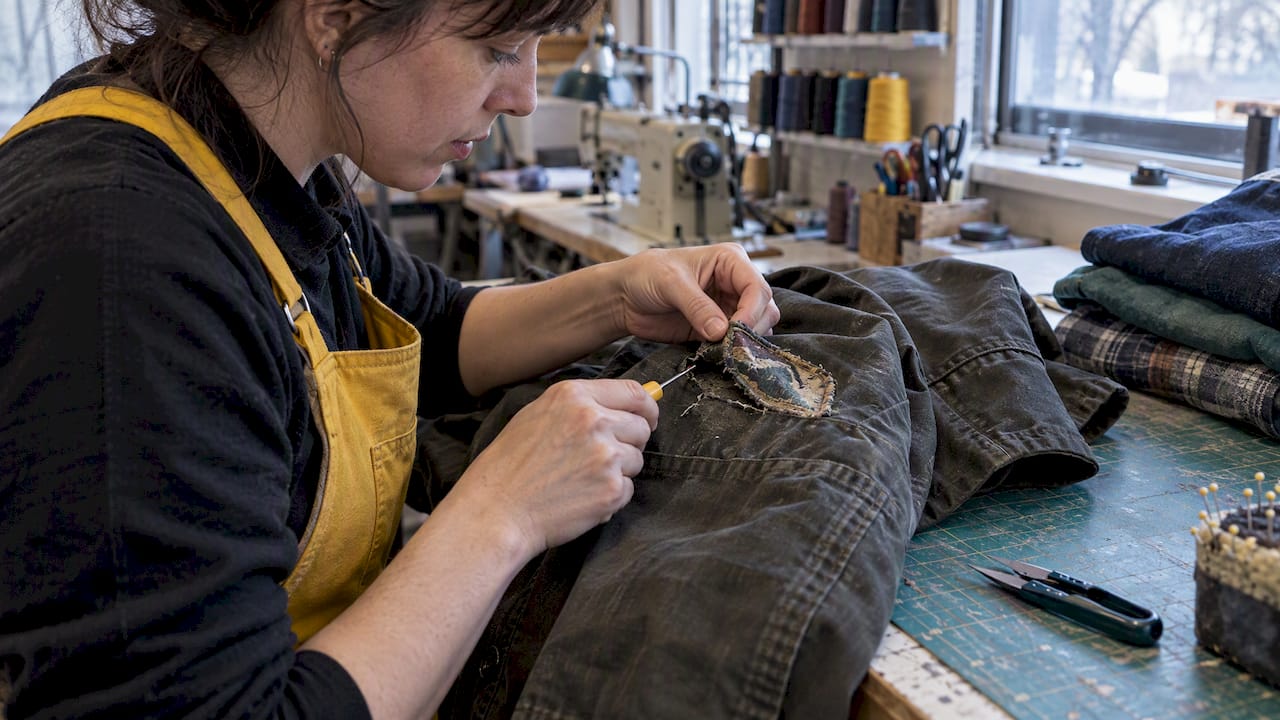
When a patch needs to come off a garment you care about, a professional can usually lift it without damaging the fabric underneath, especially with older adhesive or deeply stitched backings.
5. Why a professional maker matters for backing selection
Choosing backing gets easier with the right partner. Lee Embroidery offers sew-on, iron-on, peel-and-stick, and hook-and-loop backing across its custom patches, plus PVC and specialty options, along with embroidered patches, digitizing, and complimentary samples. A sample in hand and a quick consult catch fabric or laundering mismatches before they become a bulk-order problem.
6. What professionals recommend for heavy-use garments
For uniforms and industrial gear, the standard approach combines a heat bond with a perimeter stitch rather than trusting adhesive alone. Pair that with basic maintenance, closing Velcro before washing and spot-cleaning adhesive residue, and most backing failures never happen.
— Bilal
7. Get the right backing on your next patch order
You don’t have to guess which backing fits your project. Lee Embroidery builds custom patches with your choice of sew-on, iron-on, peel-and-stick, or hook-and-loop backing, backed by complimentary samples and a fast quote turnaround.

| Backing type | Best fit | Starting price |
|---|---|---|
| Custom Patches (any backing) | General orders, all backing types | from $99 |
| Left Chest digitizing | Small embroidery files | $10 |
| Cap digitizing | Cap embroidery files | $10 |
| Jacket Back digitizing | Large-format embroidery | from $30 |
Request a sample and a quote through Lee Embroidery’s patch page before you commit to a backing for your next run.
8. Research and manufacturer guidance behind this guide
- Thermoplastic bonding research: how bonding parameters affect garment seam durability.
- Peelable heat seal study: how sealant formulation changes heat-seal reliability.
- Adhesive selection for wearable textiles: peel stability versus peak peel strength.
- VELCRO® Brand product and care guidance: maintenance steps for hook-and-loop fasteners.
Sources
- Multi-Criteria Selection of Adhesives for Wearable Textiles
- Materials Science (Medžiagotyra) — Sewfree / thermal bonding research
- Journal of Adhesion Science and Technology — Nanocomposite sealants and peelable heat seals
FAQ
What kind of backing works best for patches?
The best backing depends on use: sew-on offers the most durability for frequent washing, while iron-on suits low-effort application on heat-tolerant fabrics. Hook-and-loop fits patches you need to swap often, and peel-and-stick works for short-term or promotional use.
What are the main types of patch backing?
Most patches use one of three core backings: sew-on, iron-on (heat-seal), or hook-and-loop. Specialty options like peel-and-stick adhesive, pin or clutch, and magnetic backings cover more specific or temporary needs.
What is the best material for a back patch?
Sew-on backing is generally the strongest choice for large back patches on jackets and uniforms because stitching handles the weight and stress better than adhesive or heat-seal alone. For heavy-use garments, pairing a heat bond with a perimeter stitch adds extra security.
What backing options are available for custom embroidered patches?
Custom embroidered patches typically come with sew-on, iron-on, peel-and-stick, or hook-and-loop backing, and Lee Embroidery offers all four along with PVC and specialty backings depending on the patch design. Choosing the right one depends on the fabric, laundering routine, and whether the patch needs to move between garments.
How do I remove adhesive residue from a peel-and-stick patch?
A citrus-based cleaner works well for lifting adhesive residue left behind by peel-and-stick backing. Always spot-test on a hidden area of the fabric first to avoid discoloration or damage.