The best personalized baby patches are small, flat, soft to the touch and attached so securely that they never come loose in the wash. Think name patches, birth-date badges, milestone icons and tiny shop logos, placed away from the neck and cuffs. Below you will find 15 ideas, the patch types that suit each one, and the U.S. safety and labeling rules to check before you sell or gift anything.
This guide is written for baby boutiques, Etsy and Shopify sellers, photographers, gift-set makers and small baby brands. If you are a parent making one gift, most of it still applies.
TL;DR
- Keep baby patches small, flat and low-profile. Embroidered, woven and printed patches suit infants best. Heavy PVC and thick chenille are better for toddler and older kids’ items.
- Attachment matters more than the design. For anything worn by a child under 3, add perimeter stitching, even to iron-on patches.
- Stay away from necklines, cuffs and any loop or dangling element.
- Garments sized 9 months or smaller have flammability rules, and a patched garment still needs an accurate care label.
- Order a sample first, wash it several times, and pull-test it before you commit to a batch.
Table of Contents
- What makes a patch right for a baby
- 15 personalized baby patch ideas
- Choosing the patch type
- Where to place a baby patch
- Safety rules sellers need to know
- How to apply patches to baby clothes
- Our perspective on baby patches
- Get your baby patches made
- FAQ
- Sources
What makes a patch right for a baby
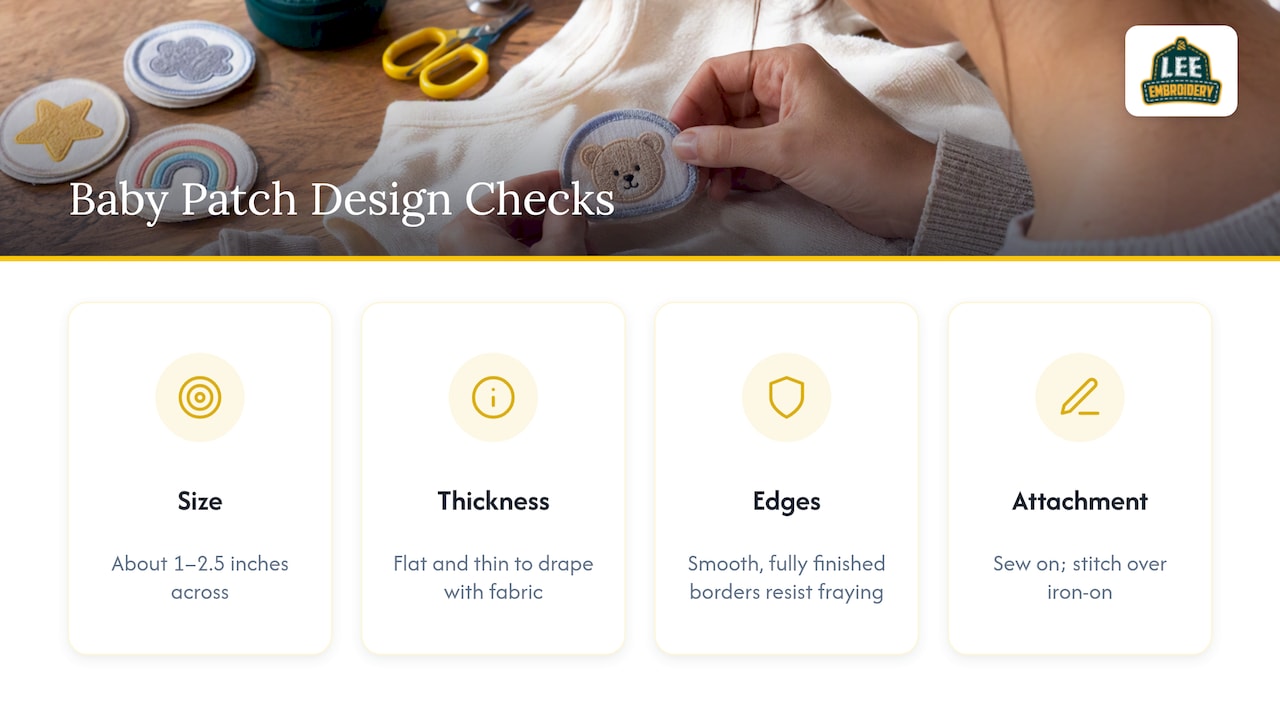
A baby patch has a different job from a jacket patch. It sits against very soft skin, goes through frequent hot washes, and may end up in a mouth. So we judge every idea by four things: size, thickness, edge finish and attachment.
Size. Keep designs compact. A patch about 1 to 2.5 inches across fits a onesie chest, a bib corner or a hat brim without overwhelming a small body.
Thickness. Flat, thin patches drape with the fabric. Thick or stiff ones can change how a garment hangs, and on infant clothing that matters (more on this below).
Edges. A merrowed or fully embroidered border is smoother and less likely to fray than a cut edge. If edges fray, loose threads become a hazard, so see our guide on fixing fraying patch edges by material.
Attachment. Sew-on is the most secure. Iron-on is convenient but should be backed up with stitching for infants.
15 personalized baby patch ideas
Name and identity patches
- First-name patch. A simple embroidered name in a soft script, placed on the left chest of a onesie. This is the best-selling idea for personalization shops because it scales: the same layout works for every name.
- Initial or monogram badge. One to three letters inside a circle or shield. It is compact, which makes it ideal for bib corners and hat brims.
- Birth-date patch. Date, weight and length in a tidy badge, popular with newborn photographers as a photo prop and keepsake.
- Family-name team patch. A “Team [Surname]” patch for matching family outfits, with a larger one for adults and a mini version for the baby.
Milestone and age patches
- Monthly milestone set. Twelve small numbered patches, one per month, for a subscription-style gift box. Keep them identical in size so photos look consistent.
- “Firsts” icons. A tiny tooth, footprint, or first-steps shoe. Pair with a small date.
- Birthday number patch. A bold “1” with a crown or balloon for first-birthday outfits.
- Big sibling and little sibling patches. Sold as a pair, they work well for baby shower and gift companies.
Themed designs
- Animal faces. Fox, bear, elephant and frog patches in a limited palette. Woven patches capture fine detail in a smooth, thin finish, which suits small faces. See our woven patches for the style.
- Celestial and nursery themes. Moons, stars and clouds in pastel thread. Embroidered patches give them a soft, textured look.
- Sports fan mini patches. A team logo or a tiny baseball for game-day outfits. If you have a team or club, a matching mini version of the adult patch is an easy upsell.
- Heritage and cultural motifs. Flags, regional symbols or a family crest, kept simple enough to read at a small size.
Business and brand patches
- Boutique logo patch. A small woven or embroidered logo on a hem or back yoke turns plain blanks into branded product. This is also the idea for daycares and preschools that want logo onesies and toddler uniforms.
- Hospital welcome-kit patch. A hospital gift shop can add a matching patch to every newborn kit: the hospital name, a small heart and a blank space for a name.
- Subscription box collectible patch. One new patch each month, shipped with the box, for parents to add to a blanket or bag. Because it ships separately, it sidesteps the question of attaching it before sale.
Choosing the patch type
Not every patch material suits every baby item. Here is how we would match them.
| Patch type | Best for | Watch out for |
|---|---|---|
| Embroidered | Names, monograms, nursery themes, bibs, hats | Keep thread coverage light on newborn items |
| Woven | Fine detail, small logos, labels-style patches | Choose a soft backing |
| Printed | Photo-like art, gradients, many colors | Confirm wash durability on a sample |
| Chenille | Toddler jackets, varsity-style mini letters | Thick and plush: not for infant sleepwear |
| PVC rubber | Diaper bags, toddler backpacks, stroller tags | Hard and heavy: avoid on infant clothing |
| Leather | Hats, bags, blanket corners for older babies | Stiff: keep off anything that touches a baby’s face |
For most newborn and infant clothing, embroidered, woven or printed patches are the natural choice. If you are weighing styles against each other, our breakdown of PVC versus embroidered patches covers the costly mistakes buyers make.
Where to place a baby patch
Placement is a safety decision as much as a design one.
- Good spots: left chest, lower front of a onesie, bib center or corner, the back yoke, the brim of a hat, the corner of a blanket (sewn flat on all sides).
- Avoid: neck openings and sleeve cuffs, where fabric snags and rubs. The CPSC has documented strangulation hazards with drawstrings in children’s upper outerwear. Patches are not drawstrings, but the lesson carries over: never create a loop or dangling element that could catch on something.
- Sleep products: the American Academy of Pediatrics recommends keeping the sleep space clear, and its safe sleep guidance favors wearable blankets over loose ones. If you decorate a sleep sack, keep any patch completely flat, fully stitched and free of loose threads or ribbons.
Safety rules sellers need to know
If you sell baby clothing in the United States, a charming patch is also a regulated component. This is general information, not legal advice. For your specific products, check with the CPSC’s guidance or a children’s product testing lab.
Small parts and attachment
The CPSC’s small parts rule, 16 C.F.R. part 1501, bans products for children under 3 that contain parts fitting inside a test cylinder 2.25 inches long by 1.25 inches wide. Children’s clothing is generally treated differently from toys, but a patch must not come off and become a loose small part in normal use or foreseeable abuse.
The real-world risk is detachment. The CPSC announced a recall of embroidered denim shorts because decorative studs could detach and pose a choking hazard. The takeaway: a decoration that passes on paper can still fail through wear.
Our practical advice:
- Add perimeter stitching to every patch on a garment for a child under 3, even iron-on ones.
- Wash the finished garment repeatedly, then pull-test the patch on the actual garment, not on a loose swatch.
- Check every edge for loose threads before packing.
Infant garments and flammability
Garments sized 9 months or smaller fall under special rules. The CPSC explains that an infant garment is sized nine months or smaller, and a one-piece garment must not exceed 25.75 inches in length. Such garments must either be tight-fitting or meet the flammability requirements. A large, thick or heavy patch can change how a garment hangs, so if you are decorating infant wear, keep patches thin and small and ask your testing provider whether a patched sample needs to be re-evaluated.
Care labels
The FTC’s Care Labeling Rule requires a permanent care label on textile apparel. When you add a patch, the base garment’s instructions may no longer be right. A high-heat iron-on application, for example, could conflict with a “tumble dry low” instruction. Make sure the finished product carries accurate care directions. Our iron-on patch steps that respect care labels show how to apply heat without damaging the base fabric, and our patch washing instructions explain how to match backing to wash method.
Fiber content labels
The garment you patch remains a textile product under the FTC’s rules. The FTC’s guide to textile and wool labeling is the place to confirm what your finished product must disclose. Starting from clean base garments with established fiber content keeps your life simpler. Patch materials do not remove your duty to test and label the garment itself.
For materials, our guide to safe baby patch materials and 100 ppm lead limits goes deeper.
How to apply patches to baby clothes
- Test on a spare. Use an identical garment, not your sellable stock.
- Position the patch flat, away from seams, neck and cuffs.
- Apply heat following the garment’s care label. Our guide to patching baby clothes with an iron walks through the short press times that protect delicate fabric.
- Stitch the perimeter with matching thread. Keep stitches tight and trim every tail.
- Wash and pull-test several times before you release the design.
If your boutique prints rather than patches some items, blank bibs and baby garments prepared for decoration, such as sublimation baby bib blanks, can sit alongside patched pieces in the same collection for a consistent look.
Our perspective on baby patches
We make patches for a wide range of customers, and baby sellers are among the most careful. They should be. A baby item is judged by the parent who washes it twenty times and the regulator who asks how it was tested.
Our view is simple: start small and flat, and pick the patch type for the garment, not the other way around. Show us the artwork and tell us the garment, the size and the age range. We will recommend a patch type, border and backing that suit it. We offer complimentary samples because a baby patch should be held, flexed and washed before a batch is made. Order a sample, wash it, pull it, and only then scale.
If your design is still a sketch, our digitizing team can turn it into an embroidery-ready file so thread density and stitch direction are right from the first sample.
— Bilal
Get your baby patches made
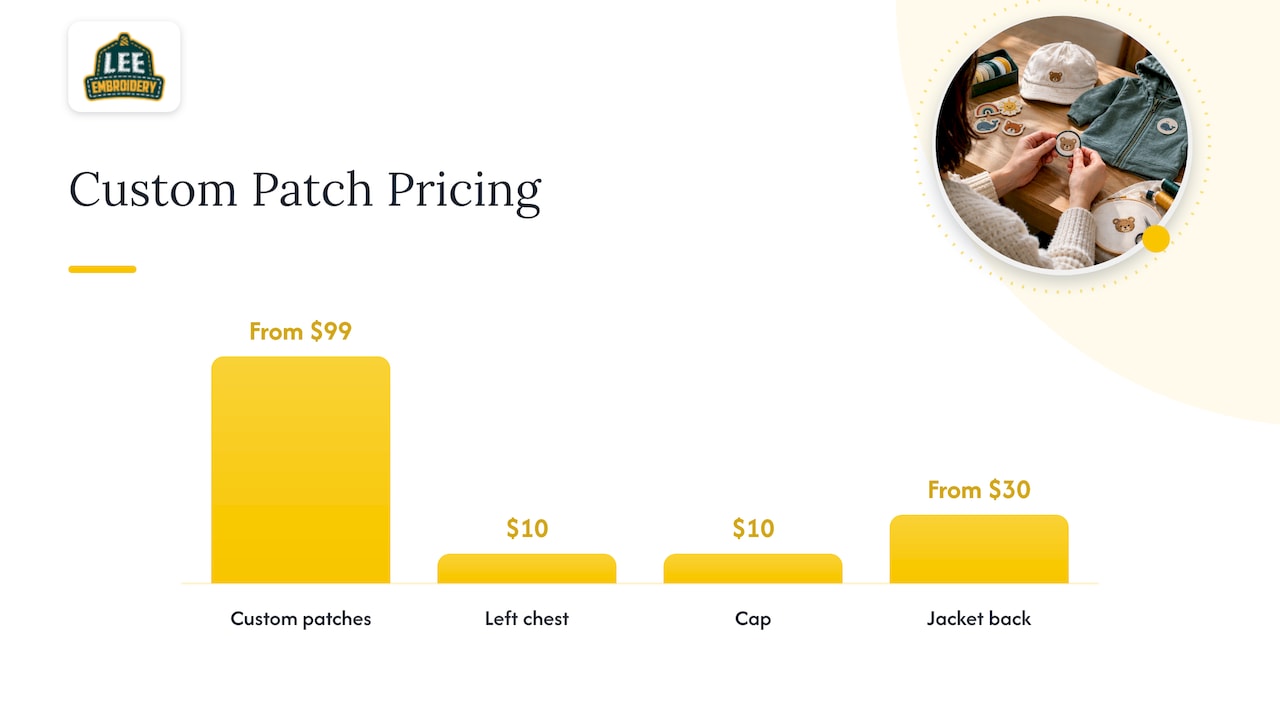
Ready to turn one of these ideas into product? Custom patches from Lee Embroidery start from $99, with choices of shape, border (merrowed, embroidered or laser cut) and backing (sew-on, iron-on, peel-and-stick or Velcro). We offer rapid quotes, complimentary samples and free shipping.
If you sell embroidered garments directly, our embroidery digitizing service converts your artwork into stitch-ready files: $10 for a left chest design, $10 for a cap, and from $30 for a jacket back. Request a free quote with your artwork and we will take it from there.
FAQ
What is the safest patch type for a newborn?
Thin, flat patches such as embroidered, woven or printed ones are the better fit for infant clothing. Avoid heavy PVC, stiff leather or thick chenille on anything a newborn wears or sleeps in. Whatever you choose, stitch around the edge and keep it away from the neck and cuffs.
Can I iron a patch onto a onesie?
Yes, but follow the garment’s care label and keep heat times short. For children under 3, we recommend adding stitching around the edge of an iron-on patch so it cannot peel loose after repeated washing. See our iron-on patch instructions.
Do I need to list a patch on the fiber content label?
The FTC’s textile labeling guidance treats the finished garment as a textile product, and the guidance notes that non-fibrous materials such as PVC or leather are not disclosed in the fiber content. That does not exempt you from safety testing or flammability rules for the garment. Confirm your specific product with the FTC’s labeling guide or a testing lab.
Can I order just a few baby patches?
It depends on the patch type and order details, so request a quote. Custom patches from Lee Embroidery start from $99, and you can ask for a complimentary sample before you decide on a larger run.
Sources
- CPSC: Small parts ban and choking hazard labeling
- CPSC: Pink Angel embroidered denim shorts recall
- CPSC: Drawstrings in children’s upper outerwear
- CPSC: Infant garments and tight-fitting sleepwear
- FTC: Care Labeling Rule
- FTC: Textile and Wool Acts labeling requirements
- AAP News: safe sleep recommendations