Choose a woven patch when you want a durable, thread-based badge with a soft hand and sharp small details. Choose a printed patch when your artwork has photographic gradients, dozens of colors or a full-bleed image that thread cannot copy. Most buyers land on one of those two answers within a minute of looking at their artwork. The rest of this guide helps you confirm it, and shows the cases where the answer is less obvious.
We make both at Lee Embroidery, so we see the same mistakes again and again: a gradient logo sent to a woven run, or a small-text crest printed on a surface that rubs against a backpack strap all day. Both are avoidable.
TL;DR
- Woven patches are built from interlaced thread, so the design is the fabric. There is no surface ink to crack or fade, which makes them the safer pick for daily wear and frequent washing.
- Printed patches reproduce photos, gradients and many colors, but the ink sits on the surface and takes the abrasion.
- Pick woven for logos, crests, small text and uniforms. Pick printed for illustrations, photographic art and short-run merchandise.
- If you are unsure, ask for a free sample of both and compare them in your hand before you commit to a bulk order.
Table of Contents
- What “woven” and “printed” actually mean
- Side by side: the differences that matter
- Detail and color: where printed wins and where woven wins
- Durability: what happens after six months of wear
- Feel, thickness and how it sits on the garment
- How the printing side works
- Do you need labels, not patches?
- What about nonwoven?
- Which one for your business?
- Backing and attachment: the half of the decision people skip
- Our perspective
- Get a quote and a free sample
- FAQ
- Sources
What “woven” and “printed” actually mean
The two words describe how the image gets onto the patch, and that one difference drives almost everything else.
A woven patch is made on a loom. As the Pratt Textile Research Lab explains, a woven is a textile created by interlacing two sets of threads, the warp and the weft, in a set pattern. On a woven patch, colored threads form the logo, lettering and background as the fabric is made. Nothing is added on top afterward.
A printed patch starts with a base fabric, usually a twill or similar cloth. The artwork is then printed onto that surface with ink. The patch is cut to shape and finished with a border and backing. You can see our own range on the printed patches page and the woven patches page.
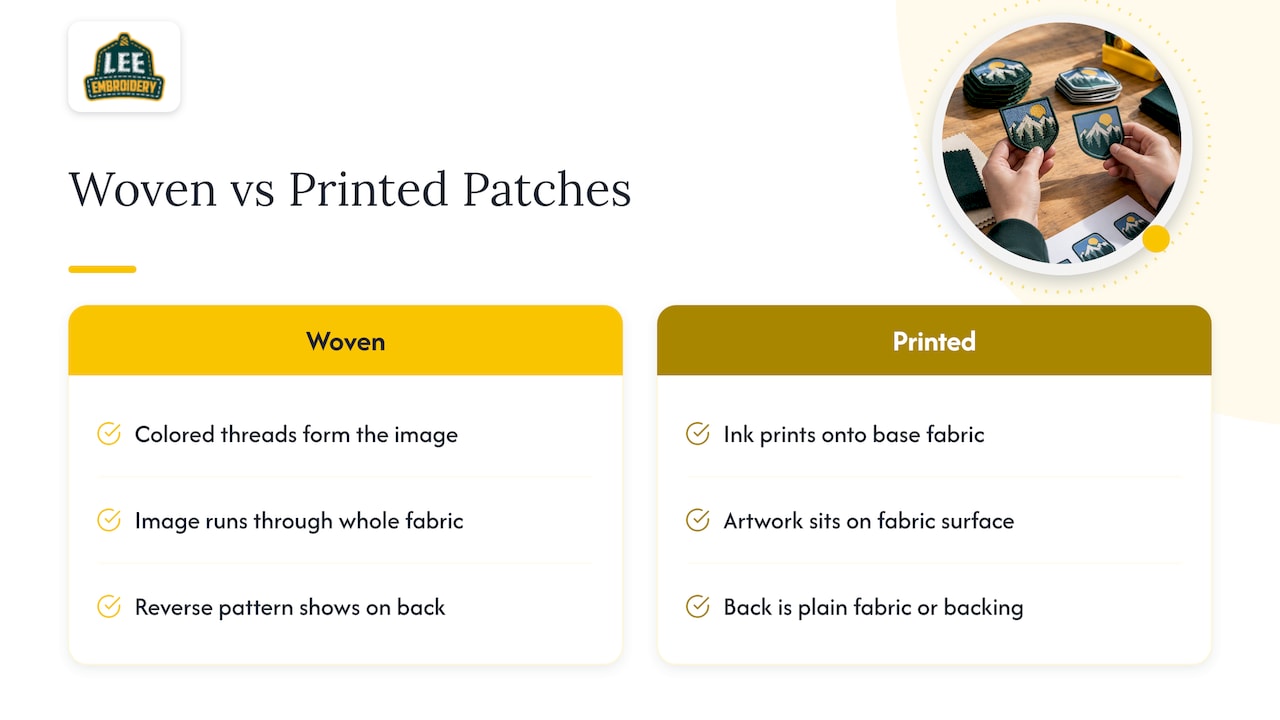
A quick way to tell them apart when you hold one: flip it over. On a woven patch, the back shows the same pattern as the front in reverse, because the image runs through the whole fabric. On a printed patch, the back is plain base fabric or backing.
Side by side: the differences that matter
| Factor | Woven patch | Printed patch |
|---|---|---|
| How the image is made | Colored threads interlaced on a loom | Ink applied to the surface of a base fabric |
| Fine detail and small text | Sharp for thread-based work, within the limits of thread count | Very fine, limited only by print resolution |
| Gradients and photos | Approximated with a limited thread palette | Reproduced closely, with unlimited color blends |
| Feel | Flat, smooth, soft, slightly textured | Smooth, can feel more like a sticker or printed label |
| Wear resistance | Strong, no surface ink to chip | Depends on the ink and coating, surface takes abrasion |
| Washing | Suited to repeated laundering | Needs a tested ink and a care plan |
| Best for | Uniforms, brand badges, hats, jackets, bags | Photographic art, event giveaways, short-term use |
No row in that table is a verdict by itself. The right patch is the one that wins on the rows your project cares about.
Detail and color: where printed wins and where woven wins
Gradients, photos and many colors
Thread comes in solid colors. A woven patch builds a gradient by stepping between thread colors, and the result reads as bands rather than a smooth blend. A sunset, a skin tone or a watercolor illustration will look flatter in woven form than on your screen.
Printing has no such limit. If your artwork is a photograph, a painted illustration or anything with soft shading, printing keeps the look you approved.
Small text and fine lines
This is the part that surprises people. Printed ink can render very small type, but a woven patch usually handles fine lines better than thick-thread embroidery does, because the loom lays thin threads tightly. For a crest with a motto, a team name in small caps or a thin outline, woven tends to stay crisp where chunkier stitched work would clog.
There is still a floor. Thread has a physical diameter, so any text that is too small will blur on any thread-based patch. Tell us the final patch size when you request a quote, and we will tell you if a line of text needs to grow.
Color matching
For brand colors, ask for a physical reference. Thread colors and printed inks both shift between screen and object. Our guide on confirming color matching with a free sample walks through the check we recommend before any reprint risk gets expensive.
Durability: what happens after six months of wear
Patches fail in three ways: the surface wears, the color fades, and the edge or backing lets go. Woven and printed patches differ mostly on the first two.
In professional garment testing, fabrics are checked against measurable criteria. A garment fabric testing overview from ORDNUR lists the standard tests, including dimensional stability to washing and colorfastness to laundering. Practitioners point out that printed designs can pass initial checks yet fall behind on light fastness and abrasion resistance, while woven designs have no surface ink to fade or chip.
A textile study from the University of Rhode Island on surface coatings on fabric points the same way when it comes to wear: a layer sitting on top of a textile is the layer that gets rubbed. For a uniform that is washed weekly or a hat that lives in a back pocket, that matters.
That does not make printed patches bad. A printed patch on a jacket that gets worn on weekends, or a patch made for a one-day event, will look good for as long as it is needed. It means you should match the patch to the abuse it will take:
- Daily wear, work uniforms, sports kits, bags: woven.
- Seasonal merchandise, event giveaways, display pieces: printed is a sensible choice.
- Outdoor use with sun and rain: woven, and read our notes on outdoor patch testing and peel strength before you buy.
Edges deserve a note too. Woven patches are usually finished with a merrowed or laser-cut border, and a poor edge frays no matter how good the face is. If you have seen fraying, see our fixes for fraying patch edges by material.
Feel, thickness and how it sits on the garment
A woven patch is thin and flexible. It follows the curve of a cap, a sleeve or a pocket without stiffness, which is why brands choose it for premium apparel. Soft goods such as polos, knitwear and lightweight shirts do best with it.
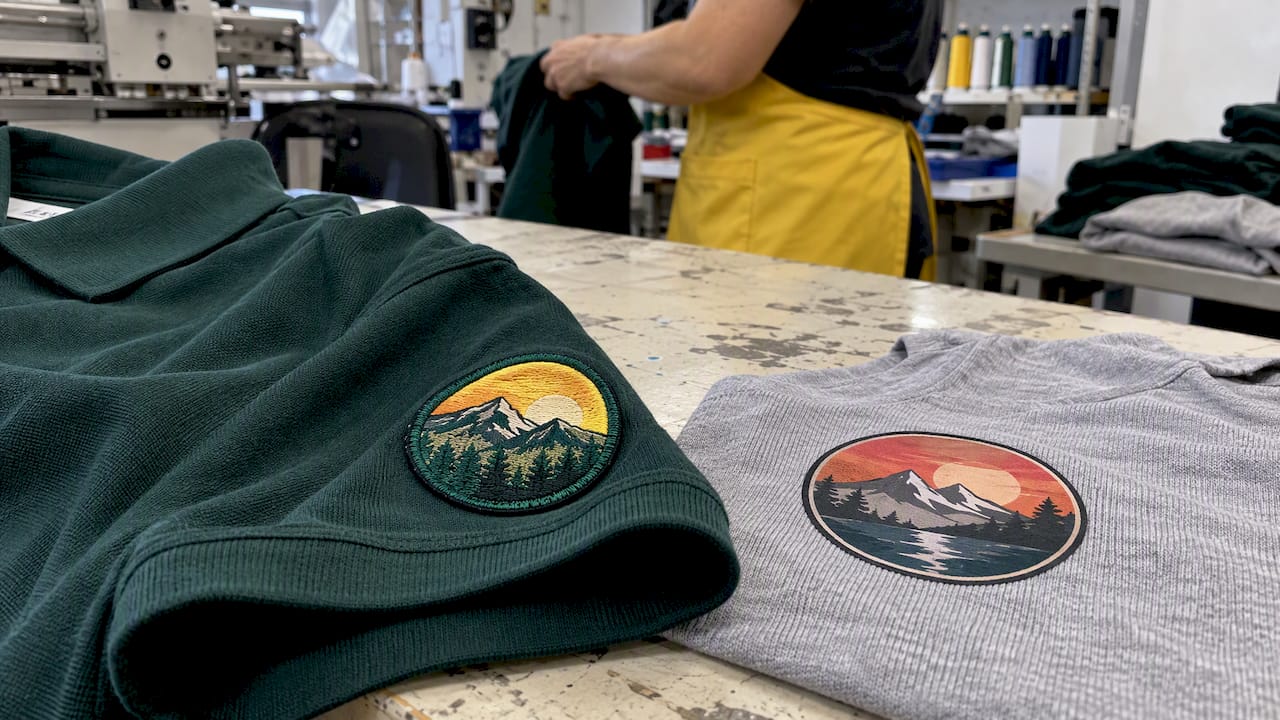
A printed patch is usually similarly flat, but its face is smoother and can feel more plastic or label-like depending on the finish. On fabrics that stretch or are very thin, check how either patch behaves before you order, because a patch that is stiffer than its garment will pucker. Our comparison of which patch survives your fabric goes deeper on that fabric-matching question.
If you want a raised, tactile look instead of a flat one, neither of these is the best option. Look at embroidered patches, chenille patches or PVC rubber patches instead.
How the printing side works
Printed goods, from patches to paper bags, share the same basics: artwork is separated into colors or prepared digitally, ink is laid down, and the result is cured or coated to hold. If you want to see how a print run is set up on a different product, this production guide to bag printing shows the stages from artwork to finished goods. The lesson carries over: the more colors and the finer the detail, the more the setup and the ink matter, and the more you should test a sample first.
Do you need labels, not patches?
People who search “printed vs woven” often mean garment labels. The same logic mostly applies: woven for brand identity, printed for care information and small text. But labels in the United States come with legal rules that patches do not.
Under the FTC’s textile rules, 16 CFR Part 303 covers how required information must appear on labels. The FTC’s clothing and textiles guidance summarizes the basics: most textile products need a label listing fiber content, country of origin and the identity of the manufacturer or another responsible business. Printed information has to stay legible for the life of the product, so a care label that fades in the wash is a compliance problem, not only a cosmetic one.
A decorative patch does not replace a required label. If you sell finished apparel, check the FTC rules for your product and talk to a compliance specialist if you are unsure. We make patches, not required labels.
What about nonwoven?
You may see “woven vs nonwoven” in the same searches. Nonwoven fabrics are bonded by chemical, mechanical or thermal means rather than interlaced yarns, and are widely used in disposable and low-cost applications. For a patch meant to last through washing and wear, woven structure is the traditional choice for stability.
Which one for your business?
Brands, teams and uniforms
Go woven. Logos with few colors, crisp text and repeated washing are what the format does best. Consistency across a run of hundreds of pieces is also easier to hold when the design is built from threads rather than layered ink.
Artists and illustrators
It depends on the art. A flat, bold design translates well to woven. A painterly piece with blends belongs on a printed patch. If you are unsure, send us the file and we will tell you which format will keep your art closest to the original.
Event organizers
For a one-day event with a quick turnaround and a full-color design, printed is practical. For credentials or commemorative pieces people will keep, woven feels more premium. Our list of event patch ideas has setup tips for each.
Baby apparel shops and personalized gift sellers
Baby items need extra care. Choose a soft, flat patch, a gentle backing and a design with no hard edges or small detachable parts. Before you order, read our guide to safe baby patch materials and the 100 ppm lead limit. A woven patch’s thin, flexible build suits onesies and bibs, while heavy or stiff patches rarely do.
Backing and attachment: the half of the decision people skip
The face of the patch gets all the attention, but the backing decides whether it stays on. We offer sew-on, iron-on, peel-and-stick and Velcro options. A few rules of thumb:
- Sew-on is the most permanent and the safest for items that are washed hard.
- Iron-on is quick, but heat can damage some fabrics and prints. Follow our iron-on steps that respect care labels and test on scrap using our heat press settings guide.
- Velcro suits uniforms where patches change. See our Velcro patch strength notes.
- Not sure between the first two? Our iron-on vs sew-on test with free samples is written for small businesses.
After you attach the patch, wash it the way the backing needs. Our patch washing instructions match backing to care so you avoid reprints.
Our perspective
We get this question weekly, and our answer is simple: we do not sell the format, we sell the result. A woven patch on the wrong artwork looks flat, and a printed patch on a work jacket looks tired in a season. Neither is a defect of the product. It is a mismatch with the job.
So we start from three questions. Where will it be worn? How often will it be washed? How much of the art is shading rather than shape? Answer those and the format almost always picks itself. When it does not, we send a free sample so you can feel the difference instead of guessing from a screen.
Our view is that most brands should default to woven for anything that carries their name every day, and keep printed for art that truly needs it. A patch is a small piece of art on someone’s shoulder, and it should still look right after the hundredth wash.
— Bilal
Get a quote and a free sample
If you have a design ready, send it to us for a rapid quote. We offer complimentary samples, so you can hold a woven patch and a printed patch side by side before you place an order. Our custom patches start from 99 $, and shipping is free. If your artwork is not embroidery-ready, our digitizing service starts at 10 $ for a left chest or cap design and from 30 $ for a jacket back.
Not sure where to start? Our ultimate guide to custom patches covers every type we make.
FAQ
Are woven patches better than printed patches?
For durability and daily wear, usually yes. The design is part of the fabric, so there is no surface ink to crack or fade. Printed patches are better when your artwork has photos, gradients or a lot of colors.
Can a woven patch show a gradient?
Only in steps. Woven patches use a limited palette of thread colors, so a smooth blend becomes bands of color. If the gradient is essential to the design, a printed patch will stay closer to your artwork.
Do printed patches survive the washing machine?
It depends on the ink, the finish and how the patch is attached. Printed designs are more exposed to abrasion and fading than woven ones, so test a sample through your real wash routine before you order in bulk.
What is the difference between woven and embroidered patches?
Woven patches are made on a loom, with threads forming a flat, fine-detailed image. Embroidered patches are stitched onto a base fabric, which gives a raised, textured look. Our guide on which patch survives your fabric compares them in detail.
Sources
- Pratt Textile Research Lab: Wovens
- ORDNUR: Fabrics Testing Requirements for Garments
- University of Rhode Island: Performance of Fabrics with 3D-Printed Photosensitive Acrylic Resin on the Surface
- eCFR: 16 CFR 303.16, Arrangement and disclosure of information on labels
- Federal Trade Commission: Clothing and Textiles