


For baby clothing, soft embroidered or woven patches with a soft backing and sewn attachment are the safest default; printed or PVC patches work only when coatings are certified under CPSC lead limits and the patch is mechanically secured, not just glued. Whatever you choose, the finished garment still has to clear lead, flammability, and tracking-label rules before it reaches a shelf.
TL;DR:
- Verify components stay at or below 100 parts per million lead, coatings at 90, and applicable phthalates at 0.1%; garments need permanent tracking labels.
- Sew patches with dense stitching and cover the reverse with soft backing; use heat bonding only after wash testing and add a sewn perimeter.
- Infant garments suit embroidered or woven patches; avoid chenille that sheds, abrasive leather, raw edges, exposed threads, and patches attached only with adhesive.
- Test each trim color for flammability, wash samples through several cycles, then pull test attachments and inspect for lifting edges before production approval.
- Advise gentle cold water washing and line drying or low heat tumble drying, because heat and agitation can loosen bonds over time.
Table of Contents
- 1. Choosing between embroidered, woven, printed, PVC, leather, and chenille
- 2. Lead, phthalates, flammability, and tracking labels: the rules that actually apply
- 3. Sew-on, iron-on, adhesive, or Velcro: picking the right attachment method
- 4. Design, placement, and QA checks before you approve a production run
- 5. Care instructions that keep the bond intact after washing
- 6. Hypoallergenic and skin-friendly materials for baby patches
- 7. How Lee Embroidery approaches safe, shop-ready baby patches
- 8. Request samples and lock in your backing before you order
- FAQ
- Sources
- Primary regulatory and guidance links
1. Choosing between embroidered, woven, printed, PVC, leather, and chenille
Not every patch style belongs on infant wear, and the differences come down to softness, bulk, and how the material behaves after a few dozen wash cycles.
Embroidered patches are the safest starting point for most baby garments. Dense stitching holds its shape, a soft backing conceals the float threads and knots that would otherwise scratch delicate skin, and the finish survives repeated laundering without fraying. Woven patches are a close second: they carry less thread bulk than embroidery, which makes them flatter against the fabric, and they handle fine detail well when paired with a soft backing. Printed patches can work too, but only when the inks and coatings are verified against paint and lead limits; look for suppliers who use inks formulated for textiles with documented safety data rather than generic print stock. PVC patches are durable and easy to clean, but the edge finish matters: a sharp laser-cut edge has no place on something a baby will rub their face against, so check that surface coatings and edges meet compliance before approving a run. Leather and chenille deserve more caution. Leather can feel abrasive against bare skin, and chenille sheds loose fibers that create both a texture problem and a potential choking concern, so both are better suited to older age ranges than to newborn or crawling-stage garments.
Before signing off on any material, run it through a short checklist:
- Soft to the touch against bare skin, with no stiff or scratchy texture
- Edges finished cleanly, with no sharp or raw cuts exposed
- Coatings and inks that can be documented against lead and phthalate limits
- Backing that fully conceals stitching and float threads on the reverse side
2. Lead, phthalates, flammability, and tracking labels: the rules that actually apply
Compliance for children’s apparel trim is not optional, and the thresholds are specific enough that you can check them against any supplier’s documentation.
- Total lead content in any component, including patches and trims, must stay at or below 100 parts per million, while lead in paints and surface coatings is capped at 90 parts per million.
- Phthalate restrictions apply to certain childcare articles and accessible plasticized components, with specified phthalates limited to concentrations at or below 0.1% where applicable, according to CPSC apparel training guidance.
- Textile flammability is governed by the Standard for the Flammability of Clothing Textiles, known as 16 CFR Part 1610, and decorative trim should be tested at the prototype stage, not after a full production run.
- Finished children’s garments need a permanent tracking label naming the manufacturer, production location and date, and batch or run information; a hangtag does not satisfy this requirement.
One figure worth underlining: the gap between the 100 ppm total lead limit and the 90 ppm coating limit means a patch can fail on its surface coating even if the base material tests clean, which is why both numbers need separate verification.
When any of these thresholds apply to your product, testing by a CPSC-accepted lab and a Children’s Product Certificate become part of the paperwork, not an afterthought.
3. Sew-on, iron-on, adhesive, or Velcro: picking the right attachment method
How a patch is attached matters as much as what it is made from, since a detached patch becomes a loose object a baby can put in their mouth.
- Sew-on is the recommended default for infant garments. Use dense, even stitching, secure every float thread on the reverse, and cover that side with a soft backing so nothing scratches the skin.
- Iron-on or heat-bond attachment is acceptable only when the fabric and patch backing are proven compatible and the bond has been wash-tested through multiple cycles; pairing a heat bond with a sewn perimeter adds real durability.
- Adhesive-only attachment carries real risk on baby garments unless the adhesive is specifically formulated for permanent, washable bonding, since ordinary craft adhesives loosen with heat and moisture.
- Velcro and peel-and-stick backings have their place on adult or costume apparel, but we recommend avoiding them on infant wear unless the product is purpose-built and tested for that use, since the hook side can irritate skin and the stick side can lift during wash.
Pro Tip: Always request a stitched sample alongside a heat-bond sample so you can compare wash performance side by side before committing to a production run.
Whichever method you choose, the backing should stay soft, nonabrasive, and large enough to cover the entire stitched or bonded area.
4. Design, placement, and QA checks before you approve a production run
Smart placement and a short testing routine catch most hazards before they reach a customer.
- Keep patches away from collars, sleeve cuffs, hood edges, and front-center areas near the mouth, favoring lower-reach spots like a hip or back panel instead.
- Finish edges with a merrowed or embroidered border rather than a raw laser cut, which can leave a stiff or sharp perimeter.
- Test each trim color separately for flammability and durability, since colorants and finishing chemicals can shift how a fabric performs even within the same patch design.
- Run prototype samples through representative wash cycles, then pull-test the attachment and inspect for loose threads or lifting edges before signing off.
- Build a QA checklist into final approval covering attachment strength, full backing coverage, and zero loose float threads on the reverse.
5. Care instructions that keep the bond intact after washing
Laundering is the single biggest stressor a patch will face, so the care instructions you hand to a customer matter almost as much as the patch itself.
- Recommend a gentle cycle in cold water, with line-drying or a low tumble setting depending on the backing material used.
- Explain, in your own packaging or care tag language, that heat and agitation are what loosen bonds over time, so gentler settings extend the life of the attachment.
- Base your wash-testing routine on standard laundering procedures referenced in industry and CPSC prototype guidance, running several cycles before approving a backing choice for bulk production.
- Keep the instructions short and practical. A one-line care note that actually gets followed prevents more returns than a paragraph nobody reads. For practical wash-testing steps, see our guidance on how to wash patches without ruining the bond.
6. Hypoallergenic and skin-friendly materials for baby patches
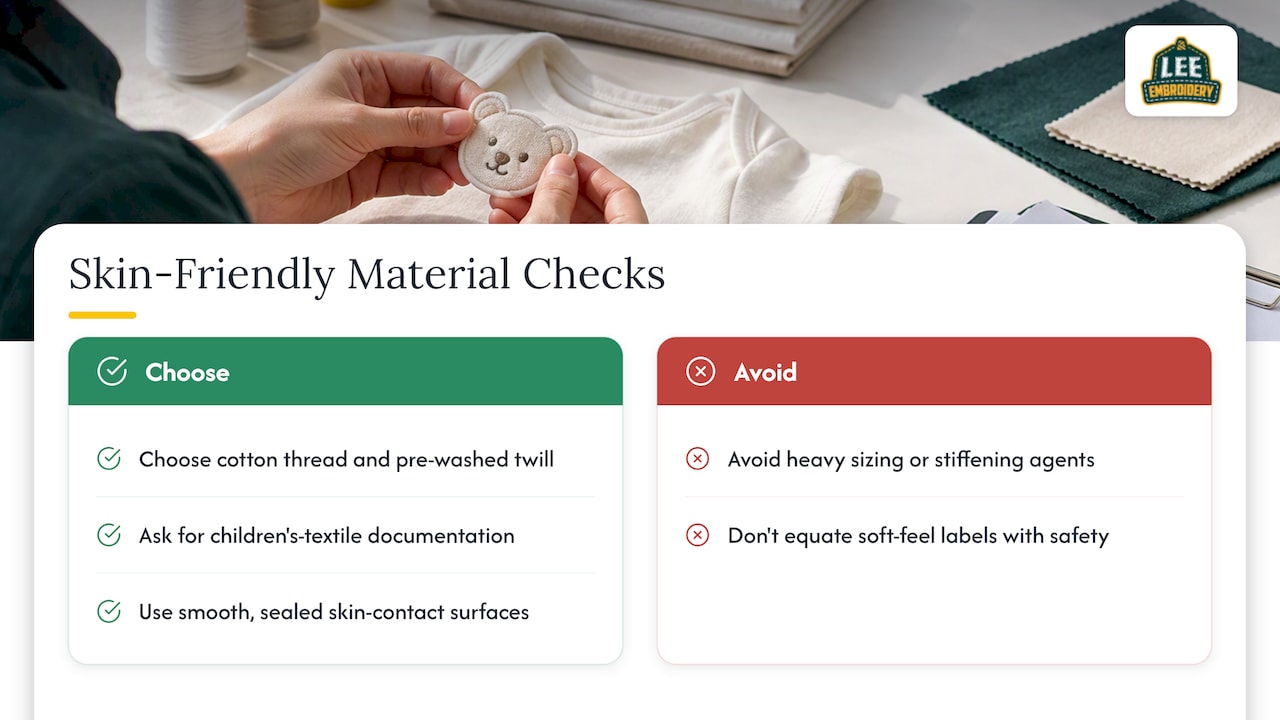
Baby skin reacts to friction and chemical residue faster than adult skin, so material choice for the parts that touch skin deserves its own pass beyond the main selection checklist. Cotton-based embroidery thread and soft, pre-washed twill backing tend to sit gentler against sensitive areas than synthetic felt or stiff vinyl backing. Avoid backings treated with heavy sizing or stiffening agents, since those finishes can flake or irritate skin before the first wash softens them out.
Dye and ink choice matters as much as fiber choice. Ask suppliers whether dyes and coatings are formulated for children’s textiles and whether they have documentation tying them to the lead and phthalate limits covered earlier, rather than assuming a “soft-feel” label guarantees skin safety. For printed or PVC elements that will sit against skin, a smooth, sealed surface finish reduces friction compared to a raw or textured one. None of this replaces regulatory testing, but it narrows your supplier shortlist to materials that are comfortable as well as compliant, which matters for a product a baby will wear for hours at a stretch.
7. How Lee Embroidery approaches safe, shop-ready baby patches
We offer custom patch manufacturing across embroidered, PVC, and leather options, and we recommend requesting samples with a rapid quote turnaround so you can pre-test material and backing choices before committing to a run. Our team typically recommends pairing a soft backing with a sewn perimeter edge and running a small wash test on samples before full production. If you want a compatibility check for a specific fabric or backing, reach out and we will walk through it with you.
— Bilal
8. Request samples and lock in your backing before you order
If you are still weighing embroidered against printed or wondering whether a heat-bond will survive daycare laundry, the fastest way to find out is to test it on your own fabric rather than guess from a spec sheet.

We produce custom patches across embroidered, PVC, printed, woven, and leather styles, with backing options including sew-on, iron-on, and Velcro to match whatever your production line already uses. Custom patches start from a moderate price per order, and we send complimentary samples so you can check softness, backing feel, and wash performance before placing a bulk order.
- Request a free sample in the material and backing you are considering
- Run a small wash test on your own fabric before approving the design
- Confirm the backing choice with our team based on your garment type
- Place a production run once the sample checks out
Head to our custom patches page to start a sample request or get a quick quote.
FAQ
Are PVC patches safe for baby clothing?
PVC patches can be safe when the surface coating meets the 90 ppm lead limit and the edges are finished smoothly rather than left as a raw laser cut. They also need to be mechanically secured, since an adhesive-only PVC patch is more prone to lifting during wash cycles.
What attachment method is safest for infant patches?
Sew-on attachment with a soft backing covering the reverse side is the safest default, since it resists the heat and agitation of laundering better than adhesive or iron-on-only methods. A heat-bond can work if it has been wash-tested and paired with a sewn perimeter for extra durability.
Do baby patches need a tracking label?
The finished garment, not the patch itself, needs a permanent tracking label identifying the manufacturer, production date and location, and batch information. A hangtag or adhesive label does not satisfy this requirement on its own.
Are chenille or leather patches appropriate for babies?
Chenille sheds loose fibers and leather can feel abrasive against bare skin, so both are generally better suited to older children than to infants. If you want a soft, skin-friendly texture for baby garments, embroidered or woven patches with a soft backing are the safer choice.
How does Lee Embroidery help shops confirm patch safety before a bulk order?
Samples and quote turnaround options help you test material, backing, and wash performance on your own fabric before committing to production. This sample-first approach lets you confirm compliance details with your own QA checklist rather than relying on a spec sheet alone.
Primary regulatory and guidance links
For compliance follow-up, these are the direct sources behind the thresholds and labeling rules covered above: the CPSC total lead content FAQ, the CPSC flammability and trim testing guidance, the CPSC tracking label requirements, and the CPSC apparel training transcript covering phthalate restrictions. For a practical look at how a PVC patch with heat-press adhesive is typically finished outside the children’s apparel context, see this PVC hat patch example from our partners at Signature Laser Designs. On our own site, our guides on iron-on versus sew-on testing and wash-testing patches before bulk orders walk through the sample process referenced throughout this article.



One Comment