A laser-cut edge gives the cleanest, most precise silhouette for synthetic patches, but material choice and parameter tuning decide whether you get a sealed, char-free finish. Laser cutting suits polyester and nylon patches with intricate shapes and fast production timelines. Light fabrics and leather need extra care to avoid scorching, so testing and sample runs before a full order are not optional. If your design has fine detail or you need repeatable output at speed, laser cutting is worth exploring.
TL;DR:
- Laser cutting is ideal for intricate shapes and repeatable custom patches, but thorough testing on the actual fabric and border style is essential beforehand.
- For natural fibers like cotton or wool, laser edges do not seal, requiring sewn borders to prevent fraying over time; synthetic fabrics typically self-seal with heat.
- Sharp corners and detailed text are best handled with laser-cut edges, while merrowed borders suit rounded shapes and offer durability in washing.
- Adjusting laser parameters such as focal height, power, and feed rate is key to achieving straight, char-free edges and avoiding issues like charring or uneven cuts.
- Requesting samples and confirming machine settings from suppliers ensures consistency and avoids costly rework, especially when working with layered or mixed materials.
Table of Contents
- How laser cutting shapes and seals a patch edge
- Laser cut vs merrowed vs hot cut: which edge fits your patch
- What different patch materials do under a laser
- Fixing uneven, sharp, or charred laser edges
- Choosing an edge style and vetting your patch supplier
- How Lee Embroidery approaches laser-cut borders
- When precision earns its cost
- Get a sample before you commit to a border
- Sources
- FAQ
How laser cutting shapes and seals a patch edge
CO2 lasers are the standard tool for cutting textile patches, and for good reason: they melt or vaporize synthetic fibers along the cut line, which fuses the edge into a smooth, self-sealing bead instead of a raw, fraying line. That single pass does two jobs at once, cutting the shape and sealing it, which is part of why laser cutting has become the go-to for complex outlines.

Modern setups add camera-based vision registration, which reads the exact position of an embroidered design before the laser fires. That matters because embroidery shifts slightly from panel to panel, and without registration, a fixed cutting path would miss the stitched outline on some patches and clip it on others.
When you’re specifying a laser-cut order, ask about:
- Bed size relative to your patch dimensions and batch layout.
- Power range, typically 60 to 100 watts for textile work, balancing cut speed against edge quality.
- Vision registration, essential for cutting around embroidered or printed shapes with any placement variance.
- Logged parameters from prior test runs, so settings are repeatable, not reinvented per order.
Laser cut vs merrowed vs hot cut: which edge fits your patch
Every patch border is a tradeoff between look, durability, shape freedom, and how fast it can move through production. Understanding those tradeoffs before you choose saves rework later.
Merrowed edges use a dense overlock stitch around the patch perimeter. They give a classic, tactile border that natural-fiber and heritage-style patches often call for, and they hold up well over years of wear and washing. The catch is shape: merrow stitching handles rounded or gently curved outlines well but struggles with sharp points, tight inner corners, or fine detail.
Hot cut, or heat cut, edges use a heated blade to slice and lightly seal synthetic fabric. It’s inexpensive and fine for straightforward shapes, but the process is largely manual, which means less consistency across a batch and rougher precision on anything but simple lines.
Laser-cut edges handle intricate contours, letters, and layered shapes that the other two methods can’t touch, and they do it with far less manual labor per piece. The tradeoff is the heat-affected zone (HAZ) that thermal cutting introduces, along with a higher setup investment for parameter testing before production begins.
When deciding, weigh:
- Design complexity: sharp corners and fine text favor laser.
- Batch size: laser setup pays off fastest on repeat or larger runs.
- Tactile preference: some buyers want the raised stitched feel of merrow.
- Turnaround: laser cutting is generally faster once settings are dialed in.
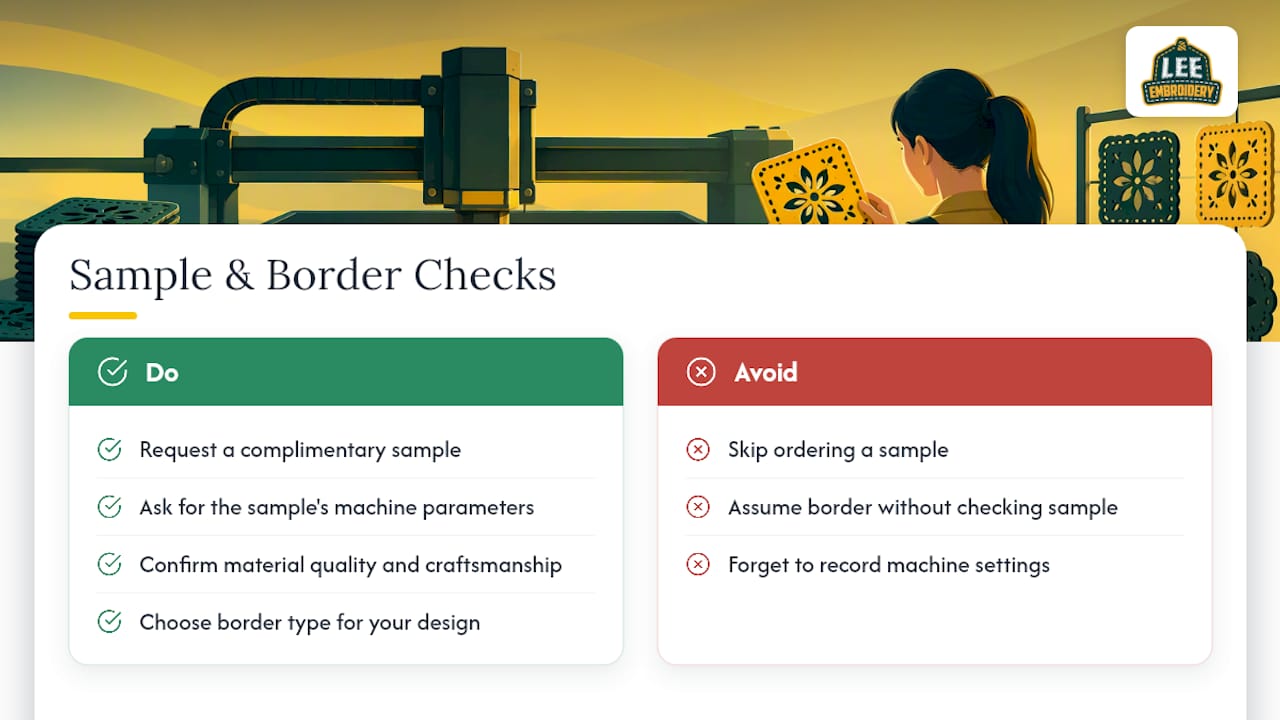
Pro Tip: Request one sample in your exact material and border style before committing to a full production run, not a generic swatch from the supplier’s catalog.
What different patch materials do under a laser
Material behavior under heat is the biggest variable in how a laser-cut edge turns out, and it’s worth understanding before you pick a fabric for your design.
- Polyester and nylon melt and re-solidify along the cut line, producing the fray-resistant seal laser cutting is known for.
- Cotton, wool, and other natural fibers do not self-seal under laser heat, so an unsupported laser-cut edge on these materials will fray over time without a sewn border.
- Leather can carbonize under laser cutting, and while darker leathers hide the darkened edge better, tuning the duty cycle and feed rate reduces visible charring on lighter hides.
- Layered constructions, like an embroidered top stitched onto a peel-and-stick or Velcro backing, need their own test pass since adhesives and mixed materials melt at different rates and can complicate a clean seal.
If your design mixes materials, plan for a dedicated sample rather than assuming results from a single-material test will carry over.
Fixing uneven, sharp, or charred laser edges
Most edge problems trace back to one of three variables: focal height, power, or feed rate. Diagnosing which one is off saves time and material.
- Wavy or uneven edges usually point to focal height drift, an unlevel bed, or misaligned registration. Recheck focal distance across the cutting area and confirm the camera registration is calibrated to the current material batch.
- Sharp-feeling edges or loose fiber ends mean the seal isn’t fully forming. Try a faster pass paired with slightly higher power rather than slowing down, which often overcooks the edge instead of smoothing it.
- Charring or carbonization, especially on leather or light-colored fabric, calls for a lower duty cycle and a faster feed rate. Test on a light-colored swatch first, since scorch marks show up there before they’d be obvious on darker material.
- Layered parts with adhesive backing may need masking, a different layer order, or a separate parameter set entirely. Request production samples that match your exact construction before approving a full run.
Pro Tip: Keep a written log of the power, speed, and focal settings that worked for each material. It turns troubleshooting into a lookup instead of a guessing game.
Choosing an edge style and vetting your patch supplier
Picking the right border comes down to matching the edge type to your material, design, and how the patch will be used.
Before finalizing your order, run through this checklist:
- Material: synthetic fabrics seal well under laser; natural fibers usually need a sewn border.
- Shape complexity: fine detail and sharp corners favor laser cutting over merrow or hot cut.
- Wash and wear durability: consider how the patch will be laundered or handled long-term.
- Placement: garment type and wear location can affect which border feels or looks right.
- Sample policy: confirm the supplier offers a sample or small pilot run before full production.
When you talk to a supplier, ask directly about camera registration capability, the power and speed settings they’d use for your material, typical lead time, and whether edge quality is covered by any guarantee. A supplier confident in their process will have straightforward answers to all four.
How Lee Embroidery approaches laser-cut borders
Custom patches are made across embroidered, PVC, chenille, woven, printed, and leather styles, with options for both laser-cut and merrowed borders depending on the design. Orders are created with attention to material quality and craftsmanship, and buyers can request a complimentary sample to check edge quality before committing to a production run. Asking for the machine parameters used on a sample provides a reference point for the full batch.
When precision earns its cost
Pick laser cutting when your design has intricate detail or you’re running short, repeatable batches. Choose merrow when a classic stitched look and natural-fiber durability matter more than sharp corners. Either way, test before you commit.
— Bilal
Get a sample before you commit to a border
You don’t have to guess which edge style fits your patch. Both laser-cut and sewn merrow borders are available across patch types including embroidered, woven, chenille, PVC, printed, and leather, and a complimentary sample lets you check the edge quality on your exact design before placing a full order.

Getting started is straightforward:
- Upload your artwork and specify your preferred border, laser or merrow.
- Request a laser-sample validation if your design includes fine detail or an unusual material.
- Ask about digitizing help if your art needs converting into an embroidery-ready file for Left Chest, Cap, or Jacket Back placement.
Visit Lee Embroidery to request your free quote and sample, or browse embroidered patches, leather patches, or PVC rubber patches to see border options by material.
Sources
For deeper detail on the process mechanics covered here, see the carbonization study on laser-cut leather, the CO2 laser cutting overview for patches, the die cutting versus laser cutting guide, and a practitioner discussion on sealing embroidered patches.
- Is CO2 laser cutting patches just about a cleaner edge?
- Analysis of Carbon Formation on Machined Leather Specimen Using FTIR Technique in Laser Diode Assisted Cutting Process
- Die Cutting vs. Laser Cutting: The Complete Guide – Colvin Friedman Company
FAQ
Does laser cutting leave sharp edges?
A properly tuned laser cut leaves a smooth, sealed bead rather than a sharp edge, since the heat melts synthetic fibers together as it cuts. If an edge feels sharp or fibrous, the power and speed settings likely need adjusting, which a test pass on scrap material can confirm before a full run.
How to keep patch edges from fraying?
On polyester or nylon patches, a laser cut naturally seals the edge and resists fraying without extra stitching. On cotton, wool, or other natural fibers, laser heat will not seal the material, so a merrowed or embroidered border is the more reliable way to prevent fraying over time.
What is a merrow border on a patch?
A merrow border is a dense overlock stitch sewn around the outer edge of a patch, giving it a raised, tactile finish. It’s a durable, classic option for rounded or simple shapes, though it isn’t well suited to sharp corners or fine detail.
Why are my laser cut edges not straight?
Uneven laser edges are usually caused by focal height drift, an unlevel cutting bed, or misaligned vision registration on embroidered pieces. Checking focal distance and recalibrating the camera registration against the current material batch typically resolves it.
Can leather patches be laser cut safely?
Leather can be laser cut, but it’s prone to carbonization, or visible charring, along the edge. Lowering the duty cycle and increasing feed rate reduces this effect, and darker leathers tend to mask any remaining discoloration better than lighter hides.