Embroidery threads fall into a handful of material families: cotton, rayon, polyester, silk, wool, linen, and metallic. The single rule that matters most is this: choose the material for look and hand, choose weight for scale and detail. For machine work, 40wt is your default top thread, and your bobbin thread should always run lighter, typically 60wt or 70wt.
TL;DR:
- Polyester thread is the most durable option for heavily washed or high-wear embroidery and matches well with a 40wt top thread for machine work.
- Rayon delivers a high-gloss sheen ideal for decorative projects, but it is not bleach-safe and less suitable for items exposed to frequent washing.
- Thread construction type, such as stranded, perle, filament, or metallic, determines its application, strength, and how it runs through machines; filament polyester is best for machine embroidery.
- Thinner threads, like 60wt, are suited for fine details and small text, but require matching needles and careful tension adjustment to prevent breakage.
- When selecting bobbin thread, use lighter 60wt or 70wt, match colors to fabric, and run tension tests to prevent show-through and threading issues.
Table of Contents
- Material families: cotton, polyester, rayon, silk, wool, linen, and metallic
- Construction and common thread types explained
- Thread weight explained: 30wt, 40wt, 60wt, and beyond
- Choosing thread weight and strand count for hand stitching
- Bobbin thread rules and quick tension troubleshooting
- Specialty threads: metallics, bullion, and chenille
- Care, colorfastness, and storage for embroidery thread
- How a patch manufacturer chooses thread for durability and finish
- Balancing sheen against durability: a note on testing
- Ordering professional patches when DIY isn’t the right fit
- Sources
- FAQ
Material families: cotton, polyester, rayon, silk, wool, linen, and metallic
Each fiber brings its own personality to a design, and picking the right one starts with knowing what you actually want the finished piece to look and feel like.
Cotton has a soft, matte finish that reads as classic and homespun. It works beautifully for heirloom projects, quilting, and cross-stitch, where a slight texture adds warmth rather than shine. Rayon, made from wood pulp, delivers a high-gloss sheen that catches light dramatically, making it a favorite for decorative machine embroidery on items that will not see heavy washing or bleach exposure. Polyester is the workhorse of the group: it holds up to abrasion, resists fading, and tolerates household laundering far better than rayon or silk, which is why commercial embroidery threads increasingly lean on polyester for apparel and uniforms. High-quality polyester can now rival rayon’s luster, closing much of the old gap between the two.
Silk brings a fine, lustrous hand prized in heirloom and couture hand embroidery, but it demands gentle care and is a poor match for anything that gets scrubbed or bleached. Wool and crewel yarns are thick and matte, built for tapestry, upholstery, and warm textural stitching rather than fine detail. Linen thread has a slightly irregular, organic texture that suits rustic or vintage-style work. Metallic thread, typically a polyester or nylon core wrapped in metallic film, adds sparkle but behaves unlike any other fiber on this list and needs special handling, covered later.
A few practical notes when you are shopping:
- Check the care label or manufacturer spec sheet before committing a fiber to a project that will be washed often.
- Rayon and silk are not bleach-safe; reserve them for decorative items, not workwear or diapers.
- Polyester is the safer default for anything commercial, from uniforms to team gear, because of its wash and wear resistance.
- Wool and linen suit texture-driven work like tapestry or rustic sampler pieces, not fine detail lettering.
Threads are categorized by both material and construction, and extension research on textile fibers confirms that fiber content and staple or filament length directly affect strength, lint production, and how a thread runs through a machine. That single distinction, natural versus synthetic, and stranded versus filament, explains most of the behavior differences stitchers notice between spools.
Construction and common thread types explained
Material tells you what a thread is made of. Construction tells you how it is built, and that shapes how it separates, how it shines, and how well it runs through a machine.
- Stranded floss is made of several thin strands twisted loosely together, usually six, which you can separate for finer lines or keep whole for bold coverage. It suits hand embroidery almost exclusively and is rarely used in machines because the strands are not built to run under tension at speed.
- Perle (pearl) cotton is a single, twisted, non-divisible strand with a subtle sheen, sized by number (from thick perle 3 to fine perle 12). It is a hand-embroidery and hand-quilting staple, never meant to be split.
- Filament polyester and rayon threads are continuous, smooth strands built specifically for machine embroidery. Their smoothness means less lint and fewer thread breaks at production speed, which is why most commercial machine thread uses this construction rather than a spun or stranded build.
- Core-spun or spun threads wrap short fibers around a stronger core, giving a softer, more matte hand than filament thread. They run fine in machines but produce slightly more lint, so tension and cleaning routines matter more.
- Metallic and bullion constructions wrap or twist metallic film around a core thread or use solid metal purl for hand embroidery. These are not run through a machine the way ordinary thread is; they are typically couched down by hand or fed at a much slower machine speed to prevent shredding.
Knowing which construction you are holding tells you immediately whether it belongs in a hoop or in your hand.
Thread weight explained: 30wt, 40wt, 60wt, and beyond
Thread weight numbers work backward from what you might expect: a higher number means a thinner thread. A 60wt thread is finer than a 40wt thread, which is finer than a 30wt thread.
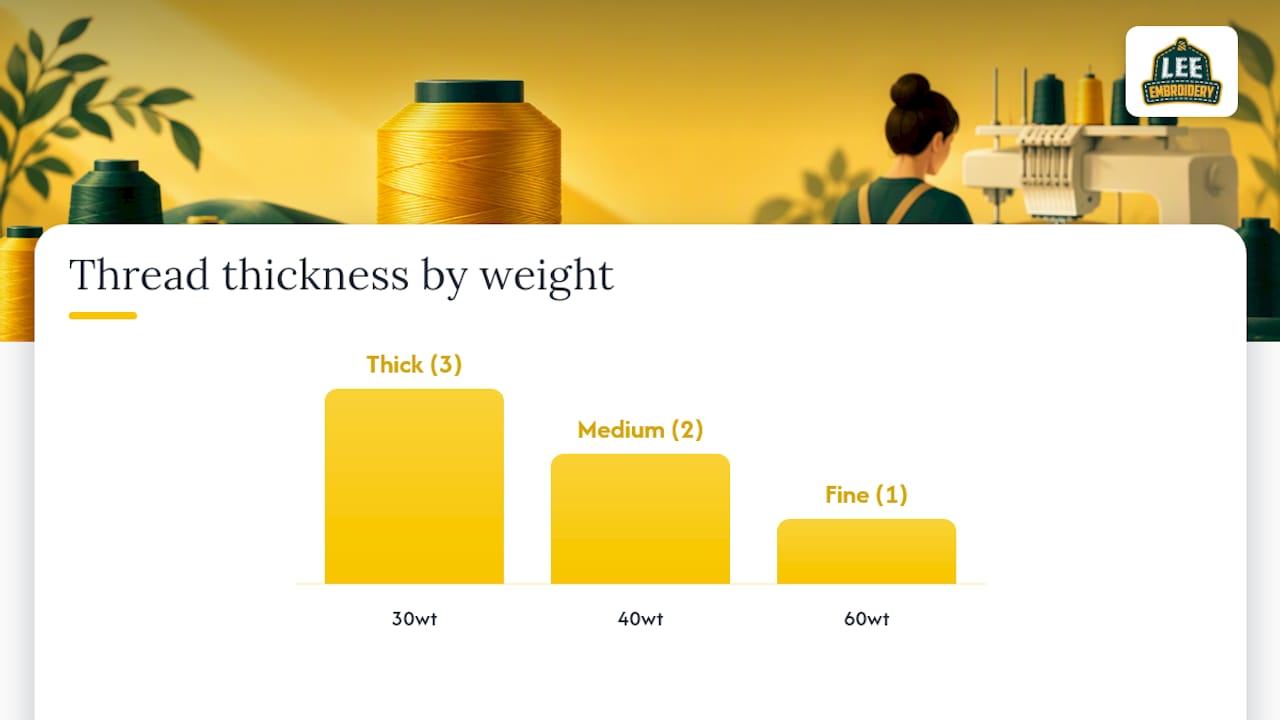
For machine embroidery, three practical categories cover almost every job. Industry guidance on thread weight groups them as heavy (12 to 30wt) for bold fills and letters that need to read from a distance, standard (40wt) as the default assumed by most digitizing software, and fine (60wt and up) for small text, delicate detail, and lightweight fabrics. Sixty-weight thread runs roughly a quarter to a third thinner than 40wt, so a design digitized for 40wt will look sparse and under-filled if you stitch it in 60wt without raising the density.
Weight and material are separate decisions that interact. A 40wt polyester and a 40wt rayon are the same thickness but behave differently on the machine, since polyester tends to stretch slightly more, which can cause pull-up in dense fills if the digitizing does not compensate for it.
| Thread weight | Typical use | Recommended needle size |
|---|---|---|
| 30wt | Bold fills, lettering, heavy coverage | 90/14 |
| 40wt | Standard machine embroidery default | 75/11 |
| 60wt | Fine detail, small text, delicate fabric | 60/8 |
Matching needle size to thread weight is not a formality. A needle too small for the thread shreds it as it passes through, while a needle too large leaves oversized holes and can cause visible fabric damage. Mismatched pairings are one of the most common causes of breakage on an otherwise well-tuned machine.
Pro Tip: When you switch thread weight, stitch a small test swatch first and compare actual coverage to the digitized design before committing to a full production run.
Choosing thread weight and strand count for hand stitching
Hand embroidery gives you more control over thickness than machine work, since you decide the strand count stitch by stitch.
- Satin stitch typically uses all six strands of floss for solid, glossy coverage on larger shapes.
- Backstitch and outline work often looks cleaner with two to three strands, keeping lines crisp rather than bulky.
- French knots usually call for two to four strands depending on how prominent you want the knot to sit.
- Cross-stitch conventionally uses two strands over standard-count fabric, adjusting up for coarser weaves.
- Perle cotton in sizes 5 or 8 suits bold outline and border work where a single, non-divisible strand with sheen adds definition without splitting.
- Wool or crewel yarn fits tapestry, upholstery, and heavier textile art, paired with a larger-eyed chenille or tapestry needle to accommodate the thicker fiber.
Blending two or three shades of floss in the same needle is a simple way to add subtle texture and depth to shading, especially in floral or naturalistic designs where a single flat color looks stiff by comparison.
Bobbin thread rules and quick tension troubleshooting
The bobbin is where a surprising number of embroidery problems start, and the fix is usually simpler than it looks.
- Default to 60wt or 70wt prewound bobbin thread under a 40wt top thread. This lighter weight keeps the bobbin from bulking up and showing through on the front of the design, a rule confirmed by both bobbin thread guidance from DRDTG and a separate practical guide to bobbin selection.
- Reserve 90wt bobbin thread for very fine lettering on delicate fabric, or when your machine’s manual specifically calls for it.
- Match bobbin color to the fabric, not the top thread, using white under light fabrics and black under dark ones as your basic stock; save color-matched bobbins for true bobbin-work techniques, following the same logic extension fiber research lays out for hiding minor bobbin show.
- Run a drop-tension test whenever you change thread weight or fabric: loosen or tighten the bobbin case screw slightly and stitch a sample before running the full design.
- Avoid conventional sewing thread in the bobbin. It is generally too heavy for embroidery’s tighter stitch density and tends to cause loops and visible show-through on the front.
Pro Tip: Keep a running log of needle size, thread weight, and tension settings for each fabric type you stitch regularly, so you are not troubleshooting from scratch every time.
Specialty threads: metallics, bullion, and chenille
Decorative threads reward patience far more than speed. Slow your machine down before you start, not after the first break.
- Metallic thread runs best at reduced machine speed with a large-eye or metallic-specific needle, since the wrapped film frays easily under normal tension and heat.
- Bullion and metal purl used in hand embroidery are coiled, not pulled taut like standard floss; stretching them defeats the technique and can snap the coil.
- Couching, laying a decorative or metallic thread on the surface and tacking it down with a finer thread, is often safer than trying to stitch heavy metallics directly through fabric.
- Chenille and other textured threads need looser stitch density and a needle sized for their bulk, or the fabric will pucker under the extra thickness.
- Always run a short test swatch with any specialty fiber before committing it to a full design, since behavior varies more between metallic brands than between standard polyester spools.
Care, colorfastness, and storage for embroidery thread
Good thread choices only pay off if the finished piece holds its color and shape over time.
- Polyester tolerates bleach and repeated washing far better than rayon or silk, which can dull or degrade under the same conditions, a tradeoff Sulky’s rayon versus polyester comparison lays out clearly for anyone choosing between the two for washable goods.
- Metallic thread can tarnish or corrode over time and should never be ironed directly; use a pressing cloth and low heat.
- Store spools away from direct sunlight and humidity, ideally in a cool, dry drawer or box, since UV exposure and moisture both accelerate color fade and fiber breakdown.
- Wind loose thread ends onto the spool rather than leaving them dangling, which prevents tangling and keeps dye consistent across a project.
- Read the manufacturer’s care note on the label, since colorfastness ratings and wash tolerance vary between brands even within the same fiber type.
How a patch manufacturer chooses thread for durability and finish
Production shops face the same material and weight decisions as home stitchers, just at higher volume and with less room for error on a bulk run.
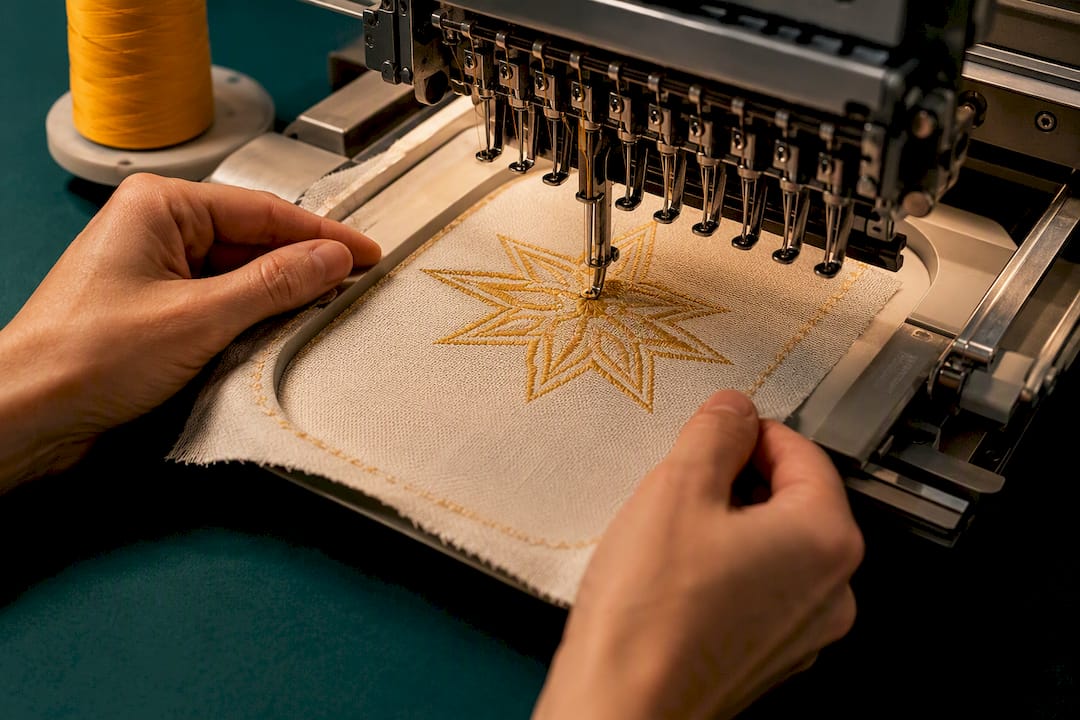
For durable goods meant to survive daily wear, washing, and sun exposure, polyester filament thread is the standard choice in patch and apparel embroidery, echoing the wash-resistance tradeoffs covered earlier. Weight shifts with the job: a jacket back design covering a large area often calls for a heavier fill thread and denser stitching, while a cap or crown design needs a lighter touch to avoid stiffness on curved, low-profile fabric.
Before committing to a full production run, shops stitch a sample first, checking coverage, color accuracy, and finish against the original artwork. That habit of testing before scaling is exactly why Lee Embroidery offers complimentary samples and a rapid quote turnaround on custom patch orders, so a design gets approved before it is stitched a thousand times over.
Balancing sheen against durability: a note on testing
Rayon and silk will always out-shine polyester under good light, and no amount of fiber engineering fully closes that gap. But sheen fades in relevance fast the moment a project needs to survive a washing machine, a job site, or years of handling. Polyester earns its reputation the unglamorous way: by holding its color and shape long after the prettier fibers have faded or frayed.
The habit that actually separates good embroidery from frustrating embroidery is not a secret fiber or a premium brand. It is sampling every new combination of fabric, thread, and needle before committing to the full piece, and writing down what worked. Keep a swatch drawer. Future you will thank present you.
— Bilal
Ordering professional patches when DIY isn’t the right fit
Sometimes the smarter move is skipping the trial-and-error entirely, especially for logos, bulk quantities, or anything that needs to survive years of wear.

Custom patches make sense when precise logo reproduction matters more than the process of getting there, when you need dozens or hundreds of identical pieces, or when durability against washing and abrasion isn’t optional. Lee Embroidery builds patches using durable, colorfast materials chosen for exactly the wear conditions described above, and offers:
- Free samples before you commit, so you see the actual stitch quality and color match first.
- Rapid quote turnaround, cutting the wait between design and production.
- A full range of formats, including embroidered patches, chenille patches, PVC rubber patches, printed patches, woven patches, and leather patches.
- Embroidery digitizing services for Left Chest and Cap designs at $10 one-off, and Jacket Back designs from $30 one-off, at Leeembroidery.
Custom Patches start from $99 one-off. Request a free sample or a quick quote at Lee Embroidery and see the material choices covered in this guide applied to your own design.
Sources
- DigitalCommons@University of Nebraska – Lincoln
- Best thread weight — machine embroidery (DRDTG)
- Machine Embroidery Series: Rayon vs. Polyester – Sulky
- Choosing Bobbin Threads for Embroidery: Practical Guide
FAQ
Are there different types of embroidery thread?
Yes, embroidery thread comes in several fiber types, including cotton, polyester, rayon, silk, wool, linen, and metallic, each built differently as floss, perle, filament, or spun thread. The right choice depends on the look you want and how the finished piece will be used and cared for.
Which thread is best for embroidery?
There is no single best thread; the right pick depends on the job. Polyester generally holds up best for wash-heavy or high-wear items, while rayon or silk suit decorative pieces where sheen matters more than durability.
Can I put embroidery thread in my sewing machine?
Embroidery thread can run through a standard sewing machine for decorative stitching, but it is engineered with a lower twist and smoother filament than regular sewing thread, which is built for straight-seam strength rather than fill coverage. Using the correct needle size for the thread weight matters more than the machine type itself.
Is there a difference between embroidery thread and embroidery floss?
Yes. Embroidery floss is a stranded, divisible cotton thread made for hand stitching, while embroidery thread more broadly includes non-divisible machine threads like filament polyester or rayon built to run smoothly at production speed. Floss is chosen by strand count, while machine thread is chosen by weight, such as 40wt or 60wt.